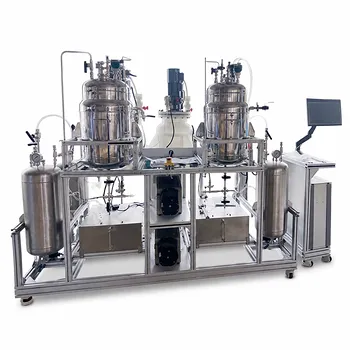
Determining the distillation end-point during solvent exchange is a matter of balancing analytical precision with operational speed. In a distillation pilot plant, you have two principal strategies: direct off-line analysis of the still contents using techniques like gas chromatography, or indirect real-time monitoring of the still temperature. In heterogeneous solvent systems, the temperature remains constant during boiling and then spikes sharply toward the boiling point of the pure replacement solvent once displacement is complete, giving you an immediate, sensor-driven endpoint.
Solvent exchange endpoint detection is not a one-size-fits-all task. Direct sampling offers chemical certainty but introduces delays and safety steps, while temperature monitoring provides instant feedback but relies on a clear thermodynamic signal. The most effective strategy matches the method to your mixture’s phase behavior and your pilot plant’s operational priorities.
The Solvent Exchange Challenge: Why Accurate Endpoint Detection Matters
The Fundamental Goal of Solvent Displacement
Solvent exchange replaces one liquid in the still with another, often to prepare for a subsequent reaction or crystallization step. The “endpoint” is the moment the original solvent is fully displaced. Missing this point means you either stop too early, leaving contaminating solvent, or run too long, wasting energy and risking thermal degradation of the product.
Consequences of an Incorrect Endpoint
An early cut leads to cross-contamination in the next processing step. An over-run can overheat sensitive compounds or extend the batch cycle unnecessarily. In a pilot plant where every run informs scale-up, inaccurate endpoints corrupt your mass balance data and mislead process design decisions.
Direct Methods: Off-line Sampling and Analysis
How Analytical Sampling Works in Practice
The operator withdraws a small aliquot from the still, cools it to stop further vaporization, and sends it for off-line analysis—typically gas chromatography (GC) or Karl Fischer titration. The measured concentration of the original solvent tells you exactly how far the exchange has progressed.
The Bottleneck of Turnaround Time and Safety
This is the slowest part of the loop. Cooling the batch to a safe sampling temperature halts the distillation, adds minutes per sample, and creates a start-stop dynamic that disturbs the column’s equilibrium. When multiple samples are needed to track the endpoint, the aggregate delay can blow out your campaign timeline.
Indirect Methods: The Temperature Signal as a Real-Time Indicator
The Thermodynamic Principle: Constant Boiling Points in Heterogeneous Mixtures
When two immiscible liquids boil together, the vapor pressure above the mixture is independent of the liquid ratio. This means the boiling temperature stays constant as long as both liquid phases are present. It’s a direct consequence of the phase rule: for a three-phase system (two liquids + vapor), the temperature is fixed at a given pressure.
Interpreting the Temperature Profile: The Plateau, The Spike, The New Equilibrium
During solvent exchange, you see a temperature plateau while the original solvent is being stripped out alongside the replacement solvent. The moment the original solvent is fully displaced and only one liquid phase remains (the pure replacement solvent), the boiling temperature shifts abruptly to the pure component’s boiling point. This sharp inflection is your indirect endpoint signal.
When the Temperature Method Shines (and When It Falters)
The method is robust and fast for truly heterogeneous mixtures with a wide boiling-point gap between the two solvents. However, if the mixture is completely miscible (homogeneous), the temperature changes gradually as the composition drifts, making a single inflection point hard to pinpoint. In those cases, a combination of temperature monitoring with periodic direct sampling is often safer.
Understanding the Trade-offs: Accuracy, Speed, and Complexity
Speed vs. Precision: The Inherent Tug-of-War
Direct GC analysis gives you chemical certainty—you know the exact residual solvent level. Temperature monitoring gives you sub-second response and zero turnaround delay. Choosing one often means sacrificing the other benefit. For regulatory filings where exact residual levels must be documented, direct methods hold more weight.
Mixture Homogeneity: Why One Method Fits All is a Myth
A heterogeneous system with a clear temperature plateau is a dream for indirect detection. But when the solvents are miscible, the boiling point follows a smooth curve, and the endpoint becomes a judgment call based on an acceptable residual concentration. Relying solely on a temperature setpoint in a homogeneous exchange without analytical verification is risky.
Equipment and Safety Considerations
Installing a thermowell and a high-accuracy resistance temperature detector (RTD) is cheap and always online. Drawing samples, however, requires a sampling port that does not introduce air or moisture and a protocol for safely handling hot, possibly flammable, liquids. The operator skill and safety overhead for direct sampling are higher in a pilot plant.
Making the Right Choice for Your Solvent Exchange Endpoint
The best endpoint strategy depends on what you are trying to maximize in your pilot plant operation.
- If your primary focus is minimizing batch cycle time and maximizing throughput: Leverage real-time temperature monitoring on heterogeneous exchanges. Automate the switchover when the temperature rises above the plateau, integrating a dead-band to avoid noise.
- If your primary focus is highest analytical accuracy and regulatory documentation: Build a sampling schedule with off-line GC or spectroscopy. Accept the cycle-time penalty in exchange for irrefutable residual-solvent data.
- If your primary focus is educational demonstration of distillation dynamics: Use the temperature method. Its transient plateau-to-spike behavior teaches bubble-point principles and the phase rule in a way that directly connects theory to a live process parameter—a key goal in a batch distillation pilot plant.
- If your primary focus is a robust, low-cost solution for routine heterogeneous exchanges: Calibrate a temperature-based endpoint and confirm it with a single end-of-batch sample. This hybrid approach marries the speed of indirect detection with the reassurance of a chemical spot check.
Your endpoint strategy becomes your pilot plant’s heartbeat—choose the rhythm that keeps your process safe, your data accurate, and your timelines on track.
Summary Table:
| Method | Type | Key Advantages | Main Drawbacks | Best Suited For |
|---|---|---|---|---|
| Direct Analysis | Off-line (GC / Karl Fischer) | High chemical precision, exact residual data | Operational delays, safety risks from sampling | Regulatory compliance, homogeneous mixtures |
| Temperature Monitoring | Real-time (RTD sensor) | Instant feedback, zero cycle-time delay | Less precise for miscible mixtures | Heterogeneous mixtures, educational demos |
Optimize your process scale-up and hands-on training with LABPARK. We provide advanced Educational and Vocational Unit Operations Pilot Plants in chemical engineering, bioprocess & biotech, and environmental & water treatment designed specifically for universities, research institutes, and enterprises.
Ready to elevate your training and research capabilities? Contact LABPARK today to discover how our tailored pilot plant solutions can enhance your laboratory's efficiency and educational value!
Related Products
- Continuous Sieve-Plate Distillation Pilot Plant for Unit Operations Laboratory Education
- Multi-Functional Special Distillation Educational Pilot Plant
- Continuous Batch Extractive Distillation Educational Pilot Plant
- Multi-Modal Distillation Unit Operations Training Pilot Plant
- Electrolyte Distillation Purification and Formulation Educational Pilot Plant
People Also Ask
- What are the primary reflux ratio control strategies? Master Distillation Unit Operations
- Why is vacuum operation capability an essential feature for a distillation unit operations pilot plant? Unlock Efficiency
- How to select the right activity coefficient model (Wilson, NRTL, UNIQUAC) for distillation pilot plants?
- How does catalyst water concentration affect distillation pilot plant design? Key separation train choices.
- How can real-time carbon number prediction improve distillation pilot plants? Optimize control.