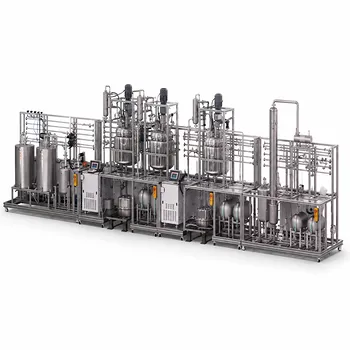
The concept of intermediate absorption for shifting thermodynamic equilibrium is demonstrated in integrated pilot plants by physically removing a reaction product (like SO₃) from the gas stream after a partial conversion step, then sending the product-lean gas back to a reactor. This directly manipulates the chemical equilibrium position, enabling a higher overall conversion than a single-pass reactor could ever achieve on its own.
The core demonstration is: after gas passes through a few catalyst beds, it is routed into an absorption column that strips out the SO₃ product. By continuously removing the product, the equilibrium of the remaining gas mixture is driven toward more product formation when the gas re-enters the next catalyst bed. This coupling of reaction and separation unit operations in a single pilot plant setup makes Le Chatelier’s principle tangible and shows how industrial processes can exceed conventional thermodynamic limits.
The Underlying Principle: Le Chatelier in Action
Chemical reactions are often limited by a state of dynamic equilibrium, where the forward and reverse reaction rates are equal. This ceiling on conversion is purely thermodynamic and cannot be breached by adding more catalyst. The integrated pilot plant demonstrates a way around that ceiling.
Why Simple Reactors Hit a Wall
In a conventional reactor, as a product accumulates, the reverse reaction gains speed. Eventually the net production stops, leaving a significant fraction of unreacted starting material. For example, in the contact process for sulfuric acid, SO₂ oxidation to SO₃ is equilibrium-limited; simply adding more catalyst beds won’t push the conversion much higher because the product SO₃ holds the reaction back.
How Product Removal Resets the Reaction
By sending the partially converted gas to an absorption column, the SO₃ is dissolved into a liquid (typically concentrated sulfuric acid) and physically separated from the gas. The gas returning to the reactor is now product-lean. With a lower product concentration, the chemical equilibrium is momentarily far from its settled state. The system responds, according to Le Chatelier’s principle, by producing more SO₃ to re-establish equilibrium. This is the thermodynamic “shift” the pilot plant exemplifies.
How the Integrated Pilot Plant Makes It Visible
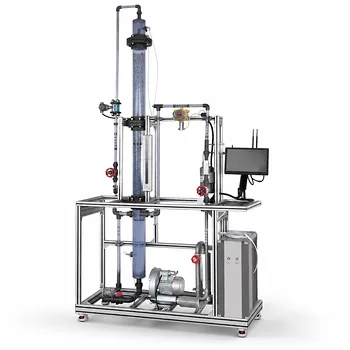
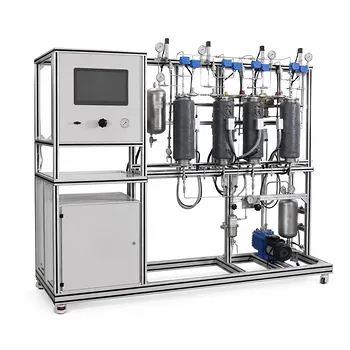
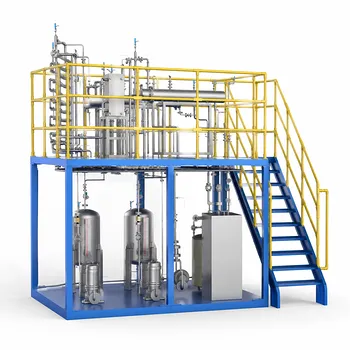
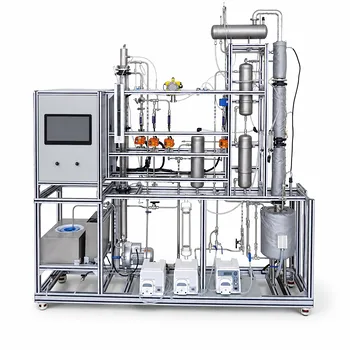
The educational or research pilot plant mimics an industrial double-absorption process. It combines tubular reactors packed with catalyst pellets and a packed column or scrubber tower, all interconnected with piping, valves, and analyzers.
The Step-by-Step Flow Path
The demonstration typically follows this sequence:
- First Reaction Stage: SO₂ and oxygen are preheated and passed through the first two or three catalyst beds. The exothermic reaction converts a portion of the SO₂ to SO₃, but equilibrium is approached and the conversion rate plateaus.
- Intermediate Absorption: The hot gas exiting the third bed is cooled and directed into the absorption column. Here, a circulating stream of sulfuric acid absorbs virtually all the SO₃, trapping it in the liquid phase.
- Second Reaction Stage: The SO₃-free gas, now rich in unreacted SO₂, is reheated and sent to a final catalyst bed. Because the equilibrium is now strongly shifted toward product, the remaining SO₂ is converted at a high rate. The gas then often passes through a final absorption column.
- Measurement Confirmation: Gas analyzers at the reactor inlet, between beds, and at the stack provide real-time concentration data. Students can compare the conversion profiles with and without the intermediate absorption step, observing a total conversion of over 99.5% compared to roughly 97–98% without it.
Key Pilot Plant Components That Enable the Demonstration
- Reactor Beds with Inter-Stage Cooling: Allow precise control of the temperature profile so that the gas enters each absorber and subsequent bed at the optimal thermodynamic condition. Lower absorption temperatures favor higher gas solubility and SO₃ removal, reinforcing the principle from gas-absorption pilot plants where lowering temperature increases solubility.
- Absorption Column with Liquid Recirculation: The column is packed to maximize contact area. Flow rates and liquid concentration can be varied to show how absorption efficiency directly impacts the equilibrium shift. If the absorption step is deliberately made inefficient, the downstream conversion in the final bed drops measurably.
- Integrated Control and Data Logging: Pressure drop, temperature, and gas concentration data are continuously recorded. This turns an abstract thermodynamic concept into a quantitative exercise: students calculate mass balances, compare the experimental conversion with the theoretical equilibrium curve, and quantify the “extra” conversion gained by product removal.
Relating the Concept to Other Process Intensification Methods
The intermediate absorption demonstration is part of a broader family of techniques where separation is embedded within the reaction loop. This helps trainees recognize a universal design strategy.
The Membrane Reactor Analogy
A catalytic membrane reactor applies the same fundamental shift—continuous, selective removal of a product—but uses a permselective membrane instead of a liquid solvent. For example, in a dehydrogenation reaction, hydrogen diffuses through a palladium membrane, pulling the equilibrium forward. In both cases, the integrated unit operation overcomes a thermodynamic bottleneck by breaking the equilibrium condition locally. The pilot plant with an absorption column makes this concept visible at a larger, more mechanically accessible scale than a membrane reactor, which is excellent for foundational teaching.
The Stripping Counterpart
Just as lowering temperature and raising pressure promotes absorption, the reverse—raising temperature or lowering pressure—promotes desorption or stripping. An integrated pilot plant can also demonstrate regenerating the solvent, completing the cycle. Understanding that thermodynamic levers (T, P) control whether a species moves into or out of a liquid phase is crucial for designing any hybrid reaction-separation process.
Understanding the Trade-offs and Practical Pitfalls
While intermediate absorption is a powerful technique, the pilot plant also reveals its inherent costs and operational complexities. Demonstrating these trade-offs is part of the educational value.
- Energy Penalty: The gas must be cooled before absorption and reheated before the final catalytic bed. This inter-stage heat exchange consumes significant energy. In a pilot plant, the heater power requirements before and after the absorption step directly illustrate this parasitic load.
- Capital Cost and Complexity: Adding absorbers, piping, and heat exchangers increases the plant footprint and investment. The pilot plant’s layout, with its many flanges, valves, and a tall column, visually reinforces that process integration comes with added hardware.
- Corrosion and Materials Handling: The absorption of SO₃ involves handling highly corrosive oleum or concentrated sulfuric acid in the column, pumps, and piping. Pilot-scale setups must use specialized materials like glass-lined steel or PTFE components, highlighting the material selection challenges that industrial designs face.
- The Concept is Not Universal: Intermediate absorption works because the product (SO₃) is easily and selectively removable. For other reactions, finding a suitable, non-interfering solvent or membrane can be difficult. The demonstration invites a critical discussion: “Why does this work so well here, and where might it fail?”
Applying the Lessons from the Pilot Plant
The core takeaway for any researcher or operator is that a reactor is not an isolated black box; its performance can be fundamentally altered by what happens between stages.
- If your primary focus is understanding thermodynamic limitations: Use the pilot plant data to plot the equilibrium curve and overlay the actual operating path. The “jump” in conversion after the absorber is the direct visual of Le Chatelier’s principle engineered into a flowsheet.
- If your primary focus is process design and optimization: Experiment with the absorber’s operating parameters—liquid recycle rate, acid concentration, gas inlet temperature—and measure how they propagate to the final-bed conversion. This teaches the sensitivity of the integrated system and the critical importance of absorber efficiency.
- If your primary focus is environmental compliance: The demonstration shows how intermediate absorption can reduce SO₂ emissions from thousands of ppm down to the double-digit range, meeting a limit like 2 kg SO₂ per metric ton of acid. The stack analyzer is your ultimate validator.
By physically linking a reactor to an absorber and looping the gas stream, the integrated pilot plant transforms an abstract textbook principle into a measurable, tunable, and memorable reality.
Summary Table:
| Stage/Component | Function in Pilot Plant | Impact on Thermodynamic Equilibrium |
|---|---|---|
| First Reaction Stage | Partial catalytic conversion of reactants (e.g., $SO_2$ to $SO_3$) | Reaction plateaus as it approaches equilibrium limit |
| Intermediate Absorption | Product is absorbed and physically removed from the gas stream | Resets equilibrium by lowering product concentration |
| Second Reaction Stage | Product-lean gas is reheated and reacted in a final catalyst bed | Drives further conversion, achieving >99.5% overall yield |
| Analytical Sensors | Real-time gas analyzers track concentrations at key stages | Provides quantitative validation of Le Chatelier's principle |
Teach Complex Chemical Engineering Concepts with LABPARK
Bring thermodynamic principles to life in your lab. LABPARK provides premium Educational and Vocational Unit Operations Pilot Plants in chemical engineering, bioprocess & biotech, and environmental & water treatment. Designed specifically for universities, research institutes, and enterprises, our modular systems turn abstract theory into hands-on practical experience.
Ready to upgrade your laboratory capabilities? Contact us today to discuss your customized pilot plant solution!
Related Products
- Multimodal Absorption and Desorption Pilot Plant for Unit Operations Training
- Multi-Reactor Educational Pilot Plant for Reaction Engineering Unit Operations
- Absorption and Desorption Educational Unit Operations Pilot Plant
- Packed Bed Absorption Educational Unit Operations Pilot Plant
- Dual-Mode Gas Absorption and Desorption Unit Operations Training Pilot Plant
People Also Ask
- How do predictive thermodynamic models integrate into pilot plants? Bridging Theory and Practice
- Which cross-validation strategy should be selected for pilot plant time-series & batch data? Avoid Data Leakage
- Why Use Center Points in Process Analyzer Calibration? Key Benefits Explained
- How can process control schemes be configured to teach basic and advanced control?
- How does polyphosphate hydrolysis affect scale and corrosion in pilot plants? Essential Monitoring Guide