The clear liquid pressure loss ($H_L$) on a tray is calculated using an empirical correlation that quantifies the liquid inventory on the deck. For a fractionation or absorption pilot plant, the primary expression is ( H_L = 0.4 \times WH + 0.4 \times (gpm / L_{WI})^{2/3} ), where ( WH ) is the weir height, ( gpm ) is the liquid flow rate, and ( L_{WI} ) is the weir length. This value—given in inches of clear liquid—directly feeds into the liquid on‑tray holdup time (( LIQT = (H_L / 12) \times (A_A / CFL) )): the larger the clear liquid height, the longer the liquid resides on the tray for a fixed active area (( A_A )) and volumetric flow (( CFL )).
Core takeaway: ( H_L ) represents the equivalent depth of deaerated liquid standing on the tray, which governs the residence time available for mass transfer. A higher holdup time generally improves separation efficiency, but it must be carefully balanced against the additional tray pressure drop and the risk of column flooding.
The Clear Liquid Pressure Loss Formula
Breaking Down the Variables
- Weir height (( WH )): The physical height of the outlet weir, typically set in inches. It establishes the baseline liquid depth on the tray.
- Liquid load (( gpm / L_{WI} )): The volumetric flow rate per unit length of the weir. This ratio, raised to the 2/3 power, captures the crest over the weir—the additional liquid head needed to push the liquid across the weir.
- The 0.4 coefficient: Both terms are multiplied by 0.4, which acts as an aeration factor. Real froth on a tray is a mixture of liquid and vapor; the 0.4 factor converts the geometric liquid height into an equivalent clear liquid height that corresponds to the actual liquid mass on the tray.
Interpreting the Formula’s Empirical Nature
In tray hydraulic models, the total tray pressure drop includes dry tray loss, liquid head, and residual losses. The ( H_L ) formula isolates the liquid‑static contribution. The factor 0.4 is a simplified representation of the relative froth density—a concept consistent with common correlations where clear liquid height ( h_L = \alpha (h_w + h_{ow}) ) and ( \alpha \approx 0.4 ). For pilot‑scale educational columns, this correlation provides a quick, reliable estimate without requiring detailed froth density data.
From Clear Liquid Height to Holdup Time
The Holdup Time Equation
Once ( H_L ) is known, the liquid on‑tray holdup time (( LIQT )) is calculated as:
( LIQT = \frac{H_L}{12} \times \frac{A_A}{CFL} ).
Dividing by 12 converts inches to feet, so ( H_L/12 ) gives the clear liquid depth in feet. Multiplying by the active bubbling area (( A_A ), in ft²) yields the liquid volume on the tray (ft³). Dividing by the volumetric liquid flow rate (( CFL ), in ft³/min) then gives the average residence time in minutes.
Practical Implications for Pilot Plant Operation
- A larger ( H_L ) directly increases ( LIQT ), giving the liquid phase more time to exchange mass with the rising vapor.
- In educational unit operations, a student can, for example, raise the weir height to increase ( H_L ), observe the resulting change in holdup time, and relate it directly to the number of liquid‑phase transfer units (( N_L )) reported in mass‑transfer correlations.
- Longer holdup times in a tray column are analogous to higher liquid hold‑up in a packed bed: they can shift the operating point toward a more efficient separation if the vapor contact remains effective.
The Link to Tray Efficiency and Column Hydrodynamics
A well‑chosen clear liquid height ensures the froth is stable and the liquid is well‑mixed, maximizing the interfacial area for mass transfer. In pilot‑scale sieve‑tray columns, the liquid‑phase resistance often controls the overall efficiency for absorption or fractionation of systems with a large liquid‑film resistance. By measuring ( H_L ) (or calculating it from the weir geometry) and monitoring ( LIQT ), operators can tune the column to stay within the optimal hydraulic window—avoiding the weeping and dumping that occur when liquid holdup is too low, and the flooding that occurs when it is too high.
Understanding the Trade‑offs
The Benefit of Higher Holdup
Increasing ( H_L ) extends the contact time. This often gives the liquid enough time to approach equilibrium with the vapor at each stage, improving the Murphree tray efficiency and allowing the same separation to be achieved with fewer actual trays.
The Risks of Excessive Holdup
- Elevated total pressure drop: The liquid head contributes directly to ( h_t ) (total tray pressure drop in mm liquid). A higher ( h_t ) increases the column’s overall (\Delta P), raising the boiling point at the bottom and the required reboiler duty.
- Flooding and downcomer backup: When the clear liquid height (plus frictional losses) becomes too large, the downcomer cannot drain effectively. Liquid accumulates on the tray, froth height surges, and entrainment skyrockets—destroying separation efficiency and threatening the pilot plant’s stability.
- Higher column hold‑up: In a pilot plant, excessive liquid retention means a larger fraction of the charge stock is “locked” inside the column. This is unacceptable when working with expensive or limited‑supply feedstocks, as it complicates material balances and recovery.
Balancing Act in Pilot Plant Design
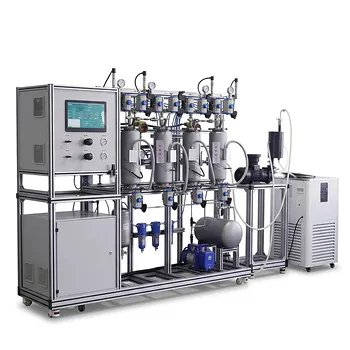
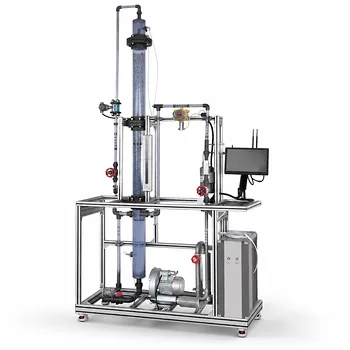
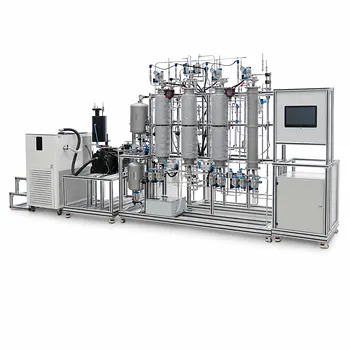
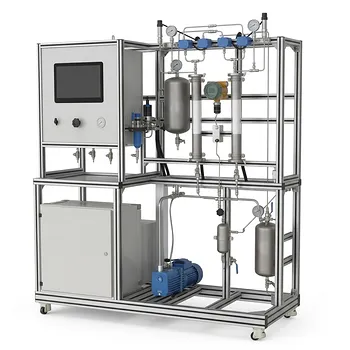
The educational pilot plant is an ideal environment to demonstrate these trade‑offs. By equipping the column with differential pressure sensors, flow meters, and sight glasses, operators can observe how changes in weir height or liquid rate alter the clear liquid height and the onset of flooding. The empirical nature of the ( H_L ) formula also teaches students that practical correlations—while easy to use—carry assumptions and limitations that must be understood before scaling up to industrial designs.
Making the Right Choice for Your Pilot Plant Goals
- If your primary focus is maximizing separation efficiency: Raise the weir height or increase the liquid rate to push ( H_L ) up within safe limits, monitor the pressure drop, and validate the gain in transfer units.
- If your primary focus is minimizing energy consumption and column (\Delta P): Keep the weir height low and the liquid load moderate, accepting a shorter holdup time while verifying that the tray still operates above weep point.
- If your primary focus is teaching hydraulic limits and operational troubleshooting: Deliberately vary ( H_L ) while recording the pressure drop and visual froth behavior, and use the flooding‑prediction correlations to demonstrate how excess clear liquid height triggers instability.
The clear liquid pressure loss is far more than a number in a calculation—it is the central lever you control to balance mass‑transfer performance and hydrodynamic stability in your pilot plant.
Summary Table:
| Parameter / Formula | Calculation / Definition | Operational Impact |
|---|---|---|
| Clear Liquid Height ($H_L$) | $H_L = 0.4 \times WH + 0.4 \times (gpm / L_{WI})^{2/3}$ | Determines equivalent deaerated liquid depth and static head. |
| Liquid Holdup Time ($LIQT$) | $LIQT = \frac{H_L}{12} \times \frac{A_A}{CFL}$ | Dictates residence time available for mass transfer on the tray. |
| Weir Height ($WH$) | Physical height of the outlet weir (inches) | Sets baseline liquid depth; higher $WH$ increases $H_L$ and efficiency. |
Ready to bring hands-on column hydraulics and mass transfer principles to life? LABPARK designs and manufactures high-quality Educational and Vocational Unit Operations Pilot Plants in chemical engineering, bioprocess & biotech, and environmental & water treatment. We help universities, research institutes, and enterprises bridge the gap between theory and industrial practice with safe, robust, and data-rich training systems.
Contact LABPARK today to discover the ideal pilot plant solution for your lab!
Related Products
- Multi-Modal Distillation Unit Operations Training Pilot Plant
- Multimodal Absorption and Desorption Pilot Plant for Unit Operations Training
- Absorption and Desorption Educational Unit Operations Pilot Plant
- Dual-Mode Gas Absorption and Desorption Unit Operations Training Pilot Plant
- Multi-Component Gas Pressure Swing Adsorption Pilot Plant for Unit Operations Education
People Also Ask
- How can energy balance equations for condensers & reboilers be validated experimentally? Guide
- Why is vacuum operation capability an essential feature for a distillation unit operations pilot plant? Unlock Efficiency
- How can real-time carbon number prediction improve distillation pilot plants? Optimize control.
- What are the primary reflux ratio control strategies? Master Distillation Unit Operations
- How does catalyst water concentration affect distillation pilot plant design? Key separation train choices.