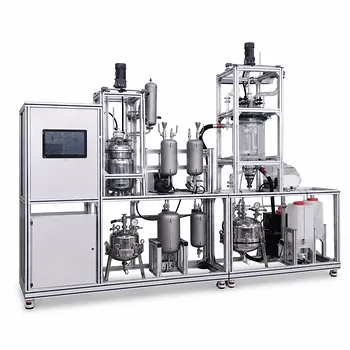
Monitoring ion-exchange column breakthrough in pilot plants requires a shift from periodic sampling to continuous, real-time analysis. Online UV-vis spectroscopy fulfills this need by continuously measuring the absorbance of target metal ions—such as nickel—in the column effluent. It detects the exact moment when the resin reaches its maximum loading capacity, instantly marking the breakthrough point and enabling precise breakthrough curves without the 10-to-30-minute delays of grab-sample testing.
Online UV-vis technology transforms column breakthrough monitoring from a reactive, time-lagged activity into a proactive, high-resolution, and automatable process. The core value is not just the data itself, but the ability to use that data moment-by-moment to maximize column utilization, prevent valuable catalyst loss, and trigger immediate corrective actions.
Why Real-Time Monitoring Is Non-Negotiable
Ion-exchange breakthrough has a narrow window. Missing it by a few minutes can mean sending loaded effluent to the wrong stream—losing product, exceeding environmental limits, or corrupting downstream steps.
Eliminating the Offline Lag
Traditional offline sampling introduces a dangerous delay. By the time a sample is drawn, sent to the lab, and analyzed, the breakthrough front has already moved. This makes it impossible to capture the true shape of the breakthrough curve or to take timely control actions.
Online UV-vis spectroscopy closes that gap. It delivers concentration data every few seconds, giving you a dynamic, real-time picture of the column’s exhaustion front.
Capturing Fine Kinetic Details
Research and process development depend on accurate breakthrough modeling. With online monitoring, you see subtle transition states and the exact time the effluent concentration begins to rise. Offline data inevitably smooths these critical details, leading to flawed mass-transfer coefficients and less reliable scale-up predictions.
How UV-Vis Spectroscopy Detects Breakthrough
The measurement principle is direct and robust. It relies on the Lambert-Beer Law, which links light absorbance to concentration for a given path length.
The Lambert-Beer Foundation
The relationship is ( A_{\lambda} = \varepsilon_{\lambda} b C ). For a metal ion like nickel, you select a wavelength where its absorbance is strong and well-characterized. As the ion-exchange column starts leaking the target metal, the absorbance at that wavelength rises. The system tracks that rise in real time.
From Absorbance to a Breakthrough Curve
The online spectrometer continuously records the absorbance signal and converts it to concentration. As the column moves from saturation to exhaustion, you see a characteristic S-shaped concentration profile. The breakthrough point—often defined as the moment effluent concentration reaches 5-10% of the feed—can be detected instantly. This allows you to plot a complete, precise breakthrough curve and calculate dynamic binding capacities with high confidence.
Delivering Reliable Data Under Real Pilot-Plant Conditions
A clean lab measurement is not enough. Pilot plants present interferences that can destroy data quality if not properly addressed.
Overcoming Bubble and Particulate Interference
Bubbles scatter light and cause noisy, erratic absorbance signals. A flow cell with a larger inner diameter (e.g., 5 cm) helps, but it is not a complete fix. If bubbles persist, the combination of a filtered flow cell and proper degassing of the sample line is essential to keep the optical path clean and reliable.
For streams with suspended solids, a filtered flow cell removes particulates that could otherwise scatter light or foul the windows. This protects measurement stability without distorting the true dissolved-phase concentration.
Compensating for Lamp and Detector Drift
A dual-beam (dual-channel) configuration with a reference fiber loop compensates for lamp intensity fluctuations. One channel sees the sample, the other sees a reference. By ratioing the signals, you eliminate drift and get a stable baseline across long pilot runs.
Managing pH Shifts and Spectral Overlap
The absorbance peak of many metal ions shifts with pH. If your process pH fluctuates, a simple single-wavelength measurement can become inaccurate. Implementing a chemometric model that tracks absorbance across a wavelength window—rather than at one fixed wavelength—accounts for these shifts and maintains accuracy even in challenging matrices.
Handling High Absorbance Without Saturation
When the target concentration is high, standard 1‑cm flow cells can saturate the detector. The solution is a short path length flow cell with a sample gap as small as 25 µm. For extreme cases, an attenuated total internal reflection (ATR) probe is recommended, as it measures only the evanescent wave interaction right at the probe surface and avoids bulk absorbance saturation entirely.
Understanding the Trade-offs
Online UV-vis monitoring is powerful, but it is not a one-size-fits-all solution. The design choices you make involve real compromises.
- Path length vs. sensitivity: Shorter path lengths prevent saturation but reduce sensitivity at low concentrations. You must match the optical path to the concentration range of your breakthrough region.
- Flow cell geometry vs. bubble tolerance: A smaller ID flow cell gives faster response and lower hold-up volume but becomes more prone to bubble noise. The larger 5‑cm cell trades some response speed for robustness.
- Chemometric models add complexity: Moving from a single wavelength to a multivariate model makes the system more resilient to pH and matrix changes, but it also demands more calibration effort and deeper technical expertise to build and maintain.
- Inline filtration can introduce back-pressure and membrane fouling: While it protects the optic path, it adds a maintenance point that can disrupt a continuous pilot run if not designed properly.
- ATR probes are robust for dirty streams but have a fixed effective path length. If your target concentration falls below their detection limit, you cannot simply switch to a longer path length—you may need a transmission cell instead.
Applying This to Your Pilot Plant Goal
Your data and control strategy should drive the hardware and method choices. Here is how to align your setup with what matters most for your project.
- If your primary focus is maximizing catalyst recovery: Use rapid-scanning online UV-vis with an automated flow diversion valve. Set a concentration threshold at the desired breakthrough percentage to switch from product collection to waste, recovering every possible gram of valuable metal.
- If your primary focus is environmental compliance and emission minimization: Implement a dual-beam spectrometer with real-time absorbance tracking at the regulated pollutant’s peak. Pair it with a filtered flow cell to prevent false alarms from turbidity, and trigger immediate diversion on any upward trend.
- If your primary focus is kinetic modeling or research: Invest in a high-frequency data acquisition system (multiple readings per second) and use a chemometric model to deconvolve pH effects. The goal is a clean, high-resolution breakthrough curve that captures subtle mass-transfer behavior without offline delay artifacts.
- If your primary focus is robust industrial pilot plant operation with variable feed: Choose a short-path transmission cell or an ATR probe based on maximum expected absorbance. Combine it with bubble-tolerant flow cell geometry and on-the-fly background correction to keep the analyzer running reliably across shifts and varying matrix conditions.
Real-time UV-vis spectroscopy turns the ion-exchange column into a transparent, self-reporting unit. By matching the optical configuration and data treatment to your specific breakthrough monitoring goal, you turn a once-blind separation step into a fully controlled, optimized, and defendable process.
Summary Table:
| Challenge / Interference | UV-Vis Technical Solution | Operational Benefit |
|---|---|---|
| Bubbles & Particulates | Filtered flow cell, degassing, & larger ID | Eliminates optical noise & window fouling |
| Lamp & Detector Drift | Dual-beam configuration (reference loop) | Maintains baseline stability over long runs |
| pH Shifts & Spectral Overlap | Chemometric modeling across a wavelength window | Ensures measurement accuracy in shifting matrices |
| High Absorbance / Saturation | Short path length flow cell or ATR probe | Prevents detector saturation at high concentrations |
Optimize Your Process Monitoring with LABPARK
Transitioning from offline analysis to real-time control requires reliable, research-grade pilot scale equipment. LABPARK provides state-of-the-art Educational and Vocational Unit Operations Pilot Plants in chemical engineering, bioprocess & biotech, and environmental & water treatment. We help universities, research institutes, and enterprises build advanced, automated systems that capture precise kinetic data and optimize column utilization.
Ready to elevate your laboratory or pilot plant capabilities? Contact LABPARK today to explore our tailored pilot plant solutions!
Related Products
- Ion Exchange Water Purification Educational Pilot Plant for Engineering Unit Operations
- Comprehensive Liquid-Liquid Extraction Pilot Plant for Engineering Education
- Constant Pressure Filtration Educational Unit Operations Pilot Plant
- Dual Mode Heat Transfer Pilot Plant for Unit Operations Training
- Dual-Mode Rectification Pilot Plant for Practical Training Unit Operations
People Also Ask
- How to Prevent Ion Exchange Channeling? Expert Solutions for Pilot Plants
- How does ion exchange work in water treatment pilot plants? Cost & process guide.
- What operational precautions should lab operators take for resin volume changes and air pockets? Key Guide
- How to use ion exchange pilot plants to verify alkalinity? A hands-on guide for engineering students.
- How can students use ion exchange pilot plants for column sizing? Master Wastewater Design