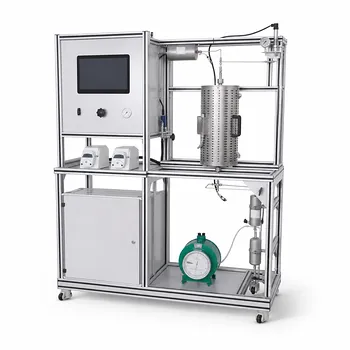
Kinetic modeling data transforms an empirical bench-scale reaction into a precisely engineered pilot-plant cascade. It allows engineers to mathematically define the reaction rate as a function of temperature and concentration, then use that rate equation to simulate how a series of continuous stirred-tank reactors will perform. By iterating on the number of stages, their individual volumes, and the flow rates entirely within a model, they arrive at an optimized configuration that meets target conversion and purity before a single drop flows through the physical pilot plant.
The core purpose of kinetic data in CSTR cascade design is to replace guesswork with prediction. Once you know the intrinsic reaction rate, you can calculate the minimum total volume and the ideal distribution of that volume across multiple stages to hit a production goal—eliminating wasteful physical trial-and-error during scale-up.
The Role of Kinetic Modeling in Reactor Design
Your deep need isn't just to know that kinetics are used, but to understand how a set of lab-scale concentration curves becomes a reliable blueprint for a multi-stage continuous reactor. This process flows from fundamental rate determination to simulation-driven layout.
Building a Predictive Rate Law from Lab Data
Everything starts with a bench-scale reactor where you measure how reactant concentration changes over time at different temperatures. By fitting this data to kinetic models—zero-order, first-order, or more complex rate expressions—you extract the kinetic parameters: the rate constant k, the activation energy Eₐ, and the concentration orders for each species.
These parameters form a mathematical rate law. It tells you the absolute reaction speed for any given temperature and concentration. Without this equation, reactor design is just a sizing guess that risks under- or over-building your pilot plant.
Simulating a CSTR Cascade with Design Equations
A single CSTR operates at the final, equilibrium-limited concentration of its well-mixed interior. In a cascade, each stage reaches a new steady-state concentration, creating a step change. The design equation for each stage links its volume, the flow rate, and the concentration into and out of that tank.
Once you have the rate law, you can plug it into that equation and numerically solve the entire sequence. You input the feed concentration, desired final conversion, and a candidate number of tanks. The model then outputs the required volume for each stage, or conversely the achievable conversion for a given total volume. This simulation lets you explore hundreds of configurations on a desktop.
Optimizing Number of Stages and Total Volume
A single large CSTR will achieve a given conversion, but often at the cost of an enormous volume because it operates at the lowest reaction rate. Adding stages raises the average reaction rate by keeping the bulk of the conversion in regions of higher concentration. However, each additional tank adds capital cost and complexity.
Kinetic simulations reveal the diminishing returns. You can plot total reactor volume against the number of stages and identify the knee of the curve—the point where adding more tanks stops giving meaningful volume reduction. This optimization directly answers the scale-up question: what is the smallest, most cost-effective cascade that still meets throughput and conversion targets.
From Bench to Pilot Plant: Practical Validation
Kinetic models are essential, but they are still a prediction. The pilot plant serves as the proving ground where you verify that the optimized cascade behaves as intended, and where you collect data that refines the model itself.
Tuning Residence Times and Stage Volumes Experimentally
In a modular pilot plant, you can physically alter the active volume of each CSTR stage or adjust the feed pump. By taking samples from ports between stages, you measure the intermediate conversion at each step. This concentration profile is then overlaid onto the simulation’s prediction. Any deviation points to a factor the model missed—perhaps a subtle heat effect or a mixing inefficiency—allowing you to update the kinetic parameters or flow model accordingly.
Accounting for Side Reactions and Impurity Profiles
A good kinetic model doesn’t just describe the desired product. It also tracks the formation rates of byproducts via parallel or consecutive reaction pathways. In a CSTR cascade, the concentration profiles of reactants and intermediates differ from a batch or plug-flow system, which can suppress or amplify side products.
By incorporating impurity kinetics, you can optimize the temperature and per-stage volumes to maximize yield while keeping impurity formation below a specification limit. This capability is critical when scaling a process where a 1% impurity in the lab would become a major purification cost at production scale.
Bridging Non-Isothermal Behavior and Heat Transfer
Most reactions are sensitive to temperature, and CSTRs in series let you impose a staged temperature profile. The kinetic model, enriched with an activation energy term, can be coupled with an energy balance for each tank. This predicts both conversion and the temperature rise from the heat of reaction.
When you run the optimized cascade in the pilot plant, integrated temperature sensors verify whether the predicted cooling duty or runaway risk aligns with reality. Adjusting an overall heat transfer coefficient in the model until the measured and simulated temperature curves match trains the simulation to become a reliable digital twin for future scale-ups.
Understanding the Trade-offs and Limitations
No design tool is perfect. Using kinetic data to optimize a CSTR cascade comes with implicit assumptions and practical pitfalls you must navigate to avoid an expensive misstep.
- Residence-Time Distribution (RTD) Approximations: A real cascade has a broader RTD than the idealized perfectly-mixed tanks in the model. With fewer than 5 tanks, the variance is high, and some fluid short-circuits through the system, reducing actual conversion. Models assuming perfect mixing will over-predict performance unless you correct for this.
- Sensitivity to Rate Law Errors at Extreme Conversions: A kinetic model fitted at moderate conversions can be wildly inaccurate when extrapolated to 99%+ conversion. A cascade sized on such a model might fail to reach the target, because the underlying physics changes (e.g., mass-transfer limits or catalyst deactivation).
- Zero-Order Kinetic Quirks: For reactions where the rate is independent of reactant concentration (zero-order), a CSTR cascade offers no volume advantage over a single tank. The Monsanto acetic acid process is a classic example—the rate depends only on catalyst and promoter, so conversion scales linearly with volume regardless of staging. If your kinetic data shows a zero-order dependence, optimizing for number of stages is pointless; focus instead on efficient catalyst utilization.
Making the Right Choice for Your Scale-Up Goal
Your path from kinetic data to a final cascade design depends entirely on what you’re prioritizing—minimum capital, maximum yield, or perfect theoretical behavior. Use these focused strategies to guide your decision.
- If your primary focus is minimizing total reactor volume: Run the kinetic simulation for increasing stage counts and pick the number of CSTRs just before the total volume reduction plateaus. This gives you the smallest physical plant footprint without over-complicating the skid.
- If your primary focus is maximizing yield for a reaction with side products: Model the parallel impurity formation and use the simulation to apply a staged temperature profile. Cooler early stages might favor selectivity, while a final, warmer tank can boost overall conversion.
- If your primary focus is approximating plug-flow behavior: Recognize that a cascade of 5–10 CSTRs can deliver conversion and RTD characteristics nearly identical to a PFR. Validate this by conducting a tracer step-test in your pilot plant to measure the actual RTD and confirm the coefficient of variation is sufficiently low.
- If your primary focus is validating a simulation model before industrial scale-up: Use the pilot plant to deliberately perturb one parameter—like feed temperature or stirrer speed—and compare the measured stage-by-stage concentration shift against model predictions. A match under varied conditions gives you the confidence to trust the model at larger scales.
Ultimately, kinetic modeling data doesn’t eliminate the need for pilot plants; it eliminates the need for a blind, resource-draining experimental campaign in them. By the time you pipe steam to the first reactor in your cascade, your model has already proven that the configuration will work.
Summary Table:
| Optimization Goal | Key Design Strategy | Practical Benefit |
|---|---|---|
| Minimizing Volume | Optimize stage count before volume reduction plateaus | Reduced capital cost and pilot plant footprint |
| Maximizing Yield | Model side reactions and apply a staged temperature profile | Higher product selectivity and lower purification costs |
| Plug-Flow Approximation | Deploy a cascade of 5–10 CSTRs and validate with RTD tests | Achieves high PFR-like conversion with CSTR control |
| Model Validation | Perturb feed temperature or flow rate in the pilot plant | Verifies simulation accuracy to create a reliable digital twin |
Accelerate Your Reactor Scale-Up with LABPARK
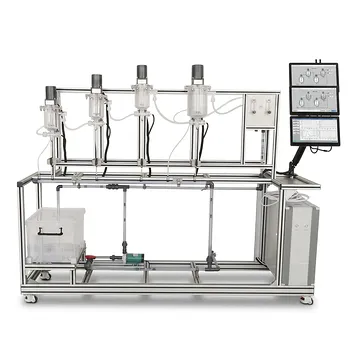
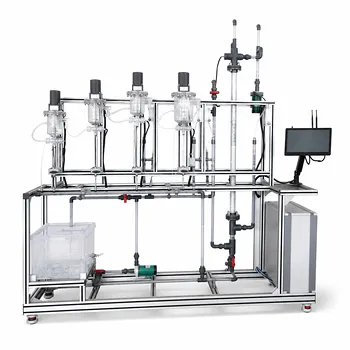
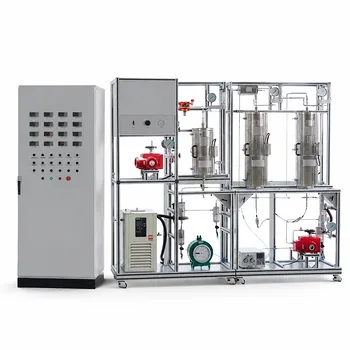
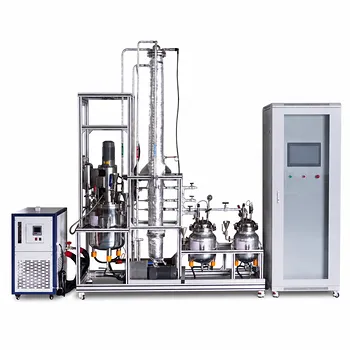
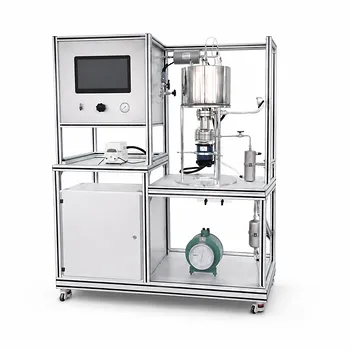
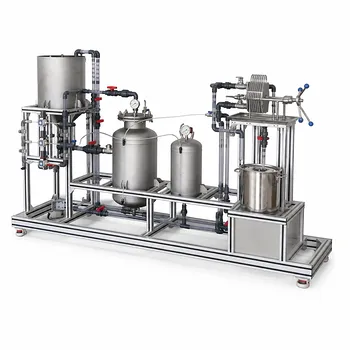
Bridging the gap between mathematical kinetic models and physical pilot-scale validation requires reliable, high-precision equipment. LABPARK provides premium Educational and Vocational Unit Operations Pilot Plants in chemical engineering, bioprocess & biotech, and environmental & water treatment for universities, research institutes, and enterprises.
Our advanced pilot plants enable you to easily test CSTR cascades, validate residence-time distributions (RTD), and optimize reaction parameters under safe, controlled conditions.
Ready to transform your laboratory kinetics into a high-performing pilot plant? Contact LABPARK today to explore our customizable pilot plant solutions!
Related Products
- Multi-Stage Stirred Tanks in Series Residence Time Distribution and Mixing Performance Determination Educational Pilot Plant
- Residence Time Distribution and Reactor Flow Characteristics Determination Educational Pilot Plant
- Gas Phase Mixing and Residence Time Distribution Determination Educational Unit Operations Pilot Plant
- Multi Functional Catalytic Reaction and Reactor Evaluation Educational Unit Operations Pilot Plant
- Multi-Reactor Educational Pilot Plant for Reaction Engineering Unit Operations
People Also Ask
- How does MRF model impeller rotation in CFD? Key Boundary Conditions Explained
- How can a CSTR pilot plant demonstrate reactor staging? Visualize volume savings.
- How does steady-state multiplicity affect the operation and safety of exothermic reactions within a CSTR pilot plant? - Guide
- What parameters to monitor transitioning from Batch to CSTR? Master Pilot Plant Setup
- Why is temperature regulation via a cooling jacket a critical feature in CSTR pilot plants used for laboratory training?