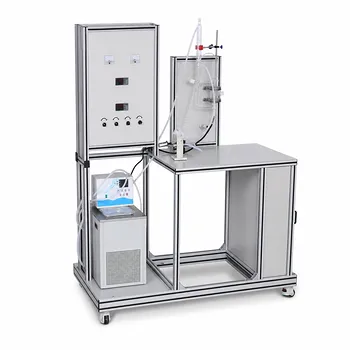
When you're building a pilot-plant separation train, equilibrium flash vaporization is applied as a pre-treatment step by installing a single-stage flash drum directly upstream of the main distillation column. This vessel throttles a pressurized liquid feed, causing a partial vaporization that strips away the most volatile light ends before the remaining liquid enters the column. The immediate outcome is a rough, energy-efficient bulk split that reduces the thermal duty on the downstream fractionator and stabilizes its feed composition.
The core insight: Placing a flash unit before a distillation column is not about achieving a final product split—it's a deliberate strategy to offload the most energy-intensive separation work, shrinking the size and energy demand of the pilot plant's main column while simultaneously turning the setup into a living laboratory for vapor–liquid equilibrium (VLE) validation.
The Role of Pre-Treatment Flash in a Pilot Plant
A flash pre-treatment step transforms a simple distillation pilot plant into a highly flexible research tool. Its purpose goes far beyond just “taking out the light stuff.”
Reducing Thermal Load and Improving Column Stability
Every unit of vapour that must be generated inside a distillation column’s reboiler costs energy. By performing a rough, single-stage separation of the most volatile components in a flash drum, you prevent those light components from consuming a disproportionate share of the column’s heat duty.
This directly reduces the reboiler steam requirement and can shrink the required column diameter. Additionally, removing large quantities of light ends stabilizes the feed quality entering the column. The downstream distillation then operates under a narrower composition range, making it easier to control and less prone to flooding or weeping caused by sudden volatility swings.
Educational and Research Value: Bridging Theory and Practice
A flash pre-treatment step turns the pilot plant into a rigorous VLE verification platform. Researchers can isolate the flash unit to test thermodynamic models before deploying them on the full column. By sampling the vapour and liquid leaving the drum and comparing them against predictions from the Rachford-Rice equation or process simulators, teams validate their phase equilibrium constants (K-values) for the specific multi-component mixture under study. This hands-on validation builds the confidence needed to scale up the separation.
Operational Principles of the Flash Pre-Treatment Step
The physics controlling the pre-treatment step are precise. When operated within a narrow temperature and pressure window, the system delivers a predictable split.
Throttling and Phase Separation Dynamics
A pressurized feed, conditioned to a pressure at or above its bubble-point pressure, is forced through a valve into the flash drum. The sudden pressure drop superheats the liquid relative to the new pressure, triggering a rapid, adiabatic partial vaporization. The two-phase mixture enters the drum, where a large disengagement space lets gravity separate the liquid from the vapour. The vapour leaves overhead, and the liquid—now stripped of the lightest components—is fed to the main column.
Determining Operating Conditions: Bubble and Dew Point Constraints
For flash vaporization to occur, the flash drum’s operating temperature must be strictly between the mixture’s bubble point and dew point at the drum pressure. Operating below the bubble point yields only liquid; operating above the dew point yields only vapour.
Pilot plant operators use this constraint to set the feed preheat temperature and the pressure drop across the throttling valve. Adjusting these parameters directly tunes the vapour-to-liquid (V/L) ratio, defining how aggressively the light ends are removed before the main column.
Solving the Flash: The Rachford-Rice Equation
To predict the split, researchers solve the Rachford-Rice equation to find the molar vapour fraction ($e = V/F$):
$G(e) = \sum \frac{z_i(K_i - 1)}{(K_i - 1)e + 1} = 0$
Since $K_i$ values are nonlinear functions of temperature and composition, an iterative Newton-Raphson method is typically employed, starting from an initial guess like $e = 0.5$. Once $e$ is known, the vapour and liquid compositions ($y_i$, $x_i$) and stream flow rates are determined. This calculation is the mathematical heartbeat linking the pre-treatment step’s setpoints to the column’s inlet conditions.
Understanding the Trade-offs
The flash pre-treatment step is powerful, but it imposes its own constraints that a pilot plant design must accommodate.
Incomplete Separation and Carry-Over Risks
A single equilibrium stage provides only a rough cut. Unlike a distillation column with multiple trays, the flash drum cannot sharpen the separation. Some desirable intermediate components will inevitably be lost to the vapour stream. If not recovered or managed, this can reduce the yield of the main column’s target product.
Furthermore, improper drum sizing or high vapour velocities can cause liquid entrainment. Droplets of heavier components can be physically carried into the vapour line, contaminating the overhead light-ends stream and invalidating the ideal equilibrium assumptions. Pilot plants must therefore include disengagement space and, when needed, mesh demisters.
Non-Ideal Mixture Complexity
Many chemical systems (like ethanol-water) exhibit strong non-ideal behaviour, where molecular interactions cause azeotropes and significant deviations from Raoult’s law. In these cases, the flash calculation requires activity coefficients ($\gamma$) to correctly correlate the equilibrium ($p_i = p_i^0 x_i \gamma_i$).
A flash pre-treatment for a non-ideal mixture demands a validated activity coefficient model (e.g., Wilson, NRTL). Without it, the predicted split and the resulting column feed composition will be wrong. The pilot plant’s multiple liquid and vapour sampling ports on the flash drum become critical tools for experimentally mapping this non-ideal VLE behaviour and correcting the model.
Making the Right Choice for Your Goal
A flash pre-treatment step should be tailored to the specific objective of the pilot plant campaign. The operating philosophy changes based on what you are trying to prove.
- If your primary focus is maximizing downstream column purity: Operate the flash drum conservatively. Keep the temperature closer to the dew point to strip only the lightest of lights. Prevent loss of the target compound while still removing the components that would contaminate the column’s top product.
- If your primary focus is drastically reducing the reboiler energy load: Operate more aggressively, with a higher V/F ratio. Accept a certain loss of product into the vapour phase in exchange for a much lighter liquid load entering the column’s bottom section.
- If your primary focus is VLE model validation for a non-ideal system: Prioritize steady-state sampling. Run the flash drum at multiple, controlled temperature/pressure points, collect vapour and liquid samples, and calculate experimental activity coefficients to tune your simulator’s binary interaction parameters before allowing any flow to the main column.
- If your primary focus is preparing a feed for a heat-sensitive compound: Use the flash step to strip volatiles under vacuum, keeping the operating temperature low. This prevents thermal degradation while still delivering a degassed, stabilized feed to the column.
The flash pre-treatment step elevates a simple distillation pilot plant into a disciplined test bed: it offloads your column, forces you to confront the reality of your VLE models, and ultimately defines the quality of what you pour into the heart of your separation process.
Summary Table:
| Pre-Treatment Goal | Process Action | Main Benefit |
|---|---|---|
| Reduce Thermal Load | Single-stage bulk split of light ends | Lower reboiler duty & column size |
| Stabilize Column | Strip highly volatile components upstream | Narrower feed composition, less flooding |
| Validate VLE Models | Sample vapor/liquid phases | Accurate scaling using Rachford-Rice data |
| Protect Heat-Sensitives | Run flash step under vacuum | Lowers operating temp to prevent degradation |
Optimize Your Chemical Engineering Labs with LABPARK
Looking to enhance your research and teaching capabilities? LABPARK provides state-of-the-art Educational and Vocational Unit Operations Pilot Plants across chemical engineering, bioprocess & biotech, and environmental & water treatment.
Whether you are a university, research institute, or enterprise, our customizable pilot plants—featuring advanced pre-treatment and separation units—are designed to bridge the gap between theory and industrial practice.
Contact us today to request a quote or discuss your laboratory configuration.
Related Products
- Binary System Vapor Liquid Equilibrium Data Determination Educational Unit Operations Pilot Plant
- Supercritical High-Gravity Flash Evaporation Educational Unit Operations Pilot Plant
- Rising and Falling Film Evaporation Educational Unit Operations Pilot Plant
- Natural Product Extraction Unit Operations Training Pilot Plant
- Fluidized Bed Gas Solid Catalytic Reaction Educational Pilot Plant
People Also Ask
- How can pilot plants assist in validating VLE models? Bridge theory and physical reality.
- Why Collect Isothermal vs. Isobaric VLE Data? Key Pilot Unit Advantages
- How Do Equations of State Predict VLE in Pilot Plants? Optimize Your Separation Design
- How do intermolecular forces and molecular kinetic energy govern gas liquefaction and vaporization? Explore VLE pilot plants
- For VLE Experiments: Fugacity vs. Activity Coefficient Method Selection Criteria