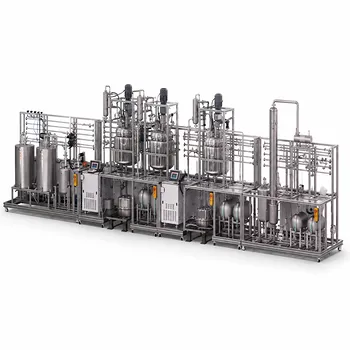
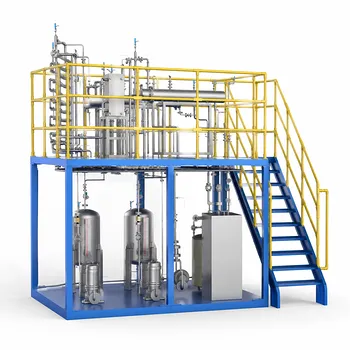
Thermodynamic theory isn’t just for the classroom—it’s a powerful design tool for the pilot plant.
Understanding Gibbs criticality criteria and the spinodal curve lets instructors craft laboratory experiments that safely reveal where a single phase loses stability. They can design runs where students intentionally approach these boundaries, observe sudden phase splits, and connect the stability of internal energy expansions to real column or extractor behavior.
Core Insight: A true grasp of spinodal decomposition and critical limits transforms pilot-plant labs from recipe‑following exercises into explorations of phase stability theory. This lets instructors create experiments where students learn to anticipate, control, and never inadvertently cross the absolute stability boundary, linking the Taylor expansion of internal energy directly to operational safety and separation performance.
Connecting Gibbs Theory to Pilot‑Plant Reality
From Taylor Series to Visual Phase Splits
Students often see the spinodal only as a mathematical artifact—the point where the second derivative of Gibbs energy vanishes.
In a pilot plant, that math becomes a visible event.
A small change in temperature or composition near the stability limit triggers an abrupt, system‑wide phase separation.
Instructors can use this moment to demonstrate how the Taylor expansion of internal energy loses its positive definite character when the stability determinant hits zero.
This turns equations of state into a physical spectacle that cements understanding far better than a textbook graph.
Defining the Spinodal as a Safety and Learning Boundary
The spinodal surface defines the ultimate boundary of phase stability.
Beyond it, a single‑phase system instantly decomposes into two or more phases with no energy barrier.
For liquid‑liquid extraction or supercritical fluid pilot units, that boundary is both a teaching tool and a safety constraint.
Instructors can map the locus of criticality on ternary or binary diagrams, then show students exactly how close they can operate before homogenization occurs.
Knowing this limit turns exploratory operation into deliberate, well‑bounded experimentation.
Designing Experiments That Teach Control and Stability
Using the Spinodal to Create Intentional Instabilities
In a liquid‑liquid extraction pilot plant, an instructor might ask students to vary temperature while monitoring a ternary mixture.
As conditions approach the spinodal, the system moves from a stable two‑phase region into a metastable or unstable zone.
The sudden, visible coalescence or splitting of phases teaches students to feel the difference between nucleation‑driven phase change and spinodal decomposition.
Such an experiment can be precisely designed because the mathematical stability criteria predict exactly where the change will occur.
Integrating Gibbs Phase Rule for Degrees of Freedom
Every control‑oriented experiment benefits from the Gibbs phase rule, F + π = 2 + N.
In a binary distillation column, for example, fixing two independent intensive variables (pressure and temperature) fully determines the vapor and liquid compositions at equilibrium.
Instructors can design exercises where students first compute the degrees of freedom, then verify by fixing those variables and measuring outputs.
When combined with the spinodal insight—showing that degrees of freedom collapse as the stability limit is approached—students learn to see control and phase stability as two sides of the same coin.
Understanding the Trade‑offs and Pitfalls
The Danger of Overshooting the Stability Limit
Operating deliberately near the spinodal is instructive, but accidentally crossing it can ruin a run.
A sudden temperature spike or a composition error may push a carefully tuned extraction into complete phase homogenization.
In a high‑pressure supercritical fluid system, entering the unstable region can cause pressure oscillations or even mechanical stress.
Instructors must teach that the spinodal is not a suggestion—it is a hard thermodynamic boundary that demands respect.
Balancing Theoretical Precision with Operational Simplicity
Real fluids often exhibit nucleation before the true spinodal is reached, especially in the metastable region.
Students may observe phase change earlier than the pure stability criterion predicts, which can create confusion.
A well‑designed experiment acknowledges this gap: it lets students compare the computed spinodal with the actual onset of phase separation, reinforcing that the model is an ideal limit.
This teaches critical evaluation of thermodynamic models without sacrificing the core learning objective.
Making the Right Choice for Your Pilot‑Plant Experiment
Goal‑driven design turns criticality criteria into a flexible instructional asset. Use the following guide to align your experiment with your teaching objectives:
- If your primary focus is teaching thermodynamic fundamentals: Design a supercritical fluid extraction experiment where students map the spinodal curve from an equation of state, then observe phase boundaries as they adjust pressure and temperature in real time.
- If your primary focus is safe pilot‑plant operation: Embed the spinodal as a “keep‑out” boundary on a ternary diagram for liquid‑liquid extraction; have students design operating procedures that never cross it and explain why.
- If your primary focus is process optimization: Challenge students to locate the point closest to the plait point (before the tie lines vanish) that maximizes extraction efficiency, connecting the cold mathematics of the stability determinant to hot economics of separation.
- If your primary focus is integrating theory with control: Create a binary distillation exercise where students must apply the phase rule to determine the controllable variables, then verify that stability is maintained as they shift the operating line toward the critical point.
By embedding Gibbs criticality and spinodal limits into the experimental blueprint, instructors turn pilot plants into living thermodynamics laboratories where abstract stability equations become the direct, watchful guardians of safe, insightful operation.
Summary Table:
| Focus Area | Experiment Type | Key Learning Objective | Operational Consideration |
|---|---|---|---|
| Thermodynamic Fundamentals | Supercritical Fluid Extraction | Map spinodal curves from EOS and observe phase boundaries in real-time | Control high-pressure phase transitions and pressure oscillations |
| Safe Operation | Liquid-Liquid Extraction | Map spinodal boundaries to prevent accidental phase homogenization | Set strict operational limits near the metastable boundary |
| Process Optimization | Ternary/Binary Separation | Locate plait points to maximize extraction and separation efficiency | Account for real-world nucleation happening before theoretical limits |
| Theory-Control Integration | Binary Distillation | Apply Gibbs phase rule to determine and verify controllable variables | Maintain stability while shifting operating lines toward critical zones |
Elevate Your Chemical Engineering Lab with LABPARK Pilot Plants
Bridging complex thermodynamic theory with hands-on practice requires safe, precise, and reliable equipment. LABPARK provides state-of-the-art Educational and Vocational Unit Operations Pilot Plants in chemical engineering, bioprocess & biotech, and environmental & water treatment.
Designed specifically for universities, research institutes, and enterprises, our pilot plants empower instructors to safely demonstrate advanced concepts like Gibbs criticality, phase stability, and spinodal decomposition in a controlled environment.
Ready to enhance your teaching and research capabilities? Contact LABPARK today to find the ideal pilot plant solution for your laboratory!
Related Products
- Carbon Dioxide Hydrogen Methanol Synthesis Educational Unit Operations Pilot Plant
- Multi Pump Fluid Transport Process Piping Unit Operations Training Pilot Plant
- Natural Product Extraction Unit Operations Training Pilot Plant
- Multi-Modal Distillation Unit Operations Training Pilot Plant
- Multi-Reactor Educational Pilot Plant for Reaction Engineering Unit Operations
People Also Ask
- How do temp & pressure affect methanol synthesis pilot plants? Optimize equilibrium and catalyst performance.
- Why is a purge system necessary when operating a gas recirculation loop in a methanol synthesis pilot plant? (Guide)
- Why do modern methanol pilot plants operate at lower pressures? Catalyst & Feed Requirements Explained
- What are the operational requirements for catalyst activation? Safe Methanol Pilot Plant Operation
- Why is the chemical plant startup schedule crucial? De-risk scale-up with pilot plants.