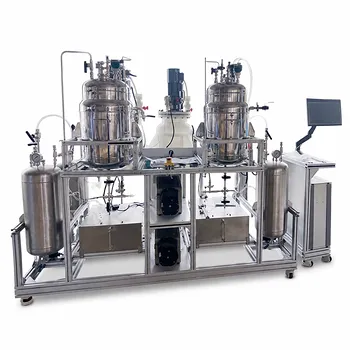
The hidden variable defining pilot plant scale separation operations. The variation in reaction enthalpy from different physical states—especially the latent heat absorbed or released during phase changes—is not a secondary detail but the primary driver of thermal design in distillation and evaporation pilot plants. It directly determines the sizing of reboilers and condensers, the consumption of heating steam and cooling water, and the required number of separation stages. Failing to account for the enthalpy differences between liquid, vapor, and mixed-phase streams will produce a pilot plant that cannot meet its target purity, throughput, or thermal efficiency.
While the standard enthalpy of reaction is calculated at 25°C and 1 atm, pilot plants operate at real process conditions where phase changes dominate energy flows. The latent heat of vaporization and the sensible heat required to reach boiling points turn textbook thermodynamics into concrete sizing decisions for every reboiler and condenser. Mastering these enthalpy variations is what transforms a pilot plant from a learning tool into a reliable scale-up platform.
Phase Change Enthalpy: The Foundation of Pilot Plant Energy Balance
Why a Liquid-to-Vapor Transition Demands So Much Energy
When a liquid vaporizes, it must absorb enough energy to overcome intermolecular forces and to perform expansion work (W = -pΔV) against the atmosphere. The total energy required under constant pressure is the enthalpy of vaporization ($\Delta H_{vap}$). In a distillation or evaporation pilot plant, this single value dictates the heating utility load.
The Direct Link to Reboiler Sizing
The reboiler must supply exactly $\Delta H_{vap}$ per mole of vapor generated. If you underestimate this figure—perhaps by using an idealized standard-state value without correcting for the actual operating temperature and pressure—the reboiler wattage or steam flow will be insufficient. That shortfall prevents the column from reaching its target reflux ratio and separation purity.
Condenser Duty Follows the Same Rule
On the condensation side, the same $\Delta H$ must be removed to turn the overhead vapor back into liquid. The condenser’s cooling water flow rate is a direct function of this latent heat load. Any inaccuracy in the enthalpy value flows straight into an undersized or oversized heat exchanger.
Moving from Standard State to Operating Reality
Correcting Reaction Enthalpy for Sensible and Latent Heat
Standard reaction enthalpy is measured at 25°C, but pilot plant units run at elevated temperatures and pressures where reactants and products may change phase. The true heat load must add or subtract the sensible heat needed to bring streams to operating temperature and the latent heat for any vaporization or condensation that occurs inside the system. Skipping these corrections leaves you with a heat balance that looks correct on paper but fails in the actual plant.
How the Clausius-Clapeyron Relationship Shapes Operating Pressure
According to the Clausius-Clapeyron equation, the saturated vapor pressure of a liquid rises exponentially with temperature. A seemingly small temperature increase can double the vapor pressure, altering the relative volatility and the minimum energy needed for separation. In pilot plant design, this relationship is used to set vacuum levels for heat-sensitive materials and to compute the precise $\Delta H_{vap}$ that goes into the condenser and reboiler sizing calculations.
The Danger of Generic Phase-Change Data
Supplementary references show that for complex mixtures—like heavy hydrocarbons or polar gas mixtures—standard pressure correction methods can deviate by 10% or more. Using uncorrected enthalpy data forces engineers to apply large safety factors, oversizing heat exchangers and driving up capital and utility costs. Pilot plants that gather real experimental data under actual pressure and temperature conditions eliminate this uncertainty and prevent over-engineering at commercial scale.
The Feed Thermal State (q-Factor): Where Enthalpy Meets Column Operation
Defining the q-Factor and Its Enthalpy Roots
The q-factor of the feed stream represents the fraction of liquid that must be vaporized solely by the heat inside the column. A cold liquid feed (q > 1) carries less enthalpy than a saturated liquid, so it must absorb more energy from the stripping section. That energy comes directly from the reboiler, increasing its heat duty.
Impact on Theoretical Stage Requirements
A cold liquid feed increases the slope of the stripping operating line, moving it closer to the equilibrium curve and reducing the mass transfer driving force. Paradoxically, this reduces the number of theoretical stages needed for a given separation—but at the price of a much larger reboiler heat load. A vapor-liquid mixture feed (q < 1) requires more stages but far less heating steam.
Utility Consumption Follows Feed Enthalpy
Increasing the feed’s enthalpy (by preheating it) shifts the load from the reboiler to the feed heater, but the total energy input to the system changes. In pilot plant operation, the feed thermal state is a dial that trades reboiler steam against condenser cooling water, allowing researchers to optimize the point where utility costs meet column size.
Experimental Validation: Why a Pilot Plant Is Your Best Thermodynamic Data Source
When Equations of State Fall Short
Accurate enthalpy calculations for vapor and liquid streams combine ideal gas enthalpy with departure terms from equations of state like Redlich-Kwong, and liquid excess enthalpy from activity coefficient models like NRTL. But for high-temperature, polar, or heavy hydrocarbon systems, these models can diverge from reality. A pilot plant running the actual mixture provides the empirical data that refines those predictive methods.
Turning Thermochemical Equations into Engineering Parameters
A pilot plant translates theoretical $\Delta H$ values into measurable outcomes: the steam consumption of the reboiler, the cooling water temperature rise, and the pressure drop across the column. By measuring these, students and researchers learn how phase-change enthalpy drives real chemical engineering design parameters—not just numbers in a textbook.
Understanding the Trade-offs
The Pitfall of Using Standard-State Enthalpy Uncorrected
Relying on standard-state reaction enthalpy without sensible and latent heat corrections produces incorrect heating/cooling duties. This leads to a pilot plant that cannot maintain steady-state conditions, undermining the entire experimental program.
Over-Engineering from Inaccurate Enthalpy Data
A common defensive strategy is to apply large safety factors when thermodynamic data is uncertain. While this ensures the plant will run, it inflates the capital cost and locks in excessive utility consumption. The pilot plant’s real value lies in generating accurate enthalpy data to eliminate those safety factors.
The Cost of Ignoring Feed Phase Splits
Treating all feeds as saturated liquids when they may be partially vaporized introduces a hidden inefficiency. The stripping section may become overloaded, flooding the column and destroying separation efficiency. The enthalpy of the feed must be measured or calculated precisely to avoid these operational failures.
Applying Enthalpy Knowledge to Your Pilot Plant Operation
Whether you are designing a new pilot unit or troubleshooting an existing one, the variation in enthalpy due to physical states guides every thermal decision. Use the following goal-based recommendations:
- If your primary focus is accurate scale-up to commercial size: Generate experimental $\Delta H_{vap}$ and heat of mixing data directly on the pilot plant using the actual feed composition. Avoid standard-state assumptions; feed your process simulator with real thermodynamic data to eliminate the need for excessive safety factors.
- If your primary focus is minimizing utility costs during pilot campaigns: Optimize the feed thermal state (q-factor) to balance reboiler steam and condenser cooling water. A partially vaporized feed reduces reboiler duty but may require more column stages—measure both to find the economic optimum.
- If your primary focus is educational or academic research: Use the pilot plant to demonstrate how phase-change enthalpy translates theoretical thermochemical equations into observable variables: steam flow, temperature profiles, and reflux ratios. These measurements make abstract enthalpy principles concrete.
- If your primary focus is processing heat-sensitive or high-boiling materials: Leverage the Clausius-Clapeyron relationship to determine the vacuum level that lowers the boiling point and $\Delta H_{vap}$ just enough to prevent thermal degradation while keeping reboiler size practical.
Every watt of heating and every liter of cooling water in your pilot plant is an expression of the enthalpy change between physical states. By making $\Delta H$ the central variable in your design and operation—not an afterthought—you build a pilot plant that is both a faithful physical model and a reliable bridge to full-scale production.
Summary Table:
| Key Parameter | Impact on Unit Operation | Engineering Action/Adjustment |
|---|---|---|
| Phase Change Enthalpy ($\Delta H_{vap}$) | Dictates reboiler heating & condenser cooling loads | Size heat exchangers based on operating temp/pressure, not standard state |
| Feed Thermal State (q-factor) | Influences theoretical stages and utility distribution | Pre-heat feed to balance reboiler steam and condenser cooling water loads |
| Vapor Pressure (Clausius-Clapeyron) | Shifts relative volatility and separation energy needed | Adjust vacuum levels to manage boiling points and protect heat-sensitive feeds |
| Real Mixture Deviations | Causes up to 10%+ deviation from ideal equation models | Run pilot campaigns to gather empirical thermodynamic data for safe scale-up |
Need a robust pilot plant to validate your thermodynamic designs? LABPARK provides state-of-the-art Educational and Vocational Unit Operations Pilot Plants in chemical engineering, bioprocess & biotech, and environmental & water treatment for universities, research institutes, and enterprises.
Whether you are teaching phase-change thermodynamics or scaling up complex chemical separations, our systems deliver the precise control and empirical data you need to succeed.
Contact LABPARK today to discuss your pilot plant requirements!
Related Products
- Continuous Sieve-Plate Distillation Pilot Plant for Unit Operations Laboratory Education
- Multi-Functional Special Distillation Educational Pilot Plant
- Continuous Batch Extractive Distillation Educational Pilot Plant
- Multi-Modal Distillation Unit Operations Training Pilot Plant
- Electrolyte Distillation Purification and Formulation Educational Pilot Plant
People Also Ask
- How to select the right activity coefficient model (Wilson, NRTL, UNIQUAC) for distillation pilot plants?
- Why is vacuum operation capability an essential feature for a distillation unit operations pilot plant? Unlock Efficiency
- What are the primary reflux ratio control strategies? Master Distillation Unit Operations
- How does catalyst water concentration affect distillation pilot plant design? Key separation train choices.
- How can real-time carbon number prediction improve distillation pilot plants? Optimize control.