The leap from glass beakers to towering steel columns is not just a change in size—it's a fundamental shift in how a chemist thinks. The transition from benchtop glassware to chemical engineering unit operations pilot plants transforms the understanding of chemical physical properties from isolated, textbook numbers into dynamic, interdependent variables that govern real industrial processes. A boiling point is no longer just a temperature; it becomes the driving force behind a distillation column’s temperature profile, energy consumption, and separation efficiency, all observed in real time.
While glassware experiments reveal what a physical property is, unit operations pilot plants force students to confront how those properties behave under the constraints of scale, fluid dynamics, and continuous operation. This bridge is what turns a chemistry student into a process engineer, transforming abstract data into actionable design and safety decisions.
The Limitations of Glassware: Seeing Properties in Isolation
Benchtop glassware is designed for transparency and simplicity. It excels at teaching fundamental concepts, but it creates an artificial world where physical properties exist in a vacuum.
Observing, Not Engineering
In a glass flask, you might measure the boiling point of a pure solvent. You observe the temperature, note the liquid turning to vapor, and record a number. It’s a static, isolated event.
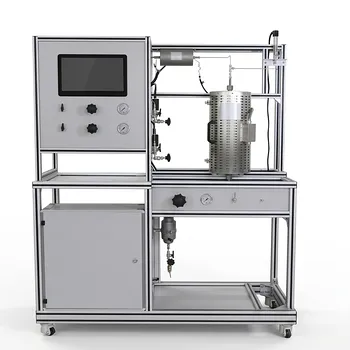
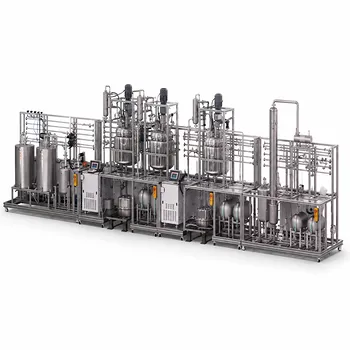
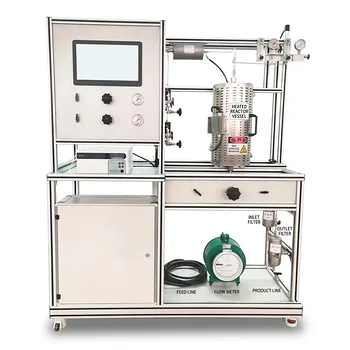
A unit operations pilot plant replaces that flask with a multi-stage distillation column. Here, the property is not observed—it is engineered. Students must manage the vapor-liquid equilibrium across many trays, each at a different temperature, to achieve a target separation. The property becomes a tool, not just a fact.
Scale and the Missing Context
Glassware experiments mask several critical realities. Because the volumes are tiny, heat and mass transfer are nearly instantaneous. A thermometer in a 100 mL beaker gives a uniform reading; there are no gradients, no delays, no hot spots.
At pilot scale, these assumptions break down. A 50-liter reactor exhibits significant temperature stratification and concentration gradients. Students suddenly realize that a physical property like density isn’t just a constant in a formula—it drives natural convection, mixing efficiency, and residence time distributions that profoundly affect safety and yield.
From Isolated Properties to Interconnected Systems
The core enhancement to a student's understanding comes from seeing physical properties as nodes in a complex network of process parameters. The pilot plant turns theoretical constructs into tactile, measurable forces that must be balanced against each other.
Real-Time Monitored Phenomena
Instead of a manual thermometer, a pilot distillation column is studded with industrial sensors. Students monitor temperature profiles at every stage, pressure drops across internal trays, and feed flow rates on a control screen.
This paints a complete picture of a physical property in action. The boiling point of the mixture isn't a single value; it shifts along the column as composition changes. Students directly observe how a lower pressure drop, caused by a physical property like viscosity, can increase column efficiency. The property is no longer a number in a handbook—it is the live pulse of an operating unit.
Linking Molecular Properties to Macroscopic Efficiency
Glassware chemistry often treats properties like solubility or vapor pressure as endpoints. Pilot plants demand a causal link to macroscopic process parameters like heat transfer and column efficiency.
For example, when a student runs an extraction column, they must predict how a solute’s partition coefficient (a physical property) affects the required number of theoretical stages. They then physically calculate stage efficiency and mass transfer coefficients by sampling the actual column. This directly connects a molecular-scale preference to the gigantic capital cost of a taller column, making the economic impact of physical properties brutally clear.
Applying Theory to Optimize Real Processes
When abstract thermodynamic equations meet a pilot plant, the learning is transformative. Students stop memorizing formulas and start using them to control a real, often stubborn, physical system.
Manipulating Operating Conditions
Textbook thermodynamics explains how equilibrium shifts with temperature and pressure. In a pilot plant, students physically manipulate these parameters—turning knobs to increase reflux ratio or adjusting a heating jacket to change the reaction rate.
They see the immediate consequence of Le Chatelier’s principle not as a line in a notebook, but as a shifting composition readout on a gas chromatograph. They learn that optimizing for a favorable thermodynamic equilibrium might kill the kinetic rate, forcing a compromise that balances yield against production time—a lesson no glass beaker can teach.
Validating Predictive Models with Empirical Data
Modern process development relies on simulation software. But these digital models are only as good as their assumptions about physical properties like heat capacity and vapor pressure. When students run the same process in a pilot plant, they collect empirical data on heat transfer and fluid flow that often deviates from the ideal.
They then feed this real data back into the simulation, refining the model. This teaches a critical truth: a physical property’s literature value is a starting point, not a guarantee. The ability to validate and correct theory with physical reality is the ultimate enhancement of their understanding.
Understanding the Trade-offs and Pitfalls
Transitioning to pilot-scale work is not a magic bullet; it introduces significant new challenges that are crucial for a complete education. The bridge is often bumpy, and that is the point.
The Risk of Assuming Ideality
A major pitfall is assuming that properties scale linearly. In glassware, students use pure reagents and short runs. A pilot plant, operating continuously for weeks, introduces real-world feedstocks with impurities.
This reveals that physical properties like solubility are altered by minor, accumulated by-products. A solvent recycling loop that looked perfect on paper can become filled with low-boiling impurities that change the entire vapor-liquid equilibrium of the distillation. The pilot plant exposes the danger of assuming ideality and forces students to design for a non-ideal world.
Challenges of Impurities and Long-Term Stability
Glassware experiments rarely run long enough to see a catalyst deactivate. In an integrated pilot plant, students confront coking, fouling in heat exchangers, and the slow accumulation of tars in recycle streams.
They learn that a physical property like viscosity can drift over time, reducing heat transfer film coefficients and slowly choking the process. This firsthand experience with degradation teaches that a successful industrial process isn’t just chemically sound at startup; it must remain physically robust after thousands of hours, a lesson completely invisible in a weekend lab session.
Making the Right Choice for Your Learning Goal
The path from glassware to pilot plant is a deliberate progression, each step suited to a different stage of understanding. Your focus should guide which platform you prioritize.
- If your primary focus is memorizing fundamental physical properties: Benchtop glassware provides a pure, distraction-free environment to observe boiling points, density, and solubility in isolation without the noise of process dynamics.
- If your primary focus is understanding how physical properties dictate process design: Unit operations pilot plants are essential. They force you to connect a vapor pressure curve to the capital cost and energy load of a 20-tray distillation column.
- If your primary focus is mastering process safety and troubleshooting: There is no substitute for pilot-scale experience. It teaches you to anticipate how a runaway reaction’s heat release (a thermodynamic property) interacts with the vessel’s heat transfer limitations, creating a critical safety hazard.
- If your primary focus is industrial technology transfer and scale-up: You must bridge the gap with pilot plant data. Use it to validate simulation models against non-ideal physical behavior, correcting assumptions before they lead to multimillion-dollar failures at full production scale.
The ultimate value lies not in replacing the glassware, but in transcending it, evolving from an observer of chemical properties into an engineer who can predict, manipulate, and respect their power in the real world.
Summary Table:
| Learning Aspect | Glassware Experiments | Unit Operations Pilot Plants |
|---|---|---|
| System State | Static & isolated | Dynamic & interdependent |
| Heat & Mass Transfer | Instantaneous (no gradients) | Realistic gradients, hot spots, & delays |
| Process Control | Manual, single-point observation | Real-time monitoring via industrial sensors |
| Focus | Observing chemical phenomena | Optimizing efficiency & safety at scale |
Bridge the Gap from Theory to Industrial Practice with LABPARK
Are you looking to elevate your students' or researchers' understanding of real-world process engineering? LABPARK provides state-of-the-art Educational and Vocational Unit Operations Pilot Plants across chemical engineering, bioprocess & biotech, and environmental & water treatment.
Specially designed for universities, research institutes, and enterprises, our systems translate abstract thermodynamic concepts into hands-on operational expertise, preparing the next generation of engineers for real-world scaling challenges.
Contact our engineering experts today to find the perfect pilot plant for your laboratory!
Related Products
- Carbon Dioxide Hydrogen Methanol Synthesis Educational Unit Operations Pilot Plant
- Multi Pump Fluid Transport Process Piping Unit Operations Training Pilot Plant
- Natural Product Extraction Unit Operations Training Pilot Plant
- Multi-Modal Distillation Unit Operations Training Pilot Plant
- Multi-Reactor Educational Pilot Plant for Reaction Engineering Unit Operations
People Also Ask
- How do temp & pressure affect methanol synthesis pilot plants? Optimize equilibrium and catalyst performance.
- Why is a purge system necessary when operating a gas recirculation loop in a methanol synthesis pilot plant? (Guide)
- Why do modern methanol pilot plants operate at lower pressures? Catalyst & Feed Requirements Explained
- What are the operational requirements for catalyst activation? Safe Methanol Pilot Plant Operation
- Why is the chemical plant startup schedule crucial? De-risk scale-up with pilot plants.