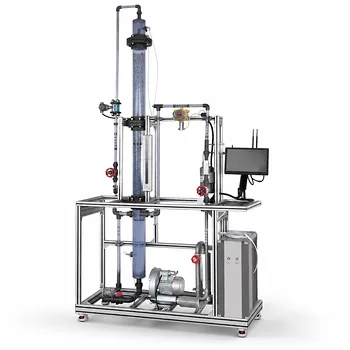
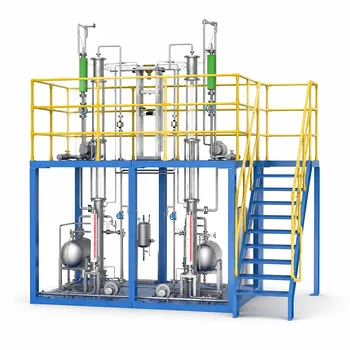
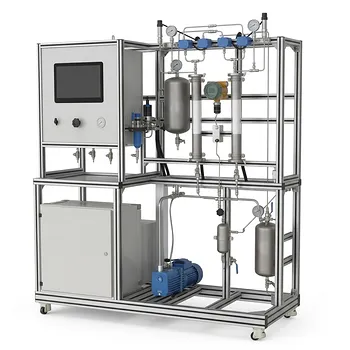
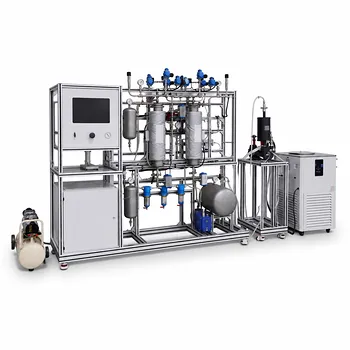
The relationship between target solute recovery and packed column height is fundamentally non-linear and exponential. As you demand higher recovery efficiencies from your absorption pilot plant, the required column height does not just increase proportionally—it escalates dramatically. For instance, pushing recovery from 90% to 96% can cause the necessary packing height to more than double. This teaches a crucial engineering lesson: the marginal cost of purity is paid in physical size and capital investment.
Achieving near-complete solute recovery in a packed column presents a classic engineering trade-off. The primary design impact is a non-linear, often exponential, increase in the required packing height, driven by the physics of mass transfer as the driving force for separation diminishes at the column's top. This forces a critical balance between recovery targets, equipment footprint, and operating costs.
The Core Design Mechanism: Translating Efficiency into Height
The direct link between your target recovery efficiency and the column's height is captured by the Number of Transfer Units (NTU). A higher recovery percentage directly dictates a significantly larger, and non-linearly scaling, NTU requirement.
The Exponential Demand of High Purity
The NTU represents the difficulty of the separation. As you aim to absorb the last remaining fractions of a solute, the concentration difference that drives mass transfer (the driving force) becomes vanishingly small.
This makes the separation exponentially harder. For example, under typical counter-current conditions where the operating and equilibrium lines are parallel, increasing the absorption rate of a gas like SO₂ from 90% to 96% causes the required NTU to jump from approximately 9 to 24.
A 6% increase in recovery efficiency required a 167% increase in the NTU. This is because the majority of the column's height is spent removing the final, most dilute traces of the solute.
The HTU-NTU Framework in Pilot Plant Design
The total packing height ($h$) is the product of a task difficulty factor and an equipment efficiency factor: $h = H_{OG} \times N_{OG}$.
The $N_{OG}$ (Number of Transfer Units) is determined by your target recovery. This term is a purely thermodynamic and mass-balance calculation, independent of the physical column. It quantifies the difficulty of the separation directly from the inlet and outlet concentrations and the system's equilibrium line.
The $H_{OG}$ (Height of a Transfer Unit) is determined by your equipment's mass transfer performance. It's inversely proportional to the volumetric mass transfer coefficient ($K_Y a$) and reflects how effectively your specific packing, flow rates, and fluid properties can perform the separation. Therefore, a higher recovery mandate forces $N_{OG}$ to climb sharply, and the only way to handle this in design is to proportionally increase the column height ($h$).
How to Manipulate Column Height for a Fixed Recovery Target
You are not locked into a single design. Once you understand the $h = H_{OG} N_{OG}$ relationship, you can see two distinct levers to achieve your target recovery.
Lever 1: Modifying the Operating Line Slope (Reducing $N_{OG}$)
You can actively reduce the $N_{OG}$ required for the same recovery efficiency. The primary reference notes this is done by changing the liquid-to-gas ratio ($L/G$). In a pilot plant lab, students can directly operate the column at a higher $L/G$ ratio. This steepens the operating line, pulling it further away from the equilibrium line. The effect is a larger average mass transfer driving force throughout the column, meaning fewer transfer units are theoretically needed. This achieves the same recovery in a seemingly "shorter" column, or a higher recovery within an existing column height, demonstrating a key operational lever for efficiency.
Lever 2: Enhancing Packing Efficiency (Reducing $H_{OG}$)
You can also reduce the height required by improving the packing. The $H_{OG}$ is heavily dependent on the characteristics of the column's internals.
Smaller packing sizes with larger specific surface areas generate a lower $H_{OG}$. This means each meter of packed height accomplishes more separation. Using 9.5 mm Raschig rings instead of 50 mm rings, or choosing structured packing over random packing, directly shrinks the column height needed for the same recovery.
Liquid distribution is critical to maintaining low $H_{OG}$. The wall flow effect, where liquid migrates to the column wall, reduces effective gas-liquid contact. This increases the $H_{OG}$ in practical terms. Pilot plant design must therefore include packed bed sections with liquid redistributors to ensure the theoretical efficiency of the packing is realized, an essential practical detail for educational setups.
Understanding the Trade-offs
The pursuit of higher recovery efficiency is not a simple decision. It forces a cascade of consequences that define an engineer's job.
- Capital Cost vs. Operating Purity: A taller column with more packing or sophisticated internals has a higher capital cost. This is the direct trade-off with the purity of the recovered stream.
- Pressure Drop and Operating Cost: A taller bed of smaller packing increases pressure drop. This means higher energy costs for the gas blower, a recurring operational expense that could outweigh the benefit of slightly higher recovery.
- Operational Complexity: Very high recovery columns are more sensitive to fluctuations in flow, temperature, and concentration. The reference on safety factors highlights the need to overdesign ($Z' = 1.2$ to $1.5 \times Z$) to ensure operational resilience in a lab setting.
- Equipment Footprint: In a pilot plant, physical space is limited. The non-linear height increase for high recovery directly challenges lab layout and accessibility, a key consideration in an educational environment.
Designing Your Pilot Plant Experiment: A Goal-Based Guide
The way recovery efficiency impacts the design height and sizing is a teachable moment you can control through the experiment's setup.
- If your primary focus is demonstrating the $h = H_{OG} \times N_{OG}$ principle: Task students with measuring the inlet/outlet concentrations to calculate $N_{OG}$ at a moderate recovery rate. Then, have them change the packing type or liquid flow rate to measure the change in $H_{OG}$, connecting material science directly to equipment size.
- If your primary focus is illustrating the economic trade-off of high purity: Assign a multi-target experiment. Students must design (or simulate designing) columns to hit 90%, 95%, and 98% recovery. They must then compare the calculated column heights and pressure drops, forcing them to justify a commercial decision based on their results.
- If your primary focus is on hydrodynamic scaling and sizing: Have students calculate the minimum tower diameter using the maximum superficial gas velocity at the column's bottom (highest gas load). This demonstrates that while height is driven by recovery, diameter is dictated by the need to avoid flooding, a completely separate mass transfer limitation.
By framing pilot plant work around these choices, you transform an abstract design equation into a clear narrative about the physical and economic laws that govern chemical processes.
Summary Table:
| Design Parameter | Impact on Column Height ($h$) | Key Operating Lever / Mechanism |
|---|---|---|
| High Recovery Target | Exponentially increases height | Increases NTU ($N_{OG}$) due to low mass transfer driving force |
| Higher Liquid-to-Gas ($L/G$) Ratio | Decreases required height | Steepens operating line, increasing driving force (reduces $N_{OG}$) |
| Smaller/Structured Packing | Decreases required height | Increases specific surface area, improving efficiency (reduces $H_{OG}$) |
| Improper Liquid Distribution | Increases required height | Causes wall flow, lowering effective contact area (increases $H_{OG}$) |
Bring Practical Process Insights to Your Students and Researchers
Are you looking to demonstrate complex mass transfer phenomena and column hydraulics in a safe, controlled environment?
LABPARK provides state-of-the-art Educational and Vocational Unit Operations Pilot Plants in chemical engineering, bioprocess & biotech, and environmental & water treatment. Specifically designed for universities, research institutes, and enterprises, our pilot plants help bridge the gap between theoretical calculations and real-world industrial operations.
Ready to upgrade your laboratory setup? Contact LABPARK today to discuss your custom pilot plant specifications!
Related Products
- Packed Bed Absorption Educational Unit Operations Pilot Plant
- Absorption and Desorption Educational Unit Operations Pilot Plant
- Multimodal Absorption and Desorption Pilot Plant for Unit Operations Training
- Pressure Swing Adsorption Educational Unit Operations Pilot Plant
- Bench Scale Dual Column Gas Separation and Capture Educational Pilot Plant
People Also Ask
- How Do Flow Regimes Transition in Packed Bed Pilot Plants? Key Scale-up Insights
- How does reactant concentration determine absorption column control? Gas-film vs. dual-film.
- How is the packing height of an absorption column calculated? Master HTU & NTU Concepts
- How does static vs. operating holdup affect pilot plant calibration? Avoid Critical Scale-Up Errors
- Why is counter-current flow selected for gas absorption? Maximize Pilot Plant Efficiency