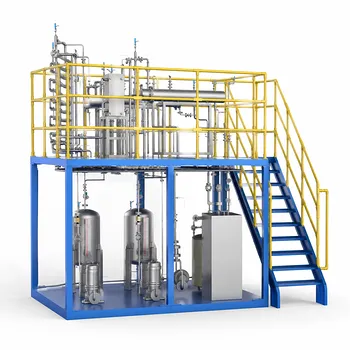
The operation and pedagogy of a unit operations pilot plant are, at their core, a physical manifestation of the laws of chemical thermodynamics. They transform abstract equations governing phase behavior into tangible, controllable processes. For a student or researcher, the pilot plant is not just a piece of hardware—it is a precision instrument that validates whether a theoretical model of molecular interactions can accurately predict the performance of an industrial-scale separation or reaction.
The fundamental challenge of process engineering is bridging the gap between molecular prediction and macroscopic reality. Chemical thermodynamics provides the theoretical map, defining the destination in terms of minimized Gibbs energy and equalized fugacities. The pilot plant validates this map, exposing its inaccuracies and teaching the critical judgment required to navigate between theory and industrial application.
The Physics of the Pilot Plant: More Than Just Operating Procedures
Operating a distillation column or reactor is not about turning valves randomly. It is a deliberate act of manipulating a system to satisfy strict thermodynamic criteria. Understanding this connection is the key to moving from a technician’s role to an engineer’s mindset.
The Fundamental Criterion: Phase Stability is a State of Minimum Energy
At constant temperature and pressure, a system is at equilibrium when its total Gibbs free energy is at a global minimum. This dictates everything you observe in a pilot plant.
A liquid-vapor system in a flash drum or on a distillation tray will spontaneously exchange molecules until this condition is met. The mathematical translation of this is the equality of fugacity for each component i in both the liquid (f_i^L) and vapor (f_i^V) phases.
By sampling the coexisting liquid and vapor streams from a pilot-scale equilibrium stage and measuring their temperature, pressure, and composition, you can calculate each phase's fugacity. This directly validates the abstract criterion that dG=0. The experiment makes the second law of thermodynamics visible.
From Activity Coefficients to Column Profiles
Computer simulations can calculate a full distillation profile in seconds, but they rely on activity coefficient models like Wilson, NRTL, or UNIQUAC. These models are not universally accurate.
In a pilot plant, you measure the actual liquid composition and temperature on each tray. With this data, you can back-calculate the real activity coefficients. This experimental data is then used to regress and refine the binary interaction parameters in the NRTL or UNIQUAC models, effectively calibrating the theory to reality. The pilot plant becomes the ultimate benchmark for the model.
Bridging the Gap: Using Pilot Plants to Calibrate Imperfect Theory
The most profound learning moment occurs when the pilot plant data disagrees with the process simulator. This failure of theory is not a problem; it is the entire point of the experiment.
Uncovering the Dependency on Precise Thermophysical Data
Separation processes are deeply non-linear. An error in relative volatility, stemming from an inaccurate energy balance, creates a cascading failure in column design. That energy balance is derived from enthalpy calculations, which themselves depend on the derivative of the phase equilibrium data.
A phase equilibrium model cannot be separated from its energy balance. By comparing a distillation column's experimental reflux ratio and reboiler duty to the values predicted by an equation of state, you learn that a small error in predicted vapor composition directly translates into a massive error in predicted heat load. The pilot plant reveals this hidden interdependency.
Experimentally Optimizing Reaction Equilibria
The van 't Hoff equation provides the theoretical framework for reaction temperature control, but pilot plants reveal the practical consequences. For an exothermic reaction like ammonia synthesis, the equation shows the equilibrium constant decreases with higher temperature.
A pilot-scale reactor with precise temperature control allows you to see this trade-off in real time. You can increase temperature to speed up the reaction rate, only to watch the final product yield drop as equilibrium limitations take hold. This physically demonstrates the critical optimization problem of balancing kinetics against thermodynamics, a lesson no textbook can convey as powerfully.
The Classroom as a Living Thermodynamic Model
Pilot plants transform the cryptic math of multicomponent thermodynamics, such as finding common tangent planes on Gibbs free energy surfaces, into a physical workflow.
Mapping Ternary Phase Behavior Experimentally
Constructing a ternary phase diagram from theory requires solving formidable equations to find the loci of tie-lines. In an educational pilot plant, this is done by conducting liquid-liquid extraction or crystallization experiments.
Students mix, settle, and sample the coexisting phases. By analyzing the compositions of the extract and raffinate or the solid crystals and mother liquor, they physically project a tie-line onto a composition diagram. Repeating this for different starting mixtures allows them to build the entire experimental binodal curve and map the tie-line field, demystifying the abstract concept of Gibbs energy minimization while revealing the reality of non-idealities like solutrope formation.
Understanding the Trade-offs
Relying on pilot plants to teach thermodynamics has limitations. It is not a perfect replacement for pure theory or full-scale industrial observation.
The most critical risk is mistaking a model deficiency for an equipment malfunction. When theoretical predictions don't match plant data, students often assume a leak or a sensor error. While possible, it’s more likely they are seeing the failure of an estimated binary interaction parameter or the model’s inability to predict a liquid phase split. A disciplined approach requires first eliminating model uncertainty before adjusting equipment.
Furthermore, a pilot plant's thermal profile and mixing efficiency create non-ideal flow patterns not accounted for in equilibrium-stage models. A perfectly insulated theoretical "stage" does not exist. The physical heat loss to the environment and the maldistribution of vapor through the packing invalidate the assumption of adiabatic equilibrium. Truly insightful students must learn to decouple thermodynamic error from hydraulic and kinetic effects.
Making the Right Choice for Your Goal
The role of the pilot plant is defined by your learning or research objective. You must align the operation with a specific thermodynamic question.
- If your primary focus is model validation: Deliberately operate at the boundaries of a model's predictive capability (e.g., dilute regions, azeotropic points) to capture highly sensitive experimental tie-line data for rigorous regression.
- If your primary focus is operational design: Use thermodynamic principle of fugacity equality not just for analysis, but to proactively set column pressures and temperatures that stabilize the separation window, confirming that the theoretical stability limit holds up under dynamic operation.
- If your primary focus is pedagogical demonstration: Focus on comparative experiments that directly correlate a measured physical property (like a temperature drop under vacuum) directly to the Clausius-Clapeyron equation, proving that vapor pressure is a thermodynamic state function, not just a number in a database.
The unit operations pilot plant remains the definitive crucible for chemical engineering knowledge, where the elegant world of equilibrium thermodynamics is forged against the messy, non-ideal reality of process engineering, producing a practical understanding that pure theory can never achieve alone.
Summary Table:
| Thermodynamic Concept | Pilot Plant Application | Real-World Engineering Benefit |
|---|---|---|
| Gibbs Free Energy & Fugacity | Sampling coexisting liquid/vapor phases | Validates phase stability models ($dG=0$) |
| Activity Coefficients | Measuring tray-by-tray compositions | Calibrates NRTL/UNIQUAC simulation parameters |
| van 't Hoff Equation | Controlling reactor temperature | Optimizes kinetics vs. thermodynamic yield |
| Ternary Phase Diagrams | Conducting liquid-liquid extraction | Maps experimental tie-lines & non-idealities |
Elevate Your Engineering Education and Research with LABPARK
Bridging the gap between molecular theory and macroscopic process engineering requires precision-built equipment. LABPARK provides state-of-the-art Educational and Vocational Unit Operations Pilot Plants in chemical engineering, bioprocess & biotech, and environmental & water treatment.
Designed specifically for universities, research institutes, and enterprises, our pilot plants empower students and researchers to validate thermodynamic models, calibrate simulation software, and master hands-on process operations.
Ready to upgrade your lab's capabilities? Contact us today to request a quote and see how LABPARK can transform your training and research outcomes.
Related Products
- Carbon Dioxide Hydrogen Methanol Synthesis Educational Unit Operations Pilot Plant
- Multi Pump Fluid Transport Process Piping Unit Operations Training Pilot Plant
- Natural Product Extraction Unit Operations Training Pilot Plant
- Multi-Modal Distillation Unit Operations Training Pilot Plant
- Multi-Reactor Educational Pilot Plant for Reaction Engineering Unit Operations
People Also Ask
- How do temp & pressure affect methanol synthesis pilot plants? Optimize equilibrium and catalyst performance.
- Why is a purge system necessary when operating a gas recirculation loop in a methanol synthesis pilot plant? (Guide)
- Why do modern methanol pilot plants operate at lower pressures? Catalyst & Feed Requirements Explained
- What are the operational requirements for catalyst activation? Safe Methanol Pilot Plant Operation
- Why is the chemical plant startup schedule crucial? De-risk scale-up with pilot plants.