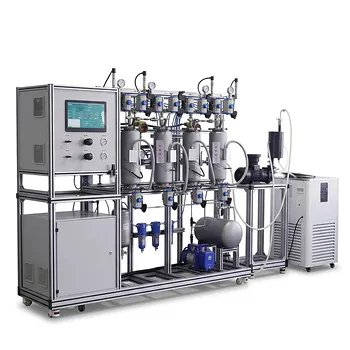
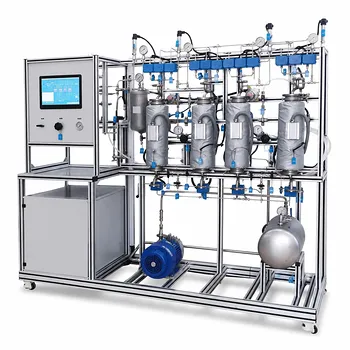
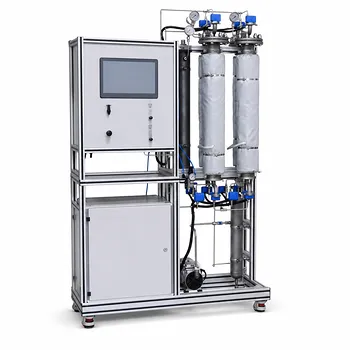
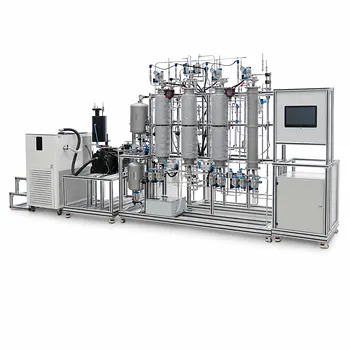
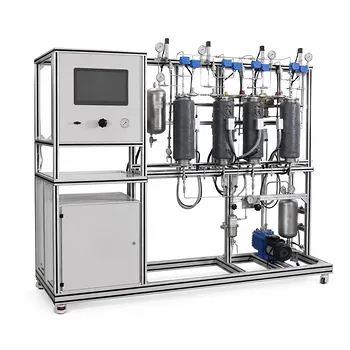
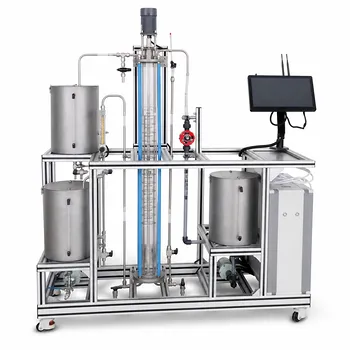
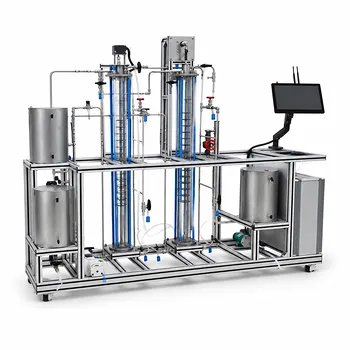
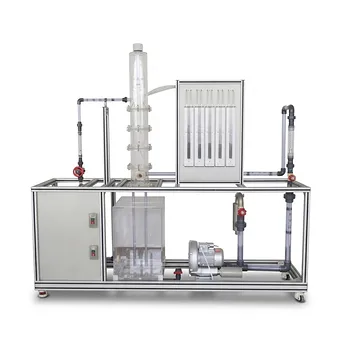
The defining choice of absorption solvent in commercial sulfuric acid manufacturing—using 96–98% sulfuric acid rather than water—is a direct answer to the costly problem of acid mist formation, and that same principle becomes the blueprint for designing and operating a pilot-scale absorption column.
When sulfur trioxide gas contacts water or weak acid, it instantaneously forms submicron sulfuric acid droplets that refuse to coalesce, creating a lost, corrosive plume. The industry bypasses this by absorbing SO₃ into concentrated acid, where the reaction stays in the liquid phase. A well-designed pilot plant mirrors this critical physical chemistry, allowing you to manipulate solvent concentration, temperature, and flow geometry to study mist suppression, absorption kinetics, and the real-world non-idealities that appear only when you faithfully replicate the industrial liquid phase.
The industrial switch from water to concentrated acid is not a minor solvent tweak—it is a fundamental phase-equilibrium mandate that eliminates gas-phase aerosol. For a pilot absorption column to generate meaningful engineering data, it must either recreate those concentrated, non-linear conditions or explicitly acknowledge the simplifications that distance it from the true industrial process.
Why Concentrated Acid, Not Water? The Industrial Necessity
The Mist Problem: Gas-Phase Hydrolysis vs. Liquid-Phase Absorption
When SO₃ vapor meets water vapor, the reaction occurs in the gas phase, producing myriads of sub-micron H₂SO₄ droplets that scatter light as a dense, stable mist.
This aerosol cannot be condensed by simple gravity or cyclonic forces; it must be electrostatically precipitated or scrubbed with extreme energy.
By absorbing SO₃ directly into 96–98% H₂SO₄, the chemistry shifts to the liquid phase, where the trioxide hydrates without forming persistent airborne droplets.
The initial absorption yields oleum or highly concentrated acid, which is then carefully diluted with water in a controlled downstream step to avoid crossing into the mist-producing concentration window.
The Absorber Design Consequences of That Choice
Because the solvent is a viscous, highly hygroscopic, and corrosive liquid, the column internals must resist chemical attack—hence industrial towers use acid-proof stoneware or quartz packing.
Liquid distribution becomes critical; uneven wetting of the packing creates local vapor paths where moisture can flash and nucleate mist, so distributors and redistributors are designed for high turndown and uniform film formation.
Temperature control is non-negotiable: the absorption reaction is extremely exothermic. Industrial columns recirculate acid through external coolers to keep the liquid temperature in a range that favors absorption equilibrium and avoids hot spots that could re-evaporate acid or accelerate corrosion.
Bridging to the Pilot Plant: What You Can Investigate
Replicating the Real System at Laboratory Scale
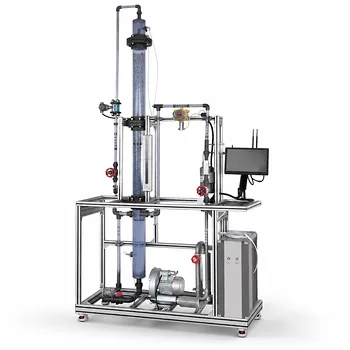
A purpose-built pilot absorption column allows you to run the same concentrated-acid, SO₃-rich gas stream as the full-scale plant, with the same packing materials, at measured L/G ratios.
Here you can directly observe how a modest drop in solvent concentration—say from 98% to 93%—suddenly triggers visible mist at the column outlet, a phenomenon impossible to quantify in a water-based simulator.
By varying gas velocity, you can map the flooding and weeping limits of a particular packing and correlate them with acid viscosity, giving engineers scale-up rules that are chemically faithful.
The Educational Simplification: Dilute Systems and Linear Approximations
Many unit operations pilot plants used for teaching deliberately avoid concentrated acids. Instead, they use dilute CO₂–water or ammonia–air systems.
In such dilute regimes, mole fractions and mole ratios are nearly equal, operating and equilibrium lines become linear, and simple expressions like (K_Y \approx K_G \cdot p) hold true. This lets students calculate HTU and NTU cleanly.
However, SO₃ absorption into concentrated sulfuric acid is highly non-linear: total gas and liquid flow rates change along the column due to chemical reaction and heat effects, making the simplified equations invalid.
A pilot plant that aims to teach real sulfuric acid production must therefore confront this complexity—or explicitly map how the dilute-system learnings diverge from industrial reality.
The Role of Exothermic Heat Management and Reaction Kinetics
The SO₃ absorption front generates significant heat, which can raise the local acid temperature enough to shift the vapor-liquid equilibrium and actually promote mist generation if cooling is inadequate.
In a pilot column, you might implement a jacketed glass section or an internal cooling coil to mimic industrial acid coolers, turning the column into a combined reactor–heat exchanger.
This thermal dimension directly connects to the earlier solvent choice: without the concentrated acid as a heat sink and reaction medium, the temperature profile across the packing would be meaningless for scale-up.
Understanding the Trade-offs in Pilot Plant Design
Faithful Replication vs. Safe, Teachable Simplicity
True industrial replication—using hot, 96% acid and SO₃—gives directly applicable performance data on mist formation, packing wetting, and corrosion rates, but demands exotic materials (glass, PTFE, or silicon carbide), rigorous safety protocols, and costly waste neutralization.
Dilute surrogate systems (e.g., NaOH scrubbing, CO₂ absorption) are inherently safer, require only simple stainless steel or plastic columns, and yield linear equilibrium relations that make mass-transfer coefficients easy to extract. Yet they completely mask the mist-forming mechanism and the non-linear, concentration-dependent hydrodynamics that dominate the industrial absorber.
The Hidden Cost of Over-Simplified Calculations
To keep math accessible, a pilot-plant instructor might use an air–water–ammonia system and assume constant molar overflow.
A student who then encounters a real sulfuric acid absorber will find that the total gas flow drops by 5–10% across the column as SO₃ is absorbed, that the liquid-phase reaction consumes water and changes the solvent’s physical properties, and that the mass-transfer coefficient is a strong function of acid concentration.
The educational gap is real; the design of an effective pilot program must explicitly reconcile the two worlds, either by using the real system in a safe, controlled environment or by presenting clear correction factors derived from the full-complexity case.
Making the Right Choice for Your Learning or Research Goal
- If your primary focus is scale-up or debottlenecking an industrial sulfuric acid absorber: Use a concentrated acid–SO₃ system in your pilot column, instrument it for temperature and concentration profiles, and deliberately probe the mist boundaries. Only this setup will give you the non-linear mass-transfer and hydrodynamic data needed for a reliable design.
- If your primary focus is teaching the fundamental principles of gas absorption: A dilute, benign system is acceptable, but you must dedicate a module to explaining how the industrial solvent choice alters the equilibrium, the flow geometry, and the very definition of a transfer unit. Use the pilot plant to compare linear and non-linear cases at least qualitatively.
- If your primary focus is developing new packing or materials for acid services: You have no shortcut—immerse the candidate packing in real process conditions, because wettability, acid film thickness, and corrosion behavior cannot be inferred from water tests. The pilot column becomes your accelerated test cell.
The absorbent in a commercial acid plant is not a minor detail but a phase-selection pivot that dictates the entire mass-transfer and aerosol-control strategy; your pilot column, in turn, must either embody that pivot or precisely account for its absence to yield actionable insight.
Summary Table:
| Parameter | Concentrated Acid System (Industrial/Real) | Dilute/Water System (Simplified) |
|---|---|---|
| Mist Formation | Prevented (liquid-phase reaction) | Severe (sub-micron aerosol mist) |
| Thermodynamics | Highly non-linear; variable molar flow | Linear equilibrium; constant molar flow |
| Materials | Acid-resistant (quartz, PTFE, stoneware) | Standard stainless steel or plastics |
| Application | Process scale-up & industrial research | Teaching fundamental absorption concepts |
Bring Real-World Chemical Engineering to Your Lab
To master complex industrial processes like gas absorption, students and researchers need hands-on experience with equipment that accurately simulates real-world thermodynamics. LABPARK offers premium Educational and Vocational Unit Operations Pilot Plants across chemical engineering, bioprocess & biotech, and environmental & water treatment.
Whether you are a university, research institute, or enterprise, our systems provide the safety, durability, and analytical precision required for advanced education and scale-up studies. Contact us today to request a quote or custom design!
Related Products
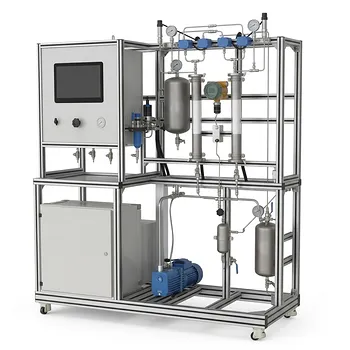
- Packed Bed Absorption Educational Unit Operations Pilot Plant
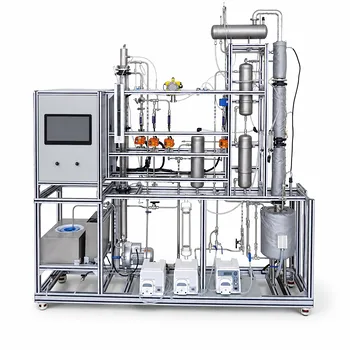
- Absorption and Desorption Educational Unit Operations Pilot Plant
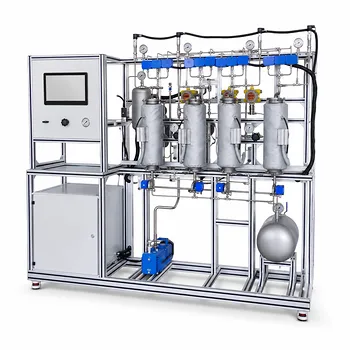
- Multimodal Absorption and Desorption Pilot Plant for Unit Operations Training
- Pressure Swing Adsorption Educational Unit Operations Pilot Plant
- Carbon Dioxide Absorption and Desorption Educational Pilot Plant for Carbon Capture Studies
People Also Ask
- How Do Flow Regimes Transition in Packed Bed Pilot Plants? Key Scale-up Insights
- How does reactant concentration determine absorption column control? Gas-film vs. dual-film.
- How is the packing height of an absorption column calculated? Master HTU & NTU Concepts
- How does static vs. operating holdup affect pilot plant calibration? Avoid Critical Scale-Up Errors
- Why is counter-current flow selected for gas absorption? Maximize Pilot Plant Efficiency