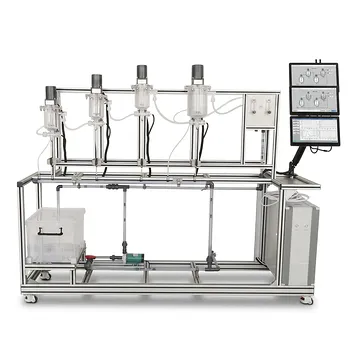
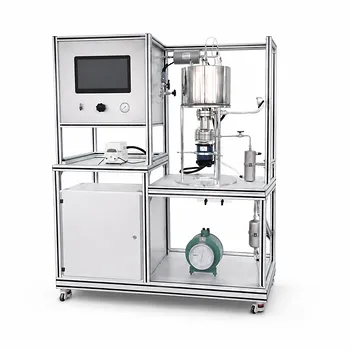
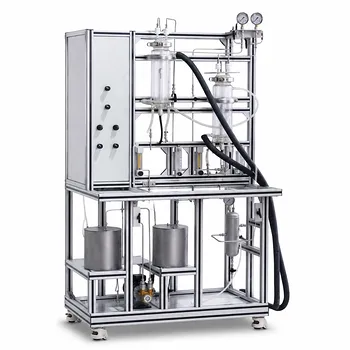
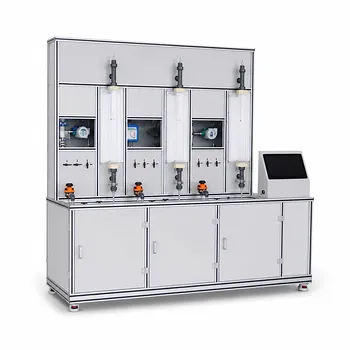
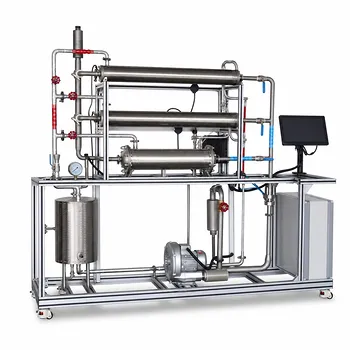
The choice of single-pass reactor conversion rate is a deliberate economic lever, not just a kinetic outcome, and it dictates the entire downstream design. In a unit operations pilot plant, high conversion often destroys selectivity by pushing the desired product into side reactions. Therefore, processes are purposefully designed with a low reactor conversion to preserve high selectivity for the target molecule. This creates a critical need for a separation system and a recycle loop to recover and reuse the massive amount of unreacted material, turning a low single-pass result into a high overall system efficiency.
The central trade-off is selectivity versus conversion. A pilot plant physically demonstrates that chasing high single-pass conversion can sabotage product yield by generating waste. The process solution is to operate the reactor at a low, "gentle" conversion to maintain high selectivity, while a downstream separation unit and recycle loop manage the large volume of unreacted feed, achieving near-total raw material utilization at the system level.
The Fundamental Trade-off: Why High Conversion Hurts Selectivity
The reactor is the heart of the pilot plant, but its optimal operating point is a compromise. The relationship between conversion and selectivity is often inverse, and understanding this is the core lesson of the unit operations experiment.
The Inverse Relationship in Reactors
In many reactions, especially those with a valuable intermediate, high concentrations of the desired product and a scarcity of reactants promote further reactions. This converts your product into unwanted by-products. For instance, in a series reaction path like $A \rightarrow R \rightarrow S$, where $R$ is your desired product, pushing for 99% conversion of $A$ almost guarantees that a significant portion of $R$ will react further to form waste product $S$. The pilot plant makes this visible through composition analysis at the reactor outlet.
Selectivity as a Profitability Multiplier
Selectivity measures the fraction of reacted raw material that became the desired product. A pilot plant operating at 90% selectivity but low conversion is often more economically viable than one with 50% selectivity and high conversion. Low selectivity means you are paying for raw materials that end up as waste, which requires costly separation and disposal. The pilot plant teaches that selectivity is the primary guardrail for raw material cost, which can be up to 80% of total production cost.
Recycle Loop Configuration: The Solution to Low Conversion
A low single-pass conversion is not a failure; it's a design strategy. The pilot plant configuration solves this through an integrated loop.
The Purpose of Downstream Separation
If the reactor only converts 20% of the feed per pass, the outlet stream is 80% unreacted material. This stream must immediately enter a separation unit, typically a distillation column. The separation unit has two missions: first, to purify the desired product and send it to product storage, and second, to prepare the unreacted material as a clean stream for recycling.
Closing the Loop for Overall Efficiency
The clean stream of unreacted reactants is pumped back to the reactor inlet, mixing with fresh feed to form the "Mixed Feed." This is the pivot from a disappointing single-pass performance to excellent system economics. In a pilot plant, students measure and calculate two metrics: the single-pass conversion (which is low, e.g., 20%) and the overall system conversion (which, after the loop reaches steady state, can approach 98%). The recycle loop physically embodies the principle of mass conservation and turns a raw material waste problem into a near-total utilization success.
Reactor Configuration's Direct Impact on Selectivity and Design
The physical choice of reactor isn't arbitrary; it's a tool to enforce the required selectivity, which then defines the separation challenge.
Matching Reactor Type to Reaction Pathway
For a series reaction ($A \rightarrow R \rightarrow S$), preventing the over-reaction of $R$ is critical. This requires a reactor with minimal backmixing and a tightly controlled residence time. A pilot-scale venturi loop reactor or a spray tower is selected over a bubble column precisely for this reason. The design ensures that product $R$ is quickly removed from the reactive environment, "freezing" its selectivity by preventing contact with fresh feed.
The Downstream Ripple Effect of Reactor Conditions
The reactor’s product distribution is the downstream unit's input problem. A low-temperature, fixed-bed reactor might produce a heavy, waxy product, requiring robust liquid-solid separation. A high-temperature, fluidized-bed reactor yields lighter hydrocarbons and olefines, making gas-solid cyclones and condensation systems essential. In the pilot plant, swapping reactor types directly changes the operating procedure and energy requirements of the entire downstream separation train.
Understanding the Trade-offs and Common Pitfalls
A pilot plant makes theoretical trade-offs tangible. The goal is to identify the system-wide optimum, not to perfect a single unit in isolation.
The Per-Pass Yield Illusion
The equation Yield = Conversion × Selectivity is a daily calculation in the control room. The pitfall is maximizing conversion to improve yield, only to discover that selectivity has plummeted. The pilot plant generates real-time data showing this mathematical relationship in action, proving that peak yield often occurs at a moderate conversion "sweet spot" where selectivity is still strong. High selectivity alone is useless if it requires a capital-intensive separation system to handle an enormous recycle flow.
Distinguishing Reactor Targets from System Targets
When an expensive recycle loop is in place, the focus shifts. The reactor's job is no longer maximum single-pass yield. Instead, the reactor's target becomes pure selectivity—minimizing byproduct formation. The system yield target, which accounts for raw material loss in recovery and purification, is met by the loop's efficiency. This distinction is critical for pilot plant data analysis: a reactor's performance is judged on its selectivity, not its conversion, in a closed-loop system.
Limits of Thermodynamics vs. Kinetics
Operators must also understand that the chemical equilibrium constant ($K$) is a thermodynamic limit that cannot be changed by catalyst or pressure. However, the conversion rate can be shifted kinetically by using an excess of one cheap reactant. A pilot plant might demonstrate driving conversion of a valuable reactant from 60% to 95% by flooding the reactor with an excess of the other, simpler reactant, without altering the reaction's fundamental equilibrium.
Making the Right Choice for Your Pilot Plant Goal
Your strategy for setting conversion, configuring the reactor, and sizing the recycle pump depends entirely on your primary objective for the pilot study.
- If your primary focus is maximizing product purity and minimizing waste: Operate the reactor at a deliberately low conversion to maintain extremely high selectivity. Accept the need for a large-capacity recycle loop, as the system-wide economics are driven by raw material savings.
- If your primary focus is evaluating catalyst longevity or deactivation: A bias toward higher single-pass conversion might be relevant, as the reactor environment is fundamentally different with higher product concentrations. The recycle loop must still be present for economic realism, but the reactor's stress condition is the key output variable.
- If your primary focus is demonstrating process intensification: Explore reactor designs like packed towers or venturi loops that inherently suppress side reactions, allowing slightly higher conversion without the typical selectivity penalty, thereby reducing the energy load on the separation and recycle system.
A pilot plant is a scaled-down economic model where every pump, heat exchanger, and column demonstrates the cost of the reactor's molecular decisions.
Summary Table:
| Design Parameter | High Single-Pass Conversion | Low Single-Pass Conversion (with Recycle Loop) |
|---|---|---|
| Product Selectivity | Low (high waste/byproduct formation) | High (preserves target intermediate) |
| Downstream Operation | Lower volume, complex purification | High volume recycle, clean separation |
| Overall System Yield | Low overall efficiency | Near-total raw material utilization (~98%) |
| Reactor Control Target | Maximum single-pass yield | High selectivity (minimizing side reactions) |
Optimize Process Engineering Education with LABPARK
Bridge the gap between theoretical chemical kinetics and industrial reality. LABPARK provides state-of-the-art Educational and Vocational Unit Operations Pilot Plants in chemical engineering, bioprocess & biotech, and environmental & water treatment for universities, research institutes, and enterprises. Our systems physically demonstrate the critical dynamics of reactor conversion, selectivity, and recycle loop configuration.
Ready to upgrade your lab's teaching and research capabilities? Contact us today to explore our pilot plant solutions!
Related Products
- Multi Functional Catalytic Reaction and Reactor Evaluation Educational Unit Operations Pilot Plant
- Residence Time Distribution and Reactor Flow Characteristics Determination Educational Pilot Plant
- 100L Continuous Loop Hydrogenation Educational Unit Operations Pilot Plant
- Tubular Reactor Flow Characteristics Determination Educational Unit Operations Pilot Plant
- Multi-Stage Stirred Tanks in Series Residence Time Distribution and Mixing Performance Determination Educational Pilot Plant
People Also Ask
- What reaction engineering principles are shown in a catalytic reactor pilot plant? SO2 Oxidation Guide
- Why is FTIR integration in catalytic pilot plants important? Real-Time Student Insights
- How to analyze active metal distribution & identify catalyst poisoning in pilot plants? Expert Diagnostic Guide
- How do temperature limits and WHSV influence catalytic reactor optimization? Scale-Up Guide
- Why is XPS Critical for Catalytic Reactor Pilot Plants? Optimize Catalyst Performance