Here’s the elegant thermodynamic principle that makes it perfectly safe to splice standard copper wire into a thermocouple circuit. The Law of Intermediate Metals states that inserting a third metal into a thermocouple loop creates no net change in the measured voltage—provided both ends of that new conductor are at the exact same temperature. This means you can transition from expensive thermocouple extension wire to ordinary copper wire at a terminal block, run that copper all the way back to a control-room PLC or data logger, and not degrade measurement accuracy, as long as the terminal block itself is isothermal.
The Law of Intermediate Metals lets you replace costly thermocouple alloy wiring with standard copper between the reference junction and the instrument, without introducing a voltage error—on one critical condition: the two junctions where copper meets the thermocouple circuit must be held at identical temperatures.
Understanding the Law of Intermediate Metals
This law is not a minor exception—it’s a direct consequence of how thermoelectric EMF is generated. To use it safely in a pilot plant, you need to see exactly why it works and where the hidden pitfalls lie.
The Thermodynamic Basis in Plain Language
A thermocouple’s voltage comes from two effects. The Seebeck effect generates a tiny EMF in each wire whenever one end is hotter than the other. The total loop voltage is the sum of these contributions from both thermocouple alloys.
When you insert a third metal, you create two new junctions. If those two junctions sit at the same temperature, the Seebeck voltages they generate in the new metal are equal in magnitude but opposite in direction. They cancel perfectly. The net loop EMF remains identical to what you would have measured without the third metal.
Why It Works: Junctions, Not Just Metals
The key insight is that the law refers to temperatures at the junctions, not the length of wire. You can run copper for 100 meters or 1 centimeter—the distance doesn’t matter. What matters is that the two points where copper enters and leaves the thermocouple circuit are thermally identical.
The Distinction from Extension Wire
Thermocouple extension wire uses alloys with matching thermoelectric properties, not identical composition. Copper, on the other hand, is a completely different third metal. The law of intermediate metals is what specifically gives you permission to use it—something that would otherwise violate the basic rules of thermocouple loops.
Why This Matters in Pilot Plant Control Systems
Pilot plants combine experimental flexibility with a need for reliable data. The law of intermediate metals unlocks several practical benefits that directly lower cost and improve adaptability.
Connecting to Standard Industrial Inputs
Most PLC analog input cards, data acquisition modules, and panel meters use copper terminals and are designed to accept a voltage signal. By proving that copper can be inserted without error, the law lets you terminate the thermocouple circuit directly into these standard, copper-based inputs.
Simplifying Cable Infrastructure
Thermocouple extension wire is expensive and often not available in multi-pair configurations suitable for long tray runs. With the law, you can transition to low-cost, shielded twisted-pair copper cable at a convenient junction box near the process, then run standard plant cabling to the control system.
Enabling Flexible Reconfiguration
Pilot plants frequently change. You might move a reactor from Bay 3 to Bay 7 and need longer wiring. Copper is far easier to splice, extend, and repurpose than thermocouple wire. The law gives you the engineering confidence to treat the reference junction as a clean demarcation point, beyond which you can use commodity wiring.
The Critical Condition: Isothermal Reference Junctions
The entire principle rests on one non-negotiable condition. If it is violated, the measurement will drift, and troubleshooting in a pilot plant can become a nightmare of intermittent errors.
What “Isothermal” Really Means
The two copper-to-thermocouple junctions must be at exactly the same temperature, not merely “about the same.” Even a 1°C difference creates an error. In a Type K thermocouple, a 1°C gradient across the copper junctions can introduce roughly 40 µV of error, which for a Type K is about 1°C—a significant offset in many processes.
Practical Ways to Enforce Isothermality
An isothermal terminal block is the gold standard. This is a solid metal bar, often gold-plated, inside a junction box that provides high thermal conductivity between all terminals and includes a mounting point for the cold-junction compensation (CJC) sensor.
In less demanding cases, a tightly lidded junction box in a stable, draft-free area can be sufficient, as long as a precision thermistor or RTD is thermally bonded to the terminal point. The goal is to minimize thermal gradients, not just shield the terminals from large temperature swings.
Why the Reference Junction Location Matters
Never place the transition point where a hot exhaust fan blows on one side of the box, or where one terminal sits in direct sunlight. In a pilot plant, temporary setups often ignore thermal stability. That’s the most common root cause of “mystery” 2-degree offsets that operators later blame on the instrument.
Understanding the Trade-offs and Pitfalls
Every elegant principle has a dark side if applied carelessly. The law of intermediate metals is no exception.
Cold Junction Compensation (CJC) Becomes Paramount
The law removes errors from the copper junctions but does nothing to compensate for the original thermocouple cold junction. Once you’ve created a copper transition point, that location becomes your effective reference junction. You must measure its temperature accurately and apply a compensating voltage. If the CJC sensor is poorly placed or slow to respond, the entire measurement chain is compromised.
Not All Copper is Created Equal
Oxidized or contaminated copper terminals can introduce small, galvanic-like voltages that swamp the thermocouple microvolt-level signal. Use high-quality, clean terminal blocks, and avoid mixing metals. A brass screw terminal with a copper bus bar may be fine, but a nickel-plated terminal can introduce additional Seebeck voltages if it creates a secondary junction at a slightly different temperature.
When to Avoid Copper Even If the Law Permits It
For extremely high-precision measurements (e.g., calorimetry in a pilot reactor), the assumption of perfect isothermality may simply not hold well enough. The tiny residual gradients in a terminal box can introduce errors that, while small, exceed your required accuracy. In such cases, running thermocouple extension wire all the way to the instrument eliminates that particular risk.
Making the Right Choice for Your Pilot Plant
Whether you should rely on the law of intermediate metals to integrate copper wiring comes down to your specific measurement needs and plant realities. Here’s how to decide.
- If your primary focus is minimizing wiring cost and complexity: Use an isothermal terminal bar in a protected junction box near the process, transition to standard shielded copper cable, and place your CJC sensor directly on the bar. This is the classic, proven approach for most pilot plant loops.
- If your primary focus is the highest possible accuracy over a wide ambient range: Run thermocouple extension wire all the way to the instrument’s terminal block, where the instrument itself provides precision CJC in a controlled, single-box environment. This sidesteps any residual gradient concern entirely.
- If your primary focus is rapid reconfiguration in a temporary pilot setup: Use pre-built isothermal reference junction boxes with integrated CJC sensors. Plug your thermocouple into one side, standard copper into the other, and treat each box as a disposable, pre-calibrated asset—fast, repeatable, and far less error-prone than field-terminated screw terminals.
This single thermodynamic law transforms what feels like a wiring limitation into a deliberate design choice—giving you the freedom to build measurement loops that are as practical as they are accurate.
Summary Table:
| Key Aspect | Details | Impact on Pilot Plants |
|---|---|---|
| Core Principle | Law of Intermediate Metals | Allows splicing copper wire without affecting net loop voltage |
| Critical Condition | Isothermal Junctions | Copper-to-thermocouple joints must be kept at identical temperatures |
| Main Advantages | Lower Cost & Flexibility | Simplifies plant cabling, supports standard PLC inputs, and eases routing |
| Key Risks | Thermal Gradients & CJC Errors | Drifts if junctions differ; demands precise Cold Junction Compensation |
Optimize Your Pilot Plant Projects with LABPARK
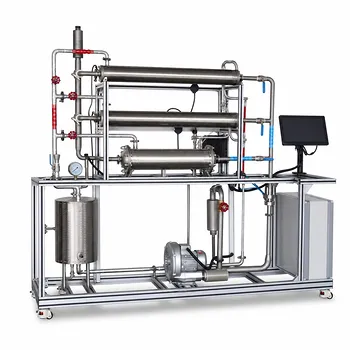
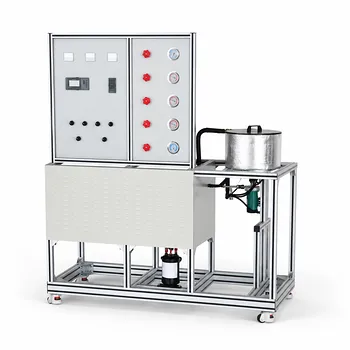
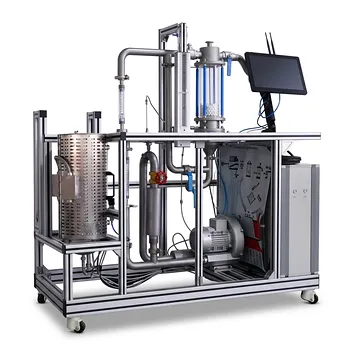
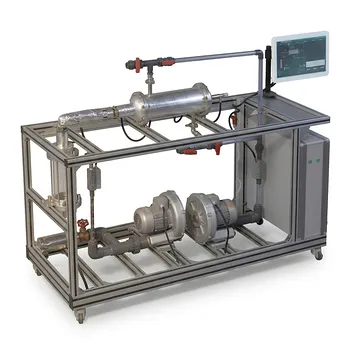
Achieving precise measurement and control in pilot systems requires both theoretical expertise and robust equipment. LABPARK provides high-quality Educational and Vocational Unit Operations Pilot Plants in chemical engineering, bioprocess & biotech, and environmental & water treatment designed specifically for universities, research institutes, and enterprises. Our systems ensure seamless instrumentation integration, reliable data acquisition, and maximum educational value.
Ready to upgrade your laboratory or pilot plant with industry-grade systems?
👉 Contact us today to discuss your custom project requirements!
Related Products
- Comprehensive Heat Transfer Coefficient Determination Educational Unit Operations Pilot Plant
- Educational Compression Refrigeration Performance Determination Unit Operations Pilot Plant
- Solid Spherical Heat Transfer Coefficient Determination Educational Chemical Engineering Pilot Plant
- Shell and Tube Heat Exchanger Heat Transfer Coefficient Determination Educational Pilot Plant
- Three-Tube Heat Transfer Educational Pilot Plant for Unit Operations Training
People Also Ask
- When is ε-NTU preferred over LMTD in pilot plants? Predict heat exchanger performance without iteration.
- How do unit conversions affect pilot plant calibration? Avoid errors in heat transfer data analysis
- Why is the prevention of scale formation on heat exchanger surfaces a critical learning objective? Key Lessons
- How can a heat transfer pilot plant demonstrate waste heat recovery? Learn to optimize industrial thermal systems.
- Why is emissivity critical in heat transfer pilot plants? Bridge the Gap Between Theory & Industrial Design