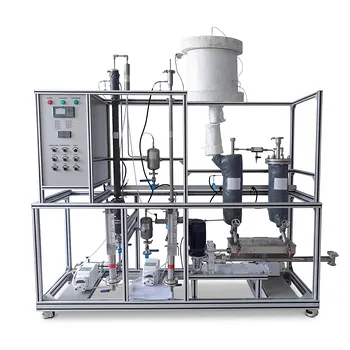
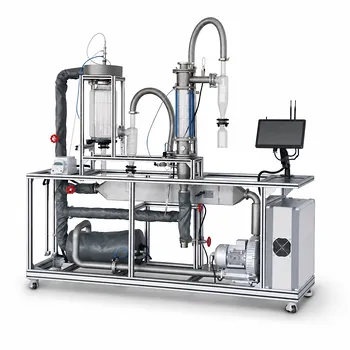
The core thermodynamic mechanism is simple but profound: adding steam to a hydrocarbon cracking reactor lowers the partial pressure of the hydrocarbon reactants. Because the primary cracking reactions are endothermic and increase the total number of molecules, a reduction in reactant partial pressure directly shifts the equilibrium toward higher alkene product yields at a given temperature. In a unit operations pilot plant, steam dilution is not a compromise—it is a deliberate thermodynamic tool that mimics vacuum operation without the associated engineering complexity.
The introduction of steam dilution in hydrocarbon steam cracking is a direct application of Le Chatelier’s principle: by lowering the partial pressure of the reactants, the equilibrium is driven toward the volume‑increasing, endothermic primary reactions, dramatically boosting alkene conversion. This effect is central to pilot plant studies, enabling students and researchers to explore how a simple dilution ratio governs equilibrium yields, temperature profiles, and secondary reaction suppression.
The Thermodynamic Imperative: Why Volume‑Increasing Reactions Need Low Pressure
Hydrocarbon steam cracking is a radical‑dominated process that converts saturated alkanes into olefins and hydrogen. Each primary cracking step, such as the dehydrogenation of ethane, reduces one reactant molecule to two product molecules.
The Le Chatelier Link Between Pressure and Conversion
For any reaction that increases the total number of moles, a reduction in pressure forces the equilibrium to favor the product side. In a fixed‑volume reactor operated at high temperature, the “pressure” that matters for equilibrium is the partial pressure of the reactive hydrocarbons.
Introducing an inert gas like steam dilutes the system, instantly dropping the hydrocarbon partial pressure without changing the total pressure of the pilot reactor. This thermodynamically shifts the conversion in the same direction that a vacuum would, but with far simpler hardware.
Why Lower Partial Pressure Also Suppresses Secondary Cracking
Secondary polymerization and coke‑forming reactions are volume‑decreasing processes—they produce fewer, heavier molecules. By holding the hydrocarbon partial pressure low, the thermodynamic driving force for these undesirable pathways is weakened.
Thus, steam dilution simultaneously enhances the yield of valuable light olefins and thermodynamically suppresses the reactions that foul the reactor walls—an elegant, two‑in‑one benefit visible even at the educational pilot scale.
Steam as the Ideal Diluent in a Pilot Plant Environment
Steam is not an arbitrary choice. Its physical properties make it the perfect thermodynamic partner for a pilot‑scale cracking reactor, where precise control and easy product separation are paramount.
Low Molecular Weight Maximises the Dilution Effect
The partial pressure reduction depends on the mole fraction of hydrocarbons in the gas mixture. Steam has a very low molecular weight, so a small mass of steam provides a large molar dilution, efficiently minimising the hydrocarbon partial pressure while keeping the total mass flow manageable.
High Heat Capacity Stabilises the Endothermic Reaction
Primary cracking is highly endothermic. Steam’s high heat capacity allows it to carry significant thermal energy into the reaction zone, counteracting the local temperature drop that would otherwise shift the equilibrium backward and slow the reaction rate.
In a pilot plant, this means students can observe stable temperature profiles even as they vary the steam‑to‑hydrocarbon ratio, isolating the thermodynamic effect from thermal runaway.
Effortless Separation and Corrosion Inhibition
Steam condenses easily out of the product stream without degrading hydrocarbons. In an educational pilot plant, this simplifies sampling and mass‑balance calculations, while also protecting stainless‑steel reactor tubes from sulphur‑induced corrosion—a practical advantage that keeps the focus on the thermodynamic demonstration.
From Theory to Practice: How Dilution Ratios Govern Conversion and Selectivity
The thermodynamic shift is not all‑or‑nothing; it is meticulously tunable. In a unit operations pilot plant, the steam‑to‑oil ratio (kg steam per kg feedstock) is the primary knob that translates thermodynamic principle into measurable performance.
Matching the Dilution Ratio to Feedstock Coking Tendency
Lighter feeds like ethane and propane have a low intrinsic coking tendency and require only modest dilution ratios (typically 0.25–0.40 and 0.3–0.5 kg/kg, respectively). Heavier or more aromatic feedstocks such as light diesel demand ratios of 0.75–1.0 kg/kg, while crude oil may require 3.5–5.0 kg/kg.
These ratios are not safety margins; they are thermodynamic necessities to keep the hydrocarbon partial pressure low enough that equilibrium favours cracking over coke formation. In the pilot plant, running side‑by‑side experiments with different ratios makes this relationship visible through changes in ethylene yield and coking rate.
Visualising the Impact on Carbon Number Distributions
By varying the steam dilution, students using a pilot plant can sample products and generate carbon number distribution curves. Lower dilution ratios yield a broader product slate with more heavy residue, while optimal dilution shifts the distribution dramatically toward light olefins—an immediate, graphical confirmation of the thermodynamic principle.
Understanding the Trade‑offs
While steam dilution is thermodynamically powerful, pilot plant operators must be aware of the balance it demands. Chasing ever‑higher ratios is not automatically beneficial.
The Heat‑Input Dilemma
A high steam ratio means more energy is absorbed simply to heat the steam to reaction temperature. This can pull heat away from the cracking reaction itself, potentially lowering the effective reaction temperature if the furnace duty is fixed. In pilot‑plant exercises, students observe that an “ideal” ratio exists where the thermodynamic gain from lower partial pressure is not outweighed by the thermal burden.
Dilution Ratio vs. Residence Time
Adding more steam increases the total volumetric flow, which reduces the residence time of the hydrocarbons in the hot zone. While this can help suppress over‑cracking, it also means the equilibrium conversion may not be fully approached. The pilot plant becomes a tool to study this kinetic‑thermodynamic coupling: how to balance dilution to maximise alkene yield without starving the reaction of the time it needs.
Making the Right Choice for Your Pilot Plant Demonstration
The introduction of steam dilution is your most direct lever to demonstrate thermodynamic control over an industrial‑scale reaction. To tailor this demonstration to your educational or research goal, consider the following:
- If your primary focus is maximising ethylene yield: Use a medium‑to‑high steam‑to‑oil ratio (e.g., 0.5–1.0 kg/kg for gas feeds) and hold the reactor temperature steady. Measure the outlet gas composition to show how conversion increases sharply when partial pressure is lowered.
- If your primary focus is understanding coking suppression: Run two identical feedstock batches with low and optimal steam ratios, then inspect the reactor tube or pressure drop. Document how the thermodynamic suppression of secondary reactions directly prolongs run length.
- If your primary focus is temperature profiling in endothermic reactions: Map the axial temperature gradient with different steam rates. Illustrate how steam’s heat capacity buffers the temperature drop, allowing the equilibrium shift to be decoupled from thermal quenching.
- If your primary focus is feedstock flexibility: Systematically vary steam dilution across light and heavy feedstocks, constructing the carbon number distribution curves. Demonstrate why heavier feeds demand higher dilution to achieve the same olefin selectivity.
By treating steam dilution as a thermodynamic instrument, not just an operating utility, your pilot plant becomes a powerful classroom for equilibrium‑driven process intensification.
Summary Table:
| Feedstock Type | Typical Dilution Ratio (kg/kg) | Primary Thermodynamic Objective |
|---|---|---|
| Lighter Feeds (Ethane/Propane) | 0.25 – 0.50 | Optimize alkene yields with minimal coking risk |
| Heavier Feeds (Light Diesel) | 0.75 – 1.00 | Lower partial pressure to suppress coke formation |
| Heavy/Crude Oil | 3.50 – 5.00 | Heavily shift equilibrium away from secondary polymerization |
Bring Industrial Thermodynamics to Life in Your Lab
Looking to demonstrate complex process principles like steam cracking in your curriculum or research? LABPARK provides state-of-the-art Educational and Vocational Unit Operations Pilot Plants in chemical engineering, bioprocess & biotech, and environmental & water treatment. We help universities, research institutes, and enterprises bridge the gap between theory and industrial reality with safe, scalable, and highly instrumented systems.
Contact LABPARK today to request a catalog or discuss a custom pilot plant configuration for your laboratory!
Related Products
- Methane Cracking Educational Unit Operations Pilot Plant
- 100L Continuous Loop Hydrogenation Educational Unit Operations Pilot Plant
- Steam Methane Reforming Hydrogen Production and Purification Educational Pilot Plant
- Crude Benzene Hydrogenation Educational Unit Operations Pilot Plant
- Dual-Mode Rectification Pilot Plant for Practical Training Unit Operations
People Also Ask
- How do ethane vs naphtha cracking influence teaching pilot plant analytical configurations? Key Design Guide
- How can flow-NMR be integrated with pilot plant reactors to monitor kinetics? A Complete Guide
- How do cracking temperature and residence time affect olefin yield? Pilot Plant Guide
- How are utility consumption rates integrated into chemical pilot plant economic evaluations?
- How should OSBL investments be estimated? Key Steps to Avoid Budget Overruns in Pilot Plant Projects