Knowledge Resources How does identifying metallic deposits assist in pilot plant monitoring? Diagnostic Guide
Author avatar

Tech Team · LABPARK

Updated 2 months ago

How does identifying metallic deposits assist in pilot plant monitoring? Diagnostic Guide


Your pilot plant is a physical model of a chemical process, but its hidden story is written in the deposits it leaves behind. The identification of specific metallic deposits like copper or vanadium acts as a forensic fingerprint, directly revealing otherwise invisible issues in unit operations. By quantifying these trace metals, students and researchers gain the diagnostic power to pinpoint material corrosion, identify upstream contamination sources, and optimize the process chemistry in real time, transforming a passive lab exercise into an active investigation of system health.

Analyzing the metal content of scale and fouling deposits is a foundational diagnostic skill. It converts a maintenance chore into a source of actionable intelligence, allowing operators to trace copper back to heat exchanger wear or vanadium to combustion inefficiencies without shutting down and disassembling the entire pilot plant.

Decoding the Messages in Deposits

Every metallic element found in a pilot plant’s scale or sludge tells a specific origin story. Understanding these narratives is what turns deposit analysis from a simple analytical task into a core competency for monitoring unit operations.

Copper: The Corrosion Indicator

The presence of copper is an unequivocal warning sign. In a pilot plant, it almost always indicates active corrosion of brass or Monel components—materials commonly found in piping, valves, and heat exchanger tubes. Its detection allows students to calculate corrosion rates, predict maintenance needs, and immediately correlate the metal loss with operational parameters like pH, flow velocity, or temperature excursions.

Vanadium: The Combustion and Catalyst Marker

Vanadium is a high-temperature messenger. If your pilot plant involves combustion processes, finding vanadium deposits typically points to residual fuel oil combustion, as crude oils contain porphyrin-bound vanadium. In catalytic reactor setups, it can signal the physical attrition and carry-over of vanadium-based catalyst materials. Monitoring its levels teaches researchers to assess furnace efficiency and catalyst bed integrity.

Iron and Molybdenum: The Broad-Spectrum Witnesses

While copper and vanadium are highly specific, other metals like iron and molybdenum tell broader stories of system-wide corrosion and chemical carry-over. Iron often indicates the baseline corrosion of carbon steel piping. Molybdenum can be a marker for specialized alloy corrosion or, in specific processes, a trace contaminant from catalysts. Systematically separating and quantifying these species—using reagents like cupferron or alpha-benzoinoxime—provides a complete map of the plant’s material balance.

Building a Diagnostic Mindset

The true value for students and researchers lies not in the data itself, but in the analytical framework it builds. Deposit identification teaches the integration of mass and energy balances with practical materials science.

Connecting Conservation Laws to Real-World Fouling

Pilot plants make the principles of conservation of mass visible. When the mass of a metal entering the system does not equal the mass exiting, the difference often accumulates as a deposit on a heat exchanger or membrane. By quantifying that metallic deposit, students close the mass balance and, more importantly, see the direct consequence of that accumulation: reduced thermal efficiency, increased pressure drop, and process upsets.

From Reactive to Proactive Monitoring

Training on these analytical techniques shifts a student’s perspective from reactive troubleshooting to proactive process control. Instead of simply noting a drop in heat transfer, they learn to sample the scale, detect vanadium, and trace it back to an air-fuel ratio problem in the combustor. This ability to link a chemical signature to a specific operational root cause is the essence of effective plant monitoring.

Understanding the Trade-offs and Limitations

This technique is powerful, but like any diagnostic tool, it has boundaries that students must understand to apply it judiciously.

  • It is a Historical Record, Not a Real-Time Sensor: Deposit analysis reveals what has already occurred. You spot the copper after corrosion has started. For dynamic process control, it must be paired with continuous inline sensors for instant feedback.
  • Sample Integrity is Everything: A sample contaminated by zinc (from galvanized tools) or taken from an unrepresentative location can lead to a false diagnosis. Rigorous sampling protocols are the non-negotiable foundation of any correct interpretation.
  • It Raises “How” But Not Always “Why” Immediately: Finding copper tells you corrosion is active, but it doesn’t tell you if the root cause is low-pH acidic attack or high-chloride pitting. Students must combine the metal’s identity with process condition logs to confirm the mechanism.

Making the Right Choice for Your Educational or Research Goal

The monitoring goal dictates the analytical focus you should prioritize in a pilot plant exercise.

  • If your primary focus is diagnosing material degradation: Prioritize quantifying copper and iron. Set clear baseline levels and track any increase against changes in process fluid chemistry.
  • If your primary focus is optimizing combustion or catalyst performance: Concentrate on vanadium. Map its presence to fuel batches and operating temperatures to understand thermal conversion efficiency and catalyst attrition patterns.
  • If your primary focus is preventing fouling and scaling: Establish a routine protocol for bulk elemental analysis using precipitation methods. Focus on calcium, iron, and silica to evaluate anti-scalant dosing strategies and water chemistry.

By teaching the art of reading these metallic fingerprints, you transform a pilot plant from a simple demonstration tool into a powerful diagnostic environment where every crusted deposit becomes a data point for building safer, more efficient industrial processes.

Summary Table:

Metal Deposit Primary Source / Indicator Diagnostic Value & Action
Copper Brass or Monel component corrosion Calculate corrosion rates; optimize pH & flow velocity
Vanadium Fuel oil combustion or catalyst attrition Assess combustion efficiency; monitor catalyst bed integrity
Iron & Molybdenum Carbon steel corrosion / alloy degradation Map baseline system wear; track chemical carry-over

Optimize Your Lab's Hands-On Training with LABPARK

Bridge the gap between theory and practical diagnostic skills. LABPARK provides state-of-the-art Educational and Vocational Unit Operations Pilot Plants in chemical engineering, bioprocess & biotech, and environmental & water treatment. Designed specifically for universities, research institutes, and enterprises, our systems empower students and researchers to master real-world process monitoring, maintenance, and troubleshooting.

Ready to elevate your engineering lab? Contact LABPARK today to find the perfect pilot plant solution for your educational or research goals!

Related Products

People Also Ask

Related Products

Multi Functional Catalytic Reaction and Reactor Evaluation Educational Unit Operations Pilot Plant

Multi Functional Catalytic Reaction and Reactor Evaluation Educational Unit Operations Pilot Plant

Bench-scale educational pilot plant for catalytic reaction and reactor evaluation, integrating fixed bed, fluidized bed, and stirred tank reactors. Students compare reactor designs, evaluate catalysts, and study reaction kinetics and hydrodynamics. Perfect for unit operations labs in chemical engineering curricula.

Electrolyte Distillation Purification and Formulation Educational Pilot Plant

Electrolyte Distillation Purification and Formulation Educational Pilot Plant

Integrated bench-to-pilot scale educational pilot plant for electrolyte distillation, purification, and formulation with borosilicate glass construction, PLC automation, touchscreen HMI, and advanced industrial safety features for hands-on chemical process training, ideal for chemical engineering and materials science curricula.

Gallium and Indium Selective Extraction Educational Pilot Plant

Gallium and Indium Selective Extraction Educational Pilot Plant

Integrated pilot-scale laboratory system for engineering education bridging theoretical concepts with industrial practice enabling hands-on study of liquid liquid extraction reaction kinetics and mass transfer for selective gallium and indium separation featuring real-time IoT connectivity with integrated safety

Rising and Falling Film Evaporation Educational Unit Operations Pilot Plant

Rising and Falling Film Evaporation Educational Unit Operations Pilot Plant

Hands-on educational pilot plant for studying rising and falling film evaporation, flow regimes, and heat transfer. Customizable for university labs with industrial instrumentation and data acquisition. Enables comparative evaluation of evaporation modes and energy efficiency.

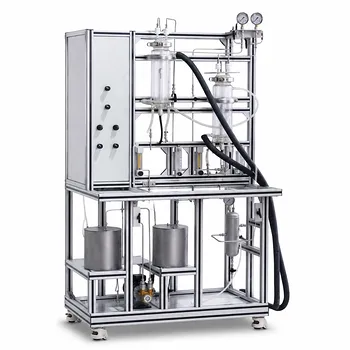
Multi-Functional Special Distillation Educational Pilot Plant

Multi-Functional Special Distillation Educational Pilot Plant

Versatile multi-functional special distillation pilot plant for chemical engineering education. Supports continuous, vacuum, azeotropic, reactive, extractive distillation. Transparent glass columns enable real-time visual observation of hydrodynamics and separation processes.

Continuous Batch Extractive Distillation Educational Pilot Plant

Continuous Batch Extractive Distillation Educational Pilot Plant

Versatile pilot plant for continuous, batch, and extractive distillation training. High-borosilicate glass column for visualizing hydraulics, 15.6-inch touchscreen with data logging, precise reflux ratio control 1-99, and durable corrosion-resistant frame. Ideal for chemical engineering education and process research.

Educational Rotary Disc Liquid-Liquid Extraction Pilot Plant

Educational Rotary Disc Liquid-Liquid Extraction Pilot Plant

A transparent rotary disc column for educational liquid-liquid extraction experiments. This pilot plant enables students to study mass transfer, droplet dynamics, and flooding behavior, bridging theory and practice in chemical engineering unit operations education. Features variable-speed agitation and PLC control.

Constant Pressure Filtration Educational Unit Operations Pilot Plant

Constant Pressure Filtration Educational Unit Operations Pilot Plant

Hands-on educational pilot plant for constant pressure filtration. Classic plate and frame filter press allows students to study kinetics, determine specific cake resistance, perform cake washing and evaluate washing rates. Ideal for chemical engineering curriculum. Mobile, customizable, safety-compliant design.

Potassium Salt Thermal Dissolution and Crystallization Separation Educational Unit Operations Pilot Plant

Potassium Salt Thermal Dissolution and Crystallization Separation Educational Unit Operations Pilot Plant

This educational pilot plant allows chemical engineering students to perform potassium salt thermal dissolution and cooling crystallization experiments, integrating solubility studies, supersaturation control, and solid-liquid separation in a safe, compact, and customizable laboratory system for hands-on unit operations learning.

Multi-Stage Stirred Tanks in Series Residence Time Distribution and Mixing Performance Determination Educational Pilot Plant

Multi-Stage Stirred Tanks in Series Residence Time Distribution and Mixing Performance Determination Educational Pilot Plant

Explore residence time distribution and mixing performance in series stirred tanks with this educational pilot plant. Real-time conductivity sensors, interactive 3D simulation, and industrial-grade PC for chemical engineering lab training. Customizable to curricula.

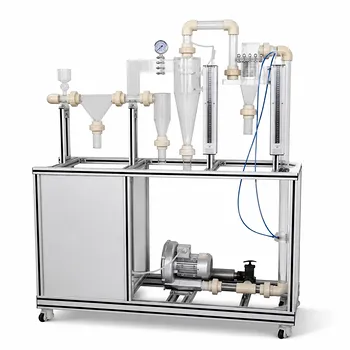
Gas-Solid Heterogeneous Separation Demonstration Educational Unit Operations Pilot Plant

Gas-Solid Heterogeneous Separation Demonstration Educational Unit Operations Pilot Plant

Comprehensive visual transparent gas-solid separation pilot plant for chemical engineering labs. Demonstrates gravity settling inertial settling cyclone and bag filter technologies. Enables real-time analysis of fluid-particle mechanics pressure drop and collection efficiency. Ideal for undergraduate unit operations courses.

Ion Exchange Water Purification Educational Pilot Plant for Engineering Unit Operations

Ion Exchange Water Purification Educational Pilot Plant for Engineering Unit Operations

This bench-scale ion exchange pilot plant trains engineering students in water purification. Dual transparent columns simulate industrial softening and demineralization. Students observe fluid dynamics, perform resin regeneration, and analyze breakthrough curves. The corrosion-resistant frame ensures durability in unit operations experiments.

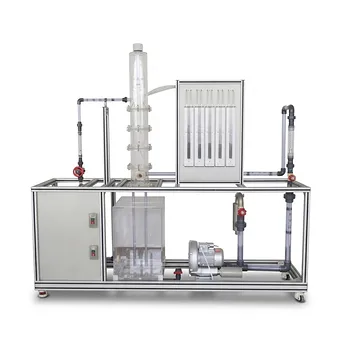
Plate Column Hydrodynamics Tray Demonstration Educational Pilot Plant

Plate Column Hydrodynamics Tray Demonstration Educational Pilot Plant

Advanced transparent educational pilot plant for chemical engineering labs demonstrates plate column hydrodynamics with industrial sieve bubble cap serrated valve trays for visual observation of gas-liquid contact pressure drop measurement and operational limit analysis including flooding weeping entrainment

Educational Unit Operations Pilot Plant for Intraparticle Diffusion Effective Factor Measurement

Educational Unit Operations Pilot Plant for Intraparticle Diffusion Effective Factor Measurement

Designed for chemical engineering university labs, this pilot plant allows hands-on determination of catalyst particle intraparticle diffusion effective factors and gas-solid reaction kinetics using a fixed-bed tubular reactor with industrial touchscreen control, bridging theory and practical reactor design.

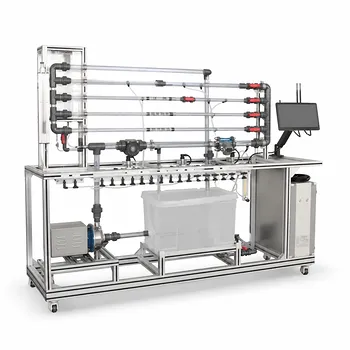
Fluid Friction Resistance Determination Educational Unit Operations Pilot Plant

Fluid Friction Resistance Determination Educational Unit Operations Pilot Plant

Engineered bench-scale system for university engineering labs. Provides hands-on fluid mechanics experience: quantitative energy loss analysis, flow regime observation, friction coefficient determination. Features four-point pressure measurement, transparent sections, industrial touchscreen PLC, 3D virtual simulation. Ideal for chemical, mechanical, civil engineering.

Methanol Synthesis and Catalyst Performance Evaluation Educational Unit Operations Pilot Plant
Methanol Synthesis and Catalyst Performance Evaluation Educational Unit Operations Pilot Plant
Bench-scale methanol synthesis and catalyst evaluation educational pilot plant for chemical engineering labs to study catalytic kinetics, high-pressure operations, process control, and unit operations under realistic conditions with industrial safety features, precision gas delivery, data acquisition, and intelligent monitoring.

General Purpose Cosmetics Production Unit Operations Training Pilot Plant

General Purpose Cosmetics Production Unit Operations Training Pilot Plant

Integrated pilot-scale cosmetics production training plant for chemical engineering education featuring utility supply emulsification blending and filtration modules with dual touchscreen manual control customizable mobile design ideal for practical hands-on unit operations and advanced process control learning.

Photocatalytic Membrane Separation and Degradation Unit Operations Pilot Plant

Photocatalytic Membrane Separation and Degradation Unit Operations Pilot Plant

Bench-scale pilot plant integrating photocatalytic degradation with membrane separation for engineering education. Study advanced oxidation, microfiltration, and hybrid processes using industrial sensors. Features safety light-blocking curtain, low-noise compressor, and durable stainless-steel construction.

Carbon Dioxide PVT Curve Determination Educational Unit Operations Pilot Plant

Carbon Dioxide PVT Curve Determination Educational Unit Operations Pilot Plant

Enable hands-on learning of thermodynamic principles with this carbon dioxide PVT curve determination pilot plant. Students visualize critical opalescence, phase transitions, and generate P-V isotherms across liquid, gas, and supercritical regions. Robust safety features, adaptable for university engineering labs.

Water Electrolysis Hydrogen Production and Storage Educational Pilot Plant

Water Electrolysis Hydrogen Production and Storage Educational Pilot Plant

Integrated pilot-scale training system for higher education engineering labs. Features AWE/PEM electrolysis, adjustable DC power, PLC controls, gas-liquid separation, and pressurized hydrogen storage. Hands-on learning in green hydrogen, process control, and safety, ideal for chemical and energy departments.


Leave Your Message