The heartbeat of any electrochemical system—from a simple classroom voltaic cell to an industrial electrolyzer—is the separation of half-reactions. In a primary battery, a salt bridge maintains electrical neutrality by allowing ions to migrate between half-cells without letting the solutions mix. When translating this principle into educational chemical engineering pilot plants, the design must enable that same ionic connectivity at a larger, controllable scale. This means replacing a simple gel tube with engineered flow channels, ion‑selective membranes, and precise mass‑transfer control, so students can study real‑world phenomena like polarization and efficiency under process‑like conditions.
The salt bridge’s role—selective ionic transport while preventing bulk mixing—directly maps to the core architectural challenge of a pilot‑scale electrochemical reactor. Educational designs must therefore combine robust physical separation, active flow management, and electrode‑housed reaction zones that mimic industrial realities while remaining transparent for learning.
The Fundamental Principle: Microscopic Ion Management
Every primary battery hinges on physically separating oxidation and reduction. This keeps electrons flowing through an external circuit, doing useful work. But without a salt bridge, the half‑cells would rapidly accumulate charge, killing the reaction.
How the Salt Bridge Solves the Problem
The salt bridge provides a dedicated ionic highway. It releases non‑reactive ions (like K⁺ and Cl⁻) into each half‑cell to counterbalance the charge generated by the redox reactions. This maintains electrical neutrality, allowing the reactions to continue.
Crucially, the salt bridge must prevent convective mixing of the two electrolyte solutions. If the bulk solutions mix, the spontaneous electron flow through the external circuit would be bypassed, and the cell would self‑discharge.
The Educational Imperative: Visibility vs. Secrecy
In a teaching lab, a U‑tube filled with KCl gel makes the principle beautifully visible. You can trace the ion path. However, that simple design cannot handle the flow, scale, or variables needed to teach chemical engineering concepts like mass transfer coefficients or concentration polarization under continuous operation.
From Lab Bench to Pilot Plant: The Scaling Challenge
Moving from a milliliter‑scale batch cell to a pilot plant forces a fundamental re‑design of the ionic pathway. The core principle stays the same, but the implementation shifts from a static gel to a dynamic, engineered system.
The Core Translation: Controlled Ionic Separation
The pilot plant must do exactly what the salt bridge does: conduct ions while blocking bulk liquid flow. But instead of a static salt gel, the design uses flow compartments separated by a semi‑permeable membrane. This membrane becomes the scaled‑up salt bridge, letting specific ions pass while keeping anolyte and catholyte distinct.
This translation is not just about size. It’s about introducing control. In a lab cell, the salt bridge’s resistance is fixed. In a pilot plant, the membrane’s resistance and selectivity become variables that students can measure, manipulate, and link to process economics.
Key Design Requirements for Educational Electrochemical Reactors
For a pilot plant to faithfully teach how the salt bridge principle operates under engineering constraints, three design features become non‑negotiable.
Precise Electrolyte Flow Control
Once electrolytes are flowing, the ionic highway is no longer a quiet diffusion path. Forced convection can disrupt the concentration gradient near the membrane, altering ion transport rates. The pilot plant must therefore include pumps, flow meters, and possibly flow straighteners to maintain a known, laminar regime. This allows students to decouple mass transfer effects from reaction kinetics.
Without this control, the “salt bridge” equivalent becomes a chaotic mixing zone, making quantitative analysis impossible.
Robust Electrode Housing
In an educational setting, durability and safety are paramount. Electrodes must be housed in chemically resistant, pressure‑rated enclosures with transparent windows or access ports for observation. The housing must also ensure consistent inter‑electrode gap and membrane alignment, because even minor misalignment can create current density hot spots that skew results. This robustness lets students focus on the electrochemical data rather than troubleshooting leaks or short circuits.
Advanced Membrane or Salt‑Bridge Equivalents
The heart of the scaled‑up principle is the membrane. Unlike a simple paper or gel bridge, pilot plants often use ion‑exchange membranes (cationic or anionic) that selectively permit the migration of one type of ion. This mimics the salt bridge’s role but with controlled selectivity, which is a key variable in industrial processes like chlor‑alkali production. Students can then measure membrane voltage drop, fouling trends, and selectivity loss—phenomena invisible in a U‑tube.
Understanding the Trade-offs in Educational Design
Translating an elegant glassware experiment into a pilot plant inevitably introduces complexity. The biggest risk is that the fundamental principle gets buried under operational noise.
Fidelity vs. Robustness
A membrane system that perfectly mimics an industrial cell may be fragile, expensive, and require hours of conditioning. If it fails repeatedly, students learn troubleshooting, not electrochemistry. Designers often choose a slightly less selective but mechanically forgiving separator to maintain uptime. This trade‑off explicitly sacrifices some industrial realism to keep the salt bridge’s function—ionic connectivity without mixing—clearly observable.
Complexity vs. Conceptual Clarity
Adding flow, pressure, and phase separation sensors can turn the pilot plant into a “black box.” A good educational design must expose the inner logic. For example, using a transparent housing to visualize gas evolution at electrodes, or placing a removable membrane cartridge so students can swap between an ideal salt‑gel bridge and a commercial membrane to directly compare performance. The design must resist the temptation to automate every variable; some manual measurements reinforce the core principles.
Cost vs. Universality
A single pilot plant can demonstrate electro‑winning, water electrolysis, or redox flow batteries. But each demands different electrolytes and electrode materials. Stray too far toward one application, and the plant loses its ability to teach the generic salt‑bridge principle across multiple processes. The design trade‑off is between a dedicated industrial copy and a flexible teaching platform.
Making the Right Choice for Your Teaching Goal
Whether you are specifying a new pilot plant or retrofitting an existing one, your decisions should start from the pedagogical purpose.
- If your primary focus is teaching core electrochemical principles: Prioritize a transparent, low‑pressure cell with a simple ion‑conducting diaphragm rather than a high‑performance membrane. The students will see the ionic separation in action and directly link it to the battery analogy.
- If your primary focus is industrially relevant process dynamics: Invest in a sturdy, opaque cell with precise flow control and a commercial ion‑exchange membrane. The data on polarization curves and mass transfer coefficients will build the engineering skills, but you must plan extra lab time for membrane conditioning.
- If your primary focus is exploring multiple process chemistries: Design for modular electrode housings and a replaceable separator cassette. Sacrifice some hydraulic efficiency to gain the ability to swap between a salt‑gel bridge, a porous frit, and an advanced membrane with minimal downtime.
Your pilot plant’s architecture is a physical expression of the salt bridge’s elegant simplicity. By keeping that principle visible in every pipe and membrane, you turn a complex reactor into a clear, powerful teaching tool.
Summary Table:
| Feature | Lab Bench Scale (Salt Bridge) | Pilot Plant Scale (Separator/Membrane) |
|---|---|---|
| Mechanism | Static salt gel (e.g., KCl U-tube) | Active ion-exchange membrane |
| Flow State | Static diffusion, no active flow | Controlled convective flow (laminar) |
| Control Variables | Fixed resistance, simple visibility | Adjustable flow, pressure, selectivity |
| Main Challenge | Charge accumulation prevention | Mass transfer, polarization, durability |
Elevate Your Engineering Lab with LABPARK
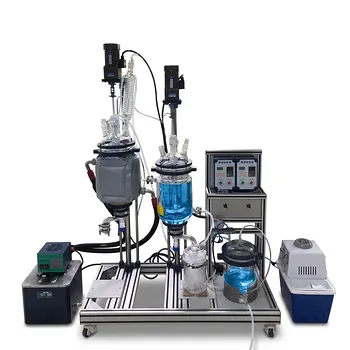
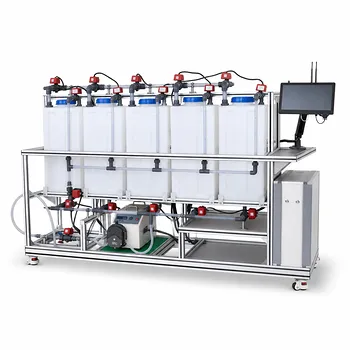
Are you looking to bridge the gap between classroom electrochemistry and industrial reality? LABPARK provides state-of-the-art Educational and Vocational Unit Operations Pilot Plants in chemical engineering, bioprocess & biotech, and environmental & water treatment. Designed specifically for universities, research institutes, and enterprises, our modular systems bring complex mass transfer, flow control, and membrane processes to life.
Contact LABPARK today to discover how we can customize a pilot plant solution for your curriculum!
Related Products
- Potassium Salt Thermal Dissolution and Crystallization Separation Educational Unit Operations Pilot Plant
- Ion Exchange Water Purification Educational Pilot Plant for Engineering Unit Operations
- Electrochemical Water Treatment Educational Unit Operations Pilot Plant
- Electrolyte Distillation Purification and Formulation Educational Pilot Plant
- Alkaline Membrane Water Electrolysis Educational Pilot Plant Unit Operations Training System
People Also Ask
- How does solubility modeling assist crystallization pilot plants? Master the BETA parameter.
- What are the benefits of integrating online PAT tools like ATR-FTIR into crystallization unit operations pilot plants?
- How do crystallization pilot plants improve student learning? Shift from manual observation to process control.
- Control Crystallization Pilot Plant Secondary Nucleation: 4 Key Adjustments
- Why is precise temperature control critical in crystallization pilot plants? Key to Scale-Up Success