Knowledge Chemical Engineering Education How does critical moisture content (Xc) impact drying efficiency? Maximize thermal unit operations
Author avatar

Tech Team · LABPARK

Updated 2 months ago

How does critical moisture content (Xc) impact drying efficiency? Maximize thermal unit operations


The critical moisture content (Xc) is the single most important transition point in any thermal drying process. It’s the moment your material stops losing water easily and begins a slow, energy-intensive internal struggle. A material with a high Xc enters this difficult stage too early, ballooning your energy bills and bottlenecking your production line, but the right dryer configuration can actively suppress Xc to keep the process efficient.

The critical moisture content isn't a fixed material property—it's a dynamic battle between surface evaporation and internal moisture diffusion. A high Xc forces your process into the costly falling-rate stage prematurely. The primary way to combat this is through dynamic unit operations, where fluidized bed or flash dryers use agitation and suspension to physically reduce Xc, maximizing the efficient constant-rate stage.

The Fundamental Role of Critical Moisture Content

Before you can optimize a dryer, you must understand the boundary that controls the entire operation. Xc is not just a number on a lab report; it’s the line between easy water removal and an uphill battle.

The Two Worlds of Drying: Constant-Rate vs. Falling-Rate

During the constant-rate drying stage, moisture is abundant on the material's surface. Evaporation occurs freely, and the drying rate is controlled solely by external factors like air temperature, humidity, and velocity.

This stage is highly efficient. The material stays at the wet-bulb temperature, and water removal is rapid and predictable. Once the moisture content drops to the critical moisture content (Xc), the surface can no longer remain fully saturated because internal moisture can't migrate to the surface fast enough. This marks the start of the falling-rate drying stage, where the drying rate plummets and the material's surface temperature begins to rise sharply.

Why a High Xc Cripples Efficiency

A higher Xc value means the material enters the falling-rate stage earlier in the process. This is a direct hit to your bottom line for two reasons. First, it drastically extends the total residence time needed to reach the target dryness.

Second, operating in the falling-rate stage is substantially more energy-intensive. You’re applying heat to a dry surface while waiting for water to slowly diffuse from the core, wasting energy and risking thermal damage to the product.

How Dryer Configuration Directly Controls Xc

The critical moisture content is not a fate you must accept. It is a parameter you can engineer, and the primary lever you have is the fundamental configuration of your drying equipment.

The Penalty of Static Equipment

Static dryer designs, such as a standard tray dryer, inherently promote a high Xc. The material sits in a thick, undisturbed bed, creating a long, tortuous path for internal moisture to reach the surface.

As the top layer dries, a dry crust forms, further insulating the wet core. This internal diffusion limitation means the surface dries out prematurely, triggering the falling-rate stage long before the material’s average moisture content is low. The Xc in a tray dryer is heavily dependent on material layer thickness; a deeper bed will have a higher Xc.

The Advantage of Dynamic Unit Operations

Dynamic drying equipment is specifically designed to manipulate and minimize Xc. Technologies like fluidized bed dryers and pneumatic (flash) dryers operate on a fundamentally different principle.

Instead of a static bed, these systems actively suspend individual particles in a hot gas stream. This action dramatically reduces the material layer thickness to the scale of a single particle and continuously increases the exposed drying surface area. By constantly agitating the material, these dryers physically prevent the formation of a dry surface crust, keeping the external mass transfer as the rate-limiting step and holding the process in the highly efficient constant-rate stage for far longer.

Understanding the Trade-offs

Manipulating Xc through dryer configuration is powerful, but it comes with critical operational boundaries that require careful management.

The Risk of Over-Accelerating the Process

While dynamic dryers minimize Xc, they also maximize the constant-rate drying rate by enhancing the convective heat transfer coefficient. An excessively aggressive drying rate—achieved by very high temperatures or air velocities—can cause severe product quality defects. Physical problems like cracking, deformation, or case hardening can occur, where the surface dries so fast it forms an impermeable shell that traps moisture inside.

The Entrainment Limit

High air velocity is essential for suspending particles in a fluidized bed or conveying them in a flash dryer. However, there is a critical limit. If the velocity is set too high, it can cause entrainment, where product particles are literally blown out of the dryer and into the exhaust system, leading to product loss and downstream equipment fouling.

Making the Right Choice for Your Goal

Optimizing drying efficiency is a balancing act between equipment capabilities and material sensitivity. Your goal will dictate the right configuration strategy.

  • If your primary focus is maximum throughput and minimizing energy costs: Select a dynamic unit operations dryer like a fluidized bed system. Its ability to suppress Xc through agitation keeps the process in the fast, efficient constant-rate stage for the vast majority of the cycle.
  • If your primary focus is preserving the integrity of a fragile, heat-sensitive material: A dynamic dryer is still likely the correct core technology, but you must pilot-test to find the safe upper limits for air temperature and velocity to prevent case hardening and physical damage. The goal is to control the rate within the constant stage, not sacrifice it.
  • If your primary focus is processing small batches of high-value material where physical agitation is impossible: Accept the inherent inefficiency of a higher Xc in a static tray dryer and optimize the falling-rate stage. Use milder conditions over a longer time, and focus on reducing the static bed depth to lower the Xc as much as physically possible.

The true measure of a drying system isn't how fast it can evaporate, but how intelligently it manages the transition point beyond which evaporation becomes an internal extraction problem.

Summary Table:

Dryer Configuration Typical Equipment Xc Level Dominant Drying Stage Energy Efficiency
Static Tray Dryers High (Early transition) Falling-Rate Stage Low (Long residence time, risk of crusting)
Dynamic Fluidized Bed / Flash Dryers Low (Delayed transition) Constant-Rate Stage High (Active suspension, rapid heat transfer)

Ready to optimize your thermal drying and chemical unit operations? LABPARK provides advanced Educational and Vocational Unit Operations Pilot Plants in chemical engineering, bioprocess & biotech, and environmental & water treatment. Tailored for universities, research institutes, and enterprises, our hands-on pilot plants empower students and researchers to master heat and mass transfer dynamics. Contact us today to configure the ideal pilot plant for your facility!

Related Products

People Also Ask

Related Products

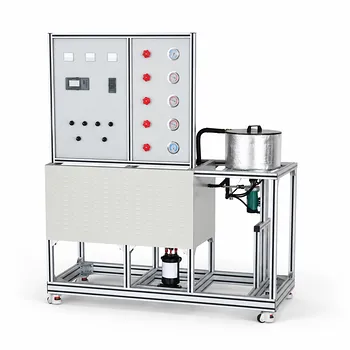
Educational Compression Refrigeration Performance Determination Unit Operations Pilot Plant

Educational Compression Refrigeration Performance Determination Unit Operations Pilot Plant

This educational pilot plant for compression refrigeration performance determination offers dual COP evaluation, regenerative cycle comparison, and calorimeter calibration. Customizable for curriculum integration, it features environmentally conscious design. Supports thermodynamic mapping on pressure-enthalpy diagrams and synchronous monitoring with centralized instrumentation.

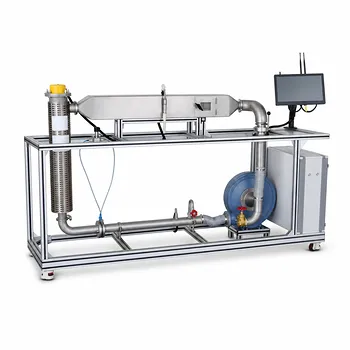
Circulating Wind Tunnel Drying and Convective Heat Transfer Coefficient Determination Educational Pilot Plant

Circulating Wind Tunnel Drying and Convective Heat Transfer Coefficient Determination Educational Pilot Plant

This educational pilot plant enables engineering students to study convective drying, air-water vapor systems, and heat transfer by determining drying curves, drying rate curves, and convective heat transfer coefficients under variable conditions.

Constant Pressure Filtration Educational Unit Operations Pilot Plant

Constant Pressure Filtration Educational Unit Operations Pilot Plant

Hands-on educational pilot plant for constant pressure filtration. Classic plate and frame filter press allows students to study kinetics, determine specific cake resistance, perform cake washing and evaluate washing rates. Ideal for chemical engineering curriculum. Mobile, customizable, safety-compliant design.

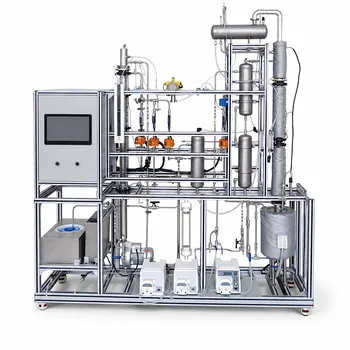
Multi-Functional Drying Educational Unit Operations Pilot Plant

Multi-Functional Drying Educational Unit Operations Pilot Plant

Versatile multi-functional drying educational unit operations pilot plant integrating tunnel, fluidized bed, and spray drying. Enables hands-on study of drying curves, psychrometry, and gas-solid separation for chemical engineering curriculum in higher education labs.

Rising and Falling Film Evaporation Educational Unit Operations Pilot Plant

Rising and Falling Film Evaporation Educational Unit Operations Pilot Plant

Hands-on educational pilot plant for studying rising and falling film evaporation, flow regimes, and heat transfer. Customizable for university labs with industrial instrumentation and data acquisition. Enables comparative evaluation of evaporation modes and energy efficiency.

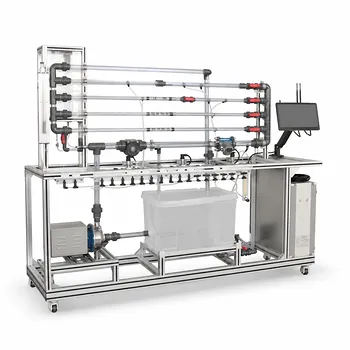
Fluid Friction Resistance Determination Educational Unit Operations Pilot Plant

Fluid Friction Resistance Determination Educational Unit Operations Pilot Plant

Engineered bench-scale system for university engineering labs. Provides hands-on fluid mechanics experience: quantitative energy loss analysis, flow regime observation, friction coefficient determination. Features four-point pressure measurement, transparent sections, industrial touchscreen PLC, 3D virtual simulation. Ideal for chemical, mechanical, civil engineering.

Hot Filtration Educational Unit Operations Pilot Plant Laboratory System

Hot Filtration Educational Unit Operations Pilot Plant Laboratory System

This integrated laboratory bench-scale hot filtration pilot plant enables students to study solid-liquid separation under thermal conditions, featuring a stainless steel vessel, removable heating jacket, and multi-layer filter plates for unit operations education, ideal for chemical engineering laboratory curriculum.

Ion Exchange Water Purification Educational Pilot Plant for Engineering Unit Operations

Ion Exchange Water Purification Educational Pilot Plant for Engineering Unit Operations

This bench-scale ion exchange pilot plant trains engineering students in water purification. Dual transparent columns simulate industrial softening and demineralization. Students observe fluid dynamics, perform resin regeneration, and analyze breakthrough curves. The corrosion-resistant frame ensures durability in unit operations experiments.

Multi-Functional Membrane Separation Educational Pilot Plant for Unit Operations Lab

Multi-Functional Membrane Separation Educational Pilot Plant for Unit Operations Lab

The Multi-functional Membrane Separation Educational Unit Operations Pilot Plant is an integrated bench-scale laboratory system designed for teaching undergraduate engineering education. It features Ultrafiltration, Nanofiltration, and Reverse Osmosis modules in a compact, mobile unit for practical hands-on learning.

Carbon Dioxide Absorption and Desorption Educational Pilot Plant for Carbon Capture Studies

Carbon Dioxide Absorption and Desorption Educational Pilot Plant for Carbon Capture Studies

Explore carbon dioxide absorption and desorption with this educational pilot plant. Transparent columns visualize mass transfer; electric heating simulates industrial solvent regeneration; touchscreen interface enables data monitoring. Ideal for chemical engineering, bridging theory and practice.

Shell and Tube Heat Exchanger Heat Transfer Coefficient Determination Educational Pilot Plant

Shell and Tube Heat Exchanger Heat Transfer Coefficient Determination Educational Pilot Plant

LABPARK's shell and tube heat exchanger pilot plant enables students to investigate heat transfer coefficients, LMTD, co-current vs counter-current flow, bridging theory and industrial practice. Customizable for chemical, mechanical, environmental engineering curricula. Ideal for unit operations and process engineering labs.

Carbon Material Thermal Pretreatment Multiphase Separation Educational Pilot Plant

Carbon Material Thermal Pretreatment Multiphase Separation Educational Pilot Plant

Educational pilot plant for carbon material thermal pretreatment and multiphase separation. Features jacketed agitated reactor, separation column, and modern controls for hands-on unit operations training in heat transfer, fluid flow, and process safety with industrial-grade materials and wireless data acquisition.

Multifunctional Membrane Separation Educational Pilot Plant with Ultrafiltration, Nanofiltration, Reverse Osmosis

Multifunctional Membrane Separation Educational Pilot Plant with Ultrafiltration, Nanofiltration, Reverse Osmosis

An integrated laboratory bench-scale membrane separation system for higher education engineering labs combining Ultrafiltration, Nanofiltration, and Reverse Osmosis processes. Features industrial PLC control with touch-screen HMI, transparent piping, and academic assessment software. Ideal for chemical and environmental engineering curricula.

Comprehensive Heat Transfer Coefficient Determination Educational Unit Operations Pilot Plant

Comprehensive Heat Transfer Coefficient Determination Educational Unit Operations Pilot Plant

Advanced industrial-grade educational pilot plant for comprehensive heat transfer coefficient determination. Enables quantitative convective heat transfer analysis, evaluates double-pipe and shell-and-tube exchanger configurations, and includes digital data acquisition. Customizable for engineering curriculum. Ideal for engineering unit operations labs.

Centrifugal Pump Performance and Orifice Flowmeter Calibration Educational Pilot Plant

Centrifugal Pump Performance and Orifice Flowmeter Calibration Educational Pilot Plant

This versatile educational pilot plant enables engineering students to conduct centrifugal pump performance tests, orifice flowmeter calibration, and fluid mechanics experiments using a transparent flow loop, industrial HMI, and 3D virtual simulation for a comprehensive hands-on learning experience.

Low Concentration Carbon Dioxide Capture Pressure Swing Adsorption Educational Pilot Plant

Low Concentration Carbon Dioxide Capture Pressure Swing Adsorption Educational Pilot Plant

Low-concentration CO2 capture pilot plant using Pressure Swing Adsorption for engineering education. Students gain practical experience in breakthrough curve measurement, adsorption dynamics, and variable analysis in a hands-on lab setting. Ideal for unit operations, mass transfer, and chemical engineering labs.

General Purpose Cosmetics Production Unit Operations Training Pilot Plant

General Purpose Cosmetics Production Unit Operations Training Pilot Plant

Integrated pilot-scale cosmetics production training plant for chemical engineering education featuring utility supply emulsification blending and filtration modules with dual touchscreen manual control customizable mobile design ideal for practical hands-on unit operations and advanced process control learning.

Water Electrolysis Hydrogen Production and Storage Educational Pilot Plant

Water Electrolysis Hydrogen Production and Storage Educational Pilot Plant

Integrated pilot-scale training system for higher education engineering labs. Features AWE/PEM electrolysis, adjustable DC power, PLC controls, gas-liquid separation, and pressurized hydrogen storage. Hands-on learning in green hydrogen, process control, and safety, ideal for chemical and energy departments.

Supercritical High-Gravity Flash Evaporation Educational Unit Operations Pilot Plant

Supercritical High-Gravity Flash Evaporation Educational Unit Operations Pilot Plant

Bench-scale integrated teaching system for advanced separation and mass transfer, combining supercritical high-gravity flash evaporation with heating, chemical reaction, and material collection, featuring modular design, Stainless Steel 316L construction, transparent visualization, touchscreen control, and safety systems for chemical engineering education.

Potassium Salt Thermal Dissolution and Crystallization Separation Educational Unit Operations Pilot Plant

Potassium Salt Thermal Dissolution and Crystallization Separation Educational Unit Operations Pilot Plant

This educational pilot plant allows chemical engineering students to perform potassium salt thermal dissolution and cooling crystallization experiments, integrating solubility studies, supersaturation control, and solid-liquid separation in a safe, compact, and customizable laboratory system for hands-on unit operations learning.


Leave Your Message