Knowledge Chemical Engineering Education How does column diameter affect tray selection in pilot plants? Integral vs. Sectional
Author avatar

Tech Team · LABPARK

Updated 2 months ago

How does column diameter affect tray selection in pilot plants? Integral vs. Sectional


The threshold that dictates your tray configuration is physical, not theoretical—it’s the diameter at which human access becomes impossible. In chemical engineering pilot plants, column diameter is the single decisive factor that forces your hand. For small-diameter columns of 800 mm or less, integral (single-piece) trays are the standard. For large-diameter columns of 1,200 mm or more, you must use sectional (segmented) trays simply to get them through the manway. The band between 800 mm and 1,200 mm represents a gray zone where either style can work.

While the diameter directly selects the tray's mechanical format, the deeper driver is maintenance ergonomics. The choice hinges on whether a person—arm, shoulder, and tool—can physically fit inside the vessel shell. Your decision process must start by answering this access question before ever evaluating separation performance.

The 800mm Threshold: Where the Arm’s Reach Ends

The primary distinction is not about fluid dynamics; it is about how the plates are installed and cleaned. Column diameter directly determines whether a technician can work inside the column shell.

The Ergonomic Limit of Integral Design

For diameters up to 800 mm, the entire circular tray is machined as a single disc. This is only possible because a technician can reach down from the top flange to handle it. The standard human arm cannot effectively maintain a column deeper than roughly an arm's length without entering the vessel. An integral plate simply drops into the shell from above.

The Challenge of Small-Scale Hydraulics

In these pilot-scale vessels, standard industrial tray design software often fails to model downcomer behavior accurately. You must often manually override active area calculations to prevent premature flooding in such tight diameters.

The 1,200mm Threshold: Entering the Vessel

Once the column shell becomes large enough for a human to enter, the logic of the tray design flips completely to prioritize disassembly.

The Manway Becomes the Deciding Factor

For diameters of 1,200 mm and greater, a full-circle integral tray is physically impossible to install because it cannot fit through a standard oval manway opening. The plate must be split into sectional panels that can be passed through the manhole and bolted together inside the tower.

The Assembly Sequence Inside the Shell

Installation shifts to an internal support ring system. Workers carry the rectangular or trapezoidal tray panels through the manway and assemble them like a puzzle on internal beams, ensuring horizontal levelness after assembly.

Beyond Access: Hidden Constraints of Diameter

The choice of diameter also triggers secondary effects on cost and process visibility that are critical for pilot plant education and research.

Spacing, Cost, and Observation

Tighter diameters often mandate closer tray spacing (often 200-300 mm for pilot units) to manage vapor capacity. For educational pilot plants, holding the diameter below 800mm allows for integral glass-walled sections or strategic viewports, letting students visually observe weeping without the obstructed sight-lines that internal bolting and support rings create.

The "Gray Zone" (800 mm - 1,200 mm)

In this intermediate range, you face a trade-off. You can opt for a single-piece tray if you omit a side manway and rely only on top-flange disassembly. Alternatively, you can choose sectional trays if you anticipate future corrosion issues or need to switch between sieve and valve tray types frequently. Here, the decision hinges on your specific maintenance schedule and budget for custom fabrication.

Common Pitfalls to Avoid

Even with a clear diameter cutoff, engineers often make costly mistakes by ignoring the mechanical reality of assembly.

Ignoring the "Bolting" Clearance

A common error is designing a sectional tray for an 800mm column. Even if the individual pieces fit through the nozzle, a worker’s hands often cannot align the bolts along the seams. The vessel diameter must provide enough internal working volume to swing a wrench.

Treating Glass Columns Like Stainless Steel

A 4-inch (100mm) glass distillation column uses integral glass trays for visual purity, but do not assume you can scale this logic to a 24-inch (600mm) metal column. The glass acts as its own construction material restriction. In stainless steel, you can weld internals, but you still cannot reach deep enough to grind and polish welds properly on a large integral floor without a removable multi-pass tray design.

Making the Right Choice for Your Pilot Plant

Your decision should align with the primary purpose of your unit operations facility. Always start with the physical diameter but apply the selection logic based on your operational goal.

  • If your primary focus is hands-on teaching and visual demonstration: Stay below 800 mm. The simplicity of an integral tray column, combined with glass viewports, maximizes student visualization of hydrodynamics without the mechanical complexity of internal bolting.
  • If your primary focus is investigating internal hydraulics or testing different tray types: Choose a sectional tray design, even if it requires pushing the diameter to 1,200 mm. The ability to swap valve trays for sieve trays in a single pilot run justifies the larger shell.
  • If your primary focus is matching a specific industrial flooding ratio at low cost: Opt for the narrowest workable integral tray column in the "gray zone," but accept that deep cleaning will require a longer shutdown time and specialized long-handled tools.

Ultimately, your task is not to select a tray type, but to select a column size that allows the necessary access and then let that physical reality dictate the correct tray construction.

Summary Table:

Column Diameter Tray Type Maintenance & Installation Best For
< 800 mm Integral (Single-Piece) Dropped from top; no internal access needed Educational labs & visual demonstration
800 - 1,200 mm Gray Zone (Either) Top-flange or sectional based on budget/needs Custom maintenance & flexible budgets
> 1,200 mm Sectional (Segmented) Assembled internally via manway panels Industrial scale-up & frequent tray changes

Optimize Your Chemical Engineering Lab with LABPARK

Are you designing a new unit operations laboratory? LABPARK provides premium Educational and Vocational Unit Operations Pilot Plants in chemical engineering, bioprocess & biotech, and environmental & water treatment. We help universities, research institutes, and enterprises select the ideal column configurations—from easy-to-clean integral trays to versatile sectional systems.

Ready to elevate your engineering programs? Contact us today to receive custom technical specifications and a tailored quote!

Related Products

People Also Ask

Related Products

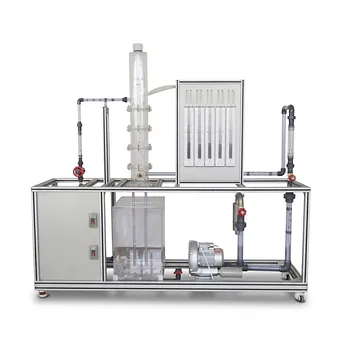
Plate Column Hydrodynamics Tray Demonstration Educational Pilot Plant

Plate Column Hydrodynamics Tray Demonstration Educational Pilot Plant

Advanced transparent educational pilot plant for chemical engineering labs demonstrates plate column hydrodynamics with industrial sieve bubble cap serrated valve trays for visual observation of gas-liquid contact pressure drop measurement and operational limit analysis including flooding weeping entrainment

Continuous Sieve-Plate Distillation Pilot Plant for Unit Operations Laboratory Education

Continuous Sieve-Plate Distillation Pilot Plant for Unit Operations Laboratory Education

Integrated pilot-scale teaching system for continuous sieve-plate distillation studies. Visual demonstration of tray hydraulics, flexible feed positions, and automatic reflux control for hands-on unit operations education in engineering labs. Designed for higher education engineering laboratories.

Multi-Modal Distillation Unit Operations Training Pilot Plant

Multi-Modal Distillation Unit Operations Training Pilot Plant

Multi-modal distillation pilot plant for practical unit operations training in chemical engineering education. Features real, analog, and semi-physical simulation modes, industrial construction, customizable for university labs. Hands-on fractionation columns, SCADA control, safety systems. Includes sight glasses, sampling ports, closed-loop recycling.

Dual-Mode Rectification Pilot Plant for Practical Training Unit Operations

Dual-Mode Rectification Pilot Plant for Practical Training Unit Operations

Industrial-scale dual-mode rectification pilot plant for chemical engineering practical training. Features real-material and simulated-material operation modes, sieve-plate column with sight glasses for visual observation of hydrodynamics, and customizable SCADA control for safe, hands-on learning of unit operations and mass transfer.

Multi-Functional Special Distillation Educational Pilot Plant

Multi-Functional Special Distillation Educational Pilot Plant

Versatile multi-functional special distillation pilot plant for chemical engineering education. Supports continuous, vacuum, azeotropic, reactive, extractive distillation. Transparent glass columns enable real-time visual observation of hydrodynamics and separation processes.

Absorption and Desorption Educational Unit Operations Pilot Plant

Absorption and Desorption Educational Unit Operations Pilot Plant

Dual packed column absorption and desorption pilot plant for chemical engineering education, offering real-time mass transfer coefficient measurement, durable mobile frame, industrial touch-screen interface, and customizable design for varied laboratory curricula, enabling hands-on study of gas absorption and stripping.

Educational Rotary Disc Liquid-Liquid Extraction Pilot Plant

Educational Rotary Disc Liquid-Liquid Extraction Pilot Plant

A transparent rotary disc column for educational liquid-liquid extraction experiments. This pilot plant enables students to study mass transfer, droplet dynamics, and flooding behavior, bridging theory and practice in chemical engineering unit operations education. Features variable-speed agitation and PLC control.

Residence Time Distribution and Reactor Flow Characteristics Determination Educational Pilot Plant

Residence Time Distribution and Reactor Flow Characteristics Determination Educational Pilot Plant

This versatile educational pilot plant is designed for comprehensive study of residence time distribution and reactor flow characteristics, featuring multiple CSTRs in series, a tubular reactor, variable recycle loop, and automated real-time data acquisition, perfect for hands-on chemical engineering education.

Natural Product Extraction Unit Operations Training Pilot Plant

Natural Product Extraction Unit Operations Training Pilot Plant

Integrated natural product extraction pilot plant for chemical engineering training bridges theory and industrial practice with modular extraction and evaporation/concentration units, hybrid touchscreen and manual control, realistic process simulation, and self-contained softened water and vacuum utilities.

Multi Pump Fluid Transport Process Piping Unit Operations Training Pilot Plant

Multi Pump Fluid Transport Process Piping Unit Operations Training Pilot Plant

Industrial-scale multi-pump pilot plant for unit operations training in fluid transport and process piping, featuring real-material and semi-physical simulation modes, comprehensive pump and flowmeter calibration, and safety-enhanced two-tier platform, bridging academic theory and industrial practice for chemical engineering education.

Ethyl Acetate Synthesis Unit Operations Pilot Plant for Practical Training

Ethyl Acetate Synthesis Unit Operations Pilot Plant for Practical Training

Modular and customizable pilot plant for ethyl acetate synthesis practical training. Integrates esterification reaction, liquid-liquid extraction, neutralization, and sieve-plate distillation unit operations. Bridging theory and real-world industrial processes. Designed for university chemical engineering labs

Ion Exchange Water Purification Educational Pilot Plant for Engineering Unit Operations

Ion Exchange Water Purification Educational Pilot Plant for Engineering Unit Operations

This bench-scale ion exchange pilot plant trains engineering students in water purification. Dual transparent columns simulate industrial softening and demineralization. Students observe fluid dynamics, perform resin regeneration, and analyze breakthrough curves. The corrosion-resistant frame ensures durability in unit operations experiments.

Continuous Batch Extractive Distillation Educational Pilot Plant

Continuous Batch Extractive Distillation Educational Pilot Plant

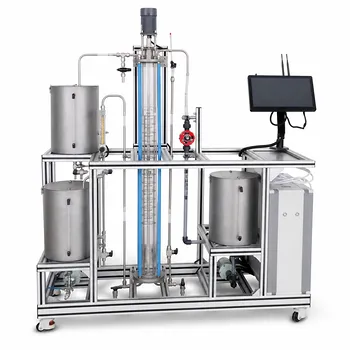
Versatile pilot plant for continuous, batch, and extractive distillation training. High-borosilicate glass column for visualizing hydraulics, 15.6-inch touchscreen with data logging, precise reflux ratio control 1-99, and durable corrosion-resistant frame. Ideal for chemical engineering education and process research.

Constant Pressure Filtration Educational Unit Operations Pilot Plant

Constant Pressure Filtration Educational Unit Operations Pilot Plant

Hands-on educational pilot plant for constant pressure filtration. Classic plate and frame filter press allows students to study kinetics, determine specific cake resistance, perform cake washing and evaluate washing rates. Ideal for chemical engineering curriculum. Mobile, customizable, safety-compliant design.

Multi-Reactor Educational Pilot Plant for Reaction Engineering Unit Operations

Multi-Reactor Educational Pilot Plant for Reaction Engineering Unit Operations

Integrated bench-scale educational pilot plant for chemical engineering teaching featuring fixed bed fluidized bed and stirred tank reactors with web-based digital twin controls and safety interlocks for hands-on unit operations and reaction engineering comparative studies in one compact system.

Tubular Reactor Flow Characteristics Determination Educational Unit Operations Pilot Plant

Tubular Reactor Flow Characteristics Determination Educational Unit Operations Pilot Plant

Educational pilot plant for investigating tubular reactor flow characteristics and residence time distribution Features adjustable recycle for plug flow and backmixing studies industrial touchscreen interface and real-time data acquisition Ideal for chemical engineering unit operations laboratory training and education

Aspirin API Synthesis Unit Operations Training Pilot Plant

Aspirin API Synthesis Unit Operations Training Pilot Plant

An integrated pilot plant for aspirin API synthesis training, featuring batch reaction, recrystallization, and packed distillation modules. Offers dual-control operation, transparent vessels, and public utility simulation for safe, hands-on chemical engineering unit operations education. Ideal for university labs.

100L Continuous Loop Hydrogenation Educational Unit Operations Pilot Plant

100L Continuous Loop Hydrogenation Educational Unit Operations Pilot Plant

This 100L continuous loop hydrogenation pilot plant is designed for chemical engineering education, featuring 316 stainless steel construction, advanced gas-liquid mass transfer components, explosion-proof safety systems, and a 15.6-inch touchscreen with 5G connectivity, cloud data logging, bridging theory and industry.

Electrolyte Distillation Purification and Formulation Educational Pilot Plant

Electrolyte Distillation Purification and Formulation Educational Pilot Plant

Integrated bench-to-pilot scale educational pilot plant for electrolyte distillation, purification, and formulation with borosilicate glass construction, PLC automation, touchscreen HMI, and advanced industrial safety features for hands-on chemical process training, ideal for chemical engineering and materials science curricula.

Rising and Falling Film Evaporation Educational Unit Operations Pilot Plant

Rising and Falling Film Evaporation Educational Unit Operations Pilot Plant

Hands-on educational pilot plant for studying rising and falling film evaporation, flow regimes, and heat transfer. Customizable for university labs with industrial instrumentation and data acquisition. Enables comparative evaluation of evaporation modes and energy efficiency.


Leave Your Message