Your packing material and nominal diameter directly dictate the resistance parameters and the active void space in the column, which in turn jointly determine the pressure drop and the liquid holdup. Smaller nominal diameters and dumped packing configurations create a mechanically tighter, more restrictive bed that naturally increases the hydraulic resistance and the amount of liquid the bed can retain. Meanwhile, the material’s surface energy controls how uniformly the liquid spreads across the packing, altering the effective liquid film thickness and the void space available for gas flow. For educational pilot plants, mastering this interplay is essential to translate raw experimental data into a fundamental understanding of transport phenomena.
While both packing size and material significantly influence pressure drop and holdup, they do so through distinct mechanisms. The nominal diameter and arrangement set the baseline geometric resistance, while the material’s wettability determines how much of that geometry is actually utilized for liquid flow. Understanding this separation of effects is the key to correctly interpreting pilot-plant data and avoiding misleading conclusions.
How Packing Geometry and Size Govern Hydraulic Resistance
The Role of Nominal Diameter in Creating Flow Restriction
Smaller packing pieces invariably produce a larger pressure drop for the same gas and liquid flow rates. This is because a smaller nominal diameter creates a tighter bed with more frequent flow passages and a higher specific surface area.
Empirical Ergun-type correlations quantify this behavior through two resistance parameters, (h_1) and (h_2). The (h_1) parameter, which dominates at higher gas velocities, rises dramatically as the packing size decreases. For example, a 3/8-inch Raschig ring has an (h_1) of 7.39, whereas a 1-inch configuration yields a much lower value. For students, this means selecting a smaller packing immediately translates into steeper pressure-drop curves and a higher energy consumption baseline for the air blower or compressor.
Stacked vs. Dumped: The Impact of Arrangement on Void Channels
How you load the packing is just as influential as its physical dimensions. Dumped packings settle randomly, creating a tortuous, higher-resistance path. Stacked packings, laid in structured rows, offer a more ordered void network.
The second resistance parameter, (h_2), captures this effect. Dumped packings display significantly larger (h_2) values than their stacked counterparts of the same nominal diameter. A 1/2-inch dumped packing might exhibit an (h_2) of 0.340, while a stacked bed of the same size can drop this parameter to 0.039. In an educational setting, explicitly comparing these two configurations allows students to see that pressure drop is not a function of packing size alone—the arrangement’s influence on the effective porosity is a powerful, controllable variable.
How Packing Material Dictates Wetting and Liquid Holdup
Critical Surface Tension and the Onset of Liquid Spreading
The packing material is the silent architect of the liquid distribution pattern. A liquid will only spread into a continuous film if the packing’s critical surface tension exceeds the liquid’s surface tension.
Materials like glass (73 mN/m) and steel (75 mN/m) readily wet with common solvents and water, creating thin, uniform films. Polymers such as polyethylene (33 mN/m) are poorly wetted, causing the liquid to channel and dribble in rivulets. This poor wetting reduces the effective interfacial area for mass transfer and can lead to a lower static liquid holdup. Crucially, even if two packings have identical dimensions, the one with the higher surface energy will hold more liquid as a stable film, directly subtracting from the void space available for gas flow.
Linking Wettability to Measurable Pressure Drop
Liquid holdup is the bridge between the material’s surface chemistry and the column’s hydraulic performance. In educational models, students calculate the pressure drop using the active void space—the packing porosity minus the fraction occupied by the retained liquid.
A highly wetted glass packing develops a uniform but slightly thicker liquid film, reducing the active void space and raising the pressure drop beyond what its dry geometry would predict. Conversely, a low-surface-energy plastic packing with poor wetting may retain less liquid, preserving more void space for gas and producing a lower liquid-phase pressure drop. This interplay teaches a powerful lesson: two columns with identical packing sizes may display vastly different flooding points if the material’s wetting characteristics are not accounted for.
Ensuring Representative Data for Scale-Up
In educational pilot plants, the column diameter itself must be chosen to avoid wall-effects that corrupt holdup measurements. Supplementary research confirms that for columns with a diameter greater than 0.15 meters, the gas holdup becomes virtually independent of column size, internal fixtures, and pressure up to 1.6 MPa.
By enforcing this minimum diameter, students ensure that the wetting patterns and the resulting holdup values they measure are a true reflection of the packing material, not a distortion caused by the liquid clinging to the wall. This is a critical design rule for any pilot plant tasked with generating scalable data.
Understanding the Trade-offs
No single packing material or diameter offers the perfect solution. Optimizing for one variable inevitably creates a penalty in another. An educational pilot plant must often balance separation efficiency against operational pressure drop.
- Smaller packing offers better mass transfer but higher energy costs. The large specific surface area that reduces the height of a transfer unit ((H_G) or (H_L)) also generates the highest resistance parameters, demanding more fan power.
- Stacked packing reduces pressure drop but may complicate uniform liquid distribution. The open channels that lower (h_2) can also allow the liquid to maldistribute if the column is not perfectly leveled.
- High-energy materials improve wettability but can be heavy and costly. Glass and steel ensure complete wetting for accurate film-coefficient experiments, yet they may require reinforced support plates due to their weight.
- Plastic packings offer chemical resistance but introduce wettability challenges. Without hydrophilizing treatments (which can raise polyethylene’s critical surface tension to 54 mN/m), a student’s absorption experiment may suffer from poor interphase contact despite a low dry pressure drop.
Making the Right Choice for Your Educational Goal
Your selection should be driven by the specific learning objective of the pilot-plant experiment.
- If your primary focus is demonstrating mass transfer fundamentals: Choose a small, wetted-wall material like glass or ceramic (e.g., 1/2-inch stacked Berl saddles). This maximizes interfacial area and ensures the measured pressure drop directly reflects the active liquid film, making the theory of active void space physically visible.
- If your primary focus is studying hydrodynamic and flooding phenomena: Compare dumped versus stacked configurations of the same 1-inch packing using a poorly wetting material like polyethylene. This decouples the geometric resistance from the liquid holdup effect, allowing students to observe distinct loading and flooding transitions with minimal film interference.
- If your primary focus is generating scale-up data: Use a column diameter of at least 0.15 meters with a modern hydrophilized polymeric packing. This combination eliminates wall-effects, provides a representative industrial wettability, and ensures that the pressure-drop and holdup data are directly applicable to full-scale absorber design.
- If your primary focus is on energy efficiency and column sizing: Select a 1-inch stacked ceramic packing. Its low (h_1) and (h_2) values yield a flat pressure-drop curve that lets students clearly isolate the friction loss from the kinetic energy changes, without the data being dominated by bed resistance.
A well-chosen packing deliberately amplifies the physical phenomenon you want your students to observe, transforming a simple absorption column into a powerful teaching tool.
Summary Table:
| Packing Parameter | Effect on Pressure Drop | Effect on Liquid Holdup | Educational Application |
|---|---|---|---|
| Smaller Diameter | Increases (higher geometric resistance $h_1$) | Increases (tighter bed structure) | Demonstrating high-energy baseline & mass transfer area |
| Dumped Packing | Increases (tortuous paths, higher $h_2$) | Varies (random channel flow) | Studying bed porosity & hydrodynamic transitions |
| Stacked Packing | Decreases (ordered void network, lower $h_2$) | Varies (requires precise leveling) | Decoupling geometric resistance from flow parameters |
| High Wetting (Glass/Steel) | Increases (reduces active void space via film) | Increases (stable, uniform liquid film) | Film-coefficient experiments & active void space theory |
| Low Wetting (Plastic) | Decreases (preserves gas flow void space) | Decreases (poor wetting, rivulet flow) | Minimizing liquid film interference during flooding runs |
Bring Industrial-Scale Insights to Your Lab with LABPARK
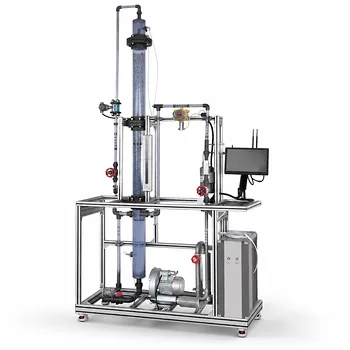
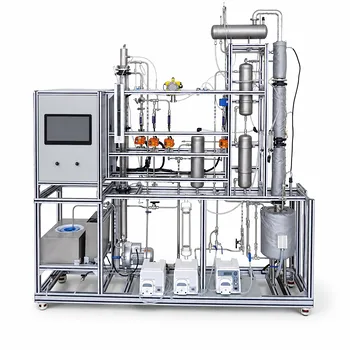
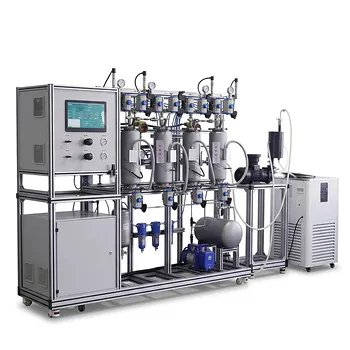
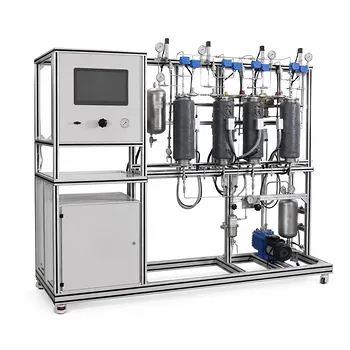
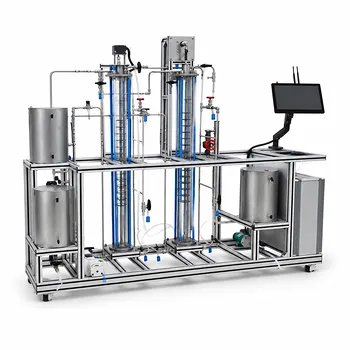
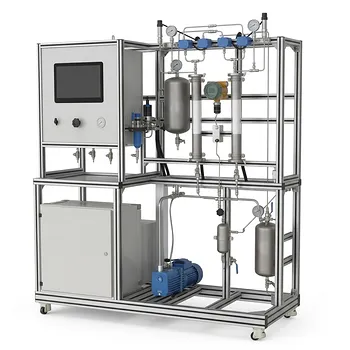
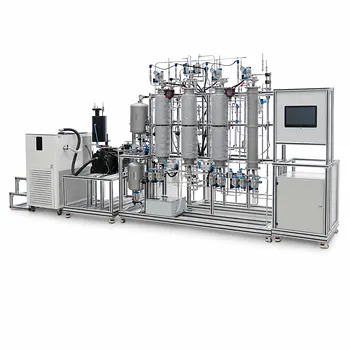
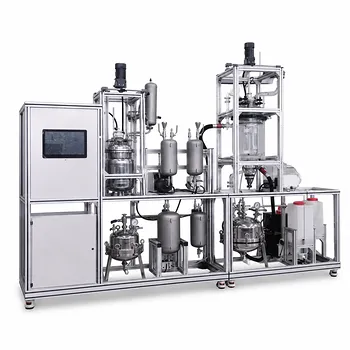
Translating complex transport phenomena into hands-on learning requires highly precise and reliable equipment. LABPARK provides top-tier Educational and Vocational Unit Operations Pilot Plants in chemical engineering, bioprocess & biotech, and environmental & water treatment.
Designed specifically for universities, research institutes, and progressive enterprises, our pilot plants enable students and researchers to accurately measure pressure drop, liquid holdup, and mass transfer efficiency under real-world conditions.
Ready to upgrade your lab's capabilities? Contact LABPARK today to find the ideal pilot plant solution for your educational goals!
Related Products
- Packed Bed Absorption Educational Unit Operations Pilot Plant
- Absorption and Desorption Educational Unit Operations Pilot Plant
- Dual-Mode Gas Absorption and Desorption Unit Operations Training Pilot Plant
- Multimodal Absorption and Desorption Pilot Plant for Unit Operations Training
- Carbon Dioxide Absorption and Desorption Educational Pilot Plant for Carbon Capture Studies
People Also Ask
- How Do Flow Regimes Transition in Packed Bed Pilot Plants? Key Scale-up Insights
- How does reactant concentration determine absorption column control? Gas-film vs. dual-film.
- How is the packing height of an absorption column calculated? Master HTU & NTU Concepts
- How does static vs. operating holdup affect pilot plant calibration? Avoid Critical Scale-Up Errors
- Why is counter-current flow selected for gas absorption? Maximize Pilot Plant Efficiency