Wet or dry milling? Your answer fundamentally reshapes the pilot plant that surrounds it. Dry milling demands a self-contained, dust-tight environment with precision powder feeders, inert gas systems, and gas-solid separation. Wet milling, in contrast, integrates directly with crystallization and filtration, creating a more compact and thermally stable workflow while eliminating the need for extensive dust management. For chemical engineering education and research, this choice not only determines the hardware on the floor but also dictates which kinetic, safety, and process-integration phenomena students and researchers can observe.
While dry milling requires a fortress of auxiliary equipment to handle dust and heat, wet milling embeds particle size reduction within a temperature-buffered liquid stream, fundamentally altering pilot plant layout, safety protocols, and the research questions you can ask. The right mechanism depends on material sensitivity, target particle size, and your educational objectives.
The Infrastructure Divide: Wet vs. Dry Milling in Pilot Plants
The moment you choose between wet and dry milling, you are making a decision about the entire unit operation ecosystem. This is not a simple swap of one mill type for another; it dictates the upstream feeders, downstream separation, safety systems, and even the building utilities.
The Ancillary Equipment Checklist for Dry Milling
A dry milling station cannot operate in isolation. You must allocate space and budget for a powder feeding device (like a screw feeder) that meters solids into the mill at a controlled rate.
To manage the airborne dust and control particle size distribution, the system requires gas-solid separation units such as cyclones and bag filters. These units prevent product loss and protect the operator and environment.
For materials that are heat-sensitive or have low melting points, the gas stream must be inerted or cooled. This often means integrating a cryogenic liquid nitrogen injection system, which adds complexity, operational cost, and safety protocols for handling cryogenic fluids.
The Process Integration Advantage of Wet Milling
Wet milling is rarely a standalone operation in a pilot plant. It is typically integrated directly with crystallization and filtration unit operations, forming a continuous isolation sequence.
This tight coupling eliminates the need for a dedicated, isolated dry milling step. You reduce cycle times and lower the overall equipment footprint, as the same liquid carrier used for milling also serves as the crystallization mother liquor or wash fluid.
For researchers, this integration enables studies of simultaneous crystallization and particle size reduction. Wet milling continuously creates fresh crystal surface area, which profoundly influences crystallization kinetics—a powerful experimental capability not accessible with dry milling.
Temperature Control as a Decisive Factor
The cooling mechanisms differ fundamentally. A liquid carrier medium in wet milling has a much higher heat capacity than a gas, acting as a thermal buffer. This results in significantly smaller temperature fluctuations, protecting sensitive materials from degradation or undesirable amorphous transitions.
In dry milling, achieving comparable temperature control means resorting to upstream cryogenic operation with liquid nitrogen injection. This is not only more expensive but also introduces challenges in maintaining a stable, low-temperature environment throughout the mill and downstream handling.
Weaving Milling into the Full Pilot Plant Sequence
Milling does not exist in a vacuum. In both educational and research settings, its role is defined by the upstream and downstream unit operations that surround it. The choice of mechanism determines how easily you can demonstrate a complete industrial process.
Milling in the Granulation Workflow
Solid dosage form production provides the clearest contrast. In a dry granulation pathway, the sequence is straightforward: blending, compaction (roller compaction or slugging), then milling the compacted ribbons into granules, followed by tableting. A dry mill here must handle a semi-dense feed.
A wet granulation pathway adds layers: after wet massing and wet screening, the granules must be dried (typically in a fluid bed dryer) before they can be milled to final size. Here, the milling step processes dried granules, but the entire pilot plant must also accommodate a granulator and dryer upstream. Demonstrating these two paths side-by-side gives students an unmatched lesson in process complexity and material handling.
Leveraging Drying and Separation Synergies
When you choose wet milling, you inherently commit to a downstream drying unit operation. The selection of that dryer—be it a batch tray dryer, fluid bed, or spray dryer—must match the slurry characteristics leaving the mill.
For example, a wet-milled slurry of fine crystals might be best fed to a flash dryer for short-contact heat-sensitive drying, or to a filter-dryer for batch isolation. The educational value lies in connecting these principles: the mill’s output condition directly dictates the dryer’s design basis, reinforcing the logic of sequential unit operations.
Contrasting Separation Efficiency
A wet milling circuit often pairs with separation techniques like filtration or centrifugation. Because the milling step reduces particle size, it can drastically alter filtration rates.
A pilot plant configured for wet milling allows researchers to study the techno-economic trade-off between generating a finer, more bioavailable particle and the increased energy and time needed for subsequent solid-liquid separation. This is a real-world constraint that dry milling circuits, focused on gas-solid separation, present entirely differently.
Understanding the Trade-offs and Pitfalls
No single milling mechanism is universally superior. Objective selection requires weighing the true operational costs and educational limitations of each approach.
The Cost of Complexity vs. Flexibility
Dry milling achieves a smaller overall equipment footprint for the mill itself, but the true cost escalates with the required nitrogent inerting loops, dust collection systems, and ATEX-rated enclosures for combustible dusts. It is a capital-intensive safety proposition.
Wet milling appears simpler because the liquid inherently suppresses dust and absorbs heat. However, the hidden cost is the solvent handling, recovery, and disposal infrastructure. Additionally, wet media mills can achieve particle sizes below 1 micrometer (submicron range), a level dry jet mills (2–10 micrometers) cannot match for many applications. If your research demands submicron particles, wet milling is not an option—it’s a requirement.
Educational Limitations and Opportunities
A dry milling pilot plant excels at teaching solids handling, dust explosion safety, and gas-solid separation principles. Students physically trace the path from a powder hopper to a cyclone, gaining a visceral understanding of pneumatic conveying and particle engineering.
A wet milling plant, conversely, teaches continuous processing, crystallization science, and solvent-based synthesis. But it may mask the challenges of dry powder flowability and dust control, which are critical in sectors like mineral processing and ceramics. The risk is creating a curriculum blind spot. A comprehensive educational facility therefore often requires both configurations, not as isolated islands but as contrasting case studies.
Making the Right Choice for Your Educational or Research Goal
Your decision should be ruthlessly pragmatic and tied to the specific phenomena you need to observe or the product specifications you must meet.
- If your primary focus is pharmaceutical or bioprocess research: Select wet milling to access submicron particle sizes and to study simultaneous crystallization-grinding effects. This configuration allows you to explore advanced bioavailability enhancement and continuous manufacturing platforms.
- If your primary focus is safety or dust explosion training: Prioritize a dry milling setup with full inerting and dust collection systems. The visible complexity of these systems provides an irreplaceable lesson in process safety management and solids handling.
- If your primary focus is teaching the broadest process contrast: Invest in both a compact dry milling loop (for granulation) and a wet milling-crystallization skid. Students can quantitatively compare cycle times, energy use, and particle size distributions for the same model compound.
- If your primary focus is cost-constrained pilot operation: wet milling can reduce overall unit operations by eliminating a standalone drying step if the next stage accepts a slurry, but always account for the total cost of solvent recovery.
Your pilot plant is not just a collection of machines; it is a physical curriculum. Choose the milling mechanism that orchestrates the most instructive downstream sequence and exposes your users to the constraints they will face in real-world process design.
Summary Table:
| Comparison Feature | Dry Milling | Wet Milling |
|---|---|---|
| Auxiliary Equipment | Screw feeders, cyclones, bag filters, inerting loops | Crystallization skids, filtration units, slurry pumps |
| Temperature Control | Requires gas/cryogenic nitrogen cooling | High-capacity liquid carrier buffering |
| Particle Size Range | Typically 2–10 μm (jet mills) | Submicron range (< 1 μm possible) |
| Process Safety | High dust explosion risk (requires ATEX) | Inherently safer (liquid dust suppression) |
| Key Edu Focus | Solids handling, gas-solid separation | Continuous processing, crystallization kinetics |
Optimize Your Chemical Engineering Lab with LABPARK
Choosing between wet and dry milling is critical to designing a high-performing pilot plant. At LABPARK, we provide state-of-the-art Educational and Vocational Unit Operations Pilot Plants in chemical engineering, bioprocess & biotech, and environmental & water treatment.
Whether you are a university looking to enhance student learning, a research institute exploring advanced crystallization kinetics, or an enterprise scaling up production, our modular pilot plants offer the safety, flexibility, and process integration you need.
Ready to build or upgrade your lab? Contact us today to collaborate with our experts and find the ideal pilot plant solution for your educational and research goals.
Related Products
- Solid Waste Pyrolysis and Refining Educational Pilot Plant for Unit Operations
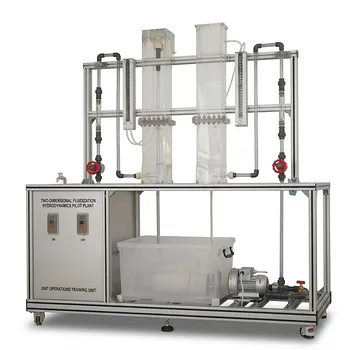
- Two-Dimensional Fluidization Hydrodynamics Educational Pilot Plant for Unit Operations Training
- Gas-Solid Heterogeneous Separation Demonstration Educational Unit Operations Pilot Plant
- Educational Unit Operations Pilot Plant for Intraparticle Diffusion Effective Factor Measurement
- Fixed-Bed Chemical Reaction and Gas Dust Tar Removal Unit Operations Pilot Plant
People Also Ask
- How do educational unit operations pilot plants bridge theory and design? Bridge the Engineering Gap
- How do educational unit operations pilot plants address safety and waste management when scaling up?
- When to transition from PID to adaptive control in pilot plants? Key process indicators.
- Why is the chemical plant startup schedule crucial? De-risk scale-up with pilot plants.
- Why Compare Predicted and Experimental Excess Enthalpy? Key to Accurate Pilot Plant Scale-up