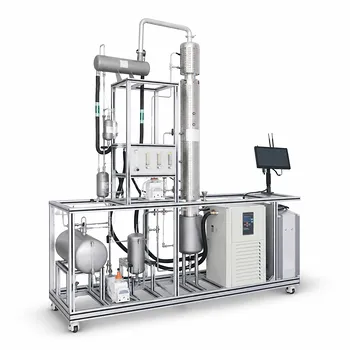
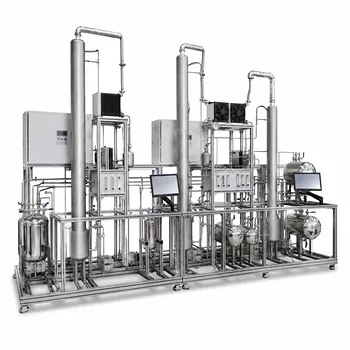
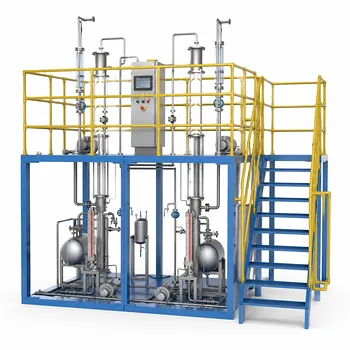
Azeotropic behavior is the defining operational constraint of any distillation pilot plant, dictating where standard separation fails and specialized techniques must begin. Positive azeotropes, like ethanol-water, create a minimum-boiling mixture that concentrates at the top of the column, preventing you from obtaining a pure overhead product. Negative azeotropes, such as hydrochloric acid-water, create a maximum-boiling mixture that locks up a component in the bottom, preventing a pure bottoms product. In both cases, the core operational impact is identical: the pilot plant hits a hard thermodynamic wall where vapor and liquid compositions become equal, and further separation in a standard column is impossible.
The behavior of an azeotropic mixture transforms a distillation pilot plant from a simple purification tool into a system defined by a thermodynamic barrier. The key to successful operation isn't fighting this barrier, but recognizing that the azeotrope—whether positive or negative—fixes the maximum achievable purity on one side of the column. Your entire pilot plant strategy must then shift from simple fractional distillation to pressure manipulation or the strategic introduction of a third component to bypass this limitation.
Thermodynamic Roots of an Operational Dead End
The challenge begins at the molecular level and manifests directly in your pilot plant's glass columns. Understanding this connection is the first step to moving from a frustrated operator to a skilled researcher.
How the Azeotropic Point Arrests Separation
In a pilot plant, you witness the azeotropic point when your column’s temperature profile and composition profile flatten into a "pinch zone." This is where the vapor-liquid equilibrium (VLE) curve intersects the 45-degree line on a McCabe-Thiele diagram.
At this exact composition, the vapor generated from the boiling liquid has an identical composition to the liquid itself. No amount of additional equilibrium stages or increased reflux can break through this point. The column is simply circulating a mixture of constant composition, and your top temperature will stubbornly refuse to reach the boiling point of a pure component.
Distinguishing Positive and Negative Behavior in the Column
The type of azeotrope dictates where this failure occurs in your pilot plant, which is a critical operational distinction.
- Positive Azeotropes (Minimum-Boiling): These mixtures boil at a temperature lower than either pure component. In your pilot plant, the azeotropic mixture will be more volatile and concentrate at the top of the column. Your distillate will approach the azeotropic composition, never pure A or B. The bottoms product, however, can be a pure component. The classic example is an ethanol-water mixture, which plateaus at roughly 95% ethanol in the overheads.
- Negative Azeotropes (Maximum-Boiling): These mixtures boil at a temperature higher than either pure component. The azeotrope is the least volatile species. Consequently, it concentrates in the bottom of your column, preventing you from obtaining a pure bottoms product. Your distillate, in this case, can be pure. A typical example is a water-hydrochloric acid system, where the high-boiling azeotrope locks up the acid in the reboiler.
Configuring the Pilot Plant to Overcome Azeotropic Barriers
Once you’ve identified the type of azeotrope limiting your separation, the pilot plant must be reconfigured. The goal is no longer simple rectification but rather a manipulation of the thermodynamic landscape.
Exploiting Pressure Sensitivity with Modular Columns
The composition of an azeotrope is highly sensitive to pressure. This principle is the basis of pressure-swing distillation, a technique perfectly suited for a flexible educational pilot plant.
If your azeotrope, like the ethanol-water system, shifts significantly with pressure, you can link two columns operating at different pressures. The first column, at atmospheric pressure, produces a distillate at the azeotropic composition. This stream is fed to a second column at a higher (or lower) pressure, where the azeotropic composition has shifted. Because the feed composition is now on one side of the new azeotrope, one of the pure components can be separated. The other stream, approaching the second azeotrope, is recycled back to the first column.
Introducing an Entrainer: Azeotropic vs. Extractive Distillation
When pressure manipulation is insufficient, you must introduce a third component—an entrainer—to alter the relative volatility of your original components. The physical configuration of the pilot plant changes dramatically depending on which method you choose.
- Azeotropic Distillation in a Pilot Plant: The entrainer forms a new, low-boiling azeotrope with one of the original components. This new azeotrope exits the top of your primary column. The setup requires a decanter—a module that allows you to visually observe and separate the condensed overhead vapor into two liquid phases. The entrainer-rich phase is recycled to the primary column, and the other phase is sent to a second column for final purification. Your pilot plant must be configured with the necessary pumps and piping for this recycling loop.
- Extractive Distillation in a Pilot Plant: The entrainer is a high-boiling solvent that does not form an azeotrope but selectively interacts with one component. It is introduced near the top of the column and exits from the bottom along with one of the feed components. This demands a different pilot plant layout. The main column's bottoms product is routed to a solvent recovery column. Here, the high-boiling entrainer is recovered from the bottom and recycled back to the main column, while the other purified component is taken from the top.
Bypassing the Problem Entirely with Hybrid Systems
Sometimes the most elegant demonstration in a modern unit operations lab is a hybrid system. Instead of adding chemicals to the mixture, you can couple the distillation column with a different unit operation.
A classic configuration links a distillation column with a pervaporation (PV) unit. Here, your distillation column concentrates the mixture to near the azeotropic point, performing the bulk separation. The near-azeotropic distillate is then fed to the PV pilot plant, where a selective membrane acts as a molecular filter. The membrane, operating by a solution-diffusion mechanism rather than volatility, removes a component—like water from ethanol—producing a pure product without needing entrainers.
Navigating the Complexities of Ternary Systems
The behavior becomes far more intricate—and educationally rich—when dealing with three or more components, as the phase diagram introduces distillation boundaries.
Understanding Distillation Boundaries
A distillation boundary on a ternary diagram is a barrier that a mass balance line between your feed, distillate, and bottoms products cannot cross with simple rectification.
If your pilot plant’s feed composition lies in one distillation region, you are thermodynamically prohibited from obtaining a pure component that lies in a different region. For example, you may be able to get a pure bottom product and a distillate on the boundary, but you cannot cross the boundary to reach a different pure vertex. Recognizing these boundaries through VLE modeling before a pilot plant run is crucial for predicting achievable product compositions.
Demonstrating How to Cross Boundaries
To demonstrate crossing these forbidden lines, the pilot plant must again be reconfigured with an additional separating agent. Techniques like salt-effect distillation or reactive distillation provide powerful visual lessons.
By adding a dissolved salt as a separating agent from an upper port, you can alter the liquid-phase activity coefficients, effectively warping the phase diagram and shifting or eliminating the azeotrope entirely. Alternatively, with a reactive distillation column—often packed with a catalyst section—you can react one component away, breaking the ternary azeotrope and allowing for the separation of the remaining products in a single, integrated unit.
Understanding the Operational Trade-offs
Choosing the right method for your pilot plant requires an objective look at the complexities and costs of each approach. Declaring one method "best" misses the point of unit operations research.
The Hidden Cost of Entrainers
Implementing azeotropic or extractive distillation in a pilot plant introduces significant operational hurdles. Entrainer recycling loops demand precise control of additional pumps, reflux ratios, and inventory levels. A student or researcher must monitor the decanter interface level in an azeotropic setup, as a loss of the entrainer phase can halt the entire separation. Furthermore, the introduction of a third component creates a new challenge: the final product's purity can be compromised by trace entrainer contamination, requiring additional analytical steps like gas chromatography for verification.
The Energy and Time Penalty of Complex Configurations
A pressure-swing distillation experiment is conceptually elegant but operationally demanding. Running two columns in a coupled, steady-state loop takes significant time to stabilize. The energy consumption, while potentially lower than some alternatives, is still substantial. A pervaporation pilot plant offers low-temperature operation and circumvents volatile entrainers, but it introduces the trade-off of lower throughput, membrane fouling susceptibility, and the high capital cost of the membrane modules themselves. There is no free lunch in industrial thermodynamics.
Making the Right Choice for Your Pilot Plant Goal
Your selection of an azeotropic separation strategy in a pilot plant should be directly tied to your primary objective, whether it's education, fundamental research, or process simulation.
- If your primary focus is demonstrating thermodynamic principles: Choose pressure-swing distillation. It cleanly illustrates how phase equilibria shift without the confounding complexity of a third component.
- If your primary focus is replicating large-scale industrial processes: Configure the pilot plant for azeotropic distillation with a decanter or extractive distillation with a solvent recovery column to teach the critical skill of running and troubleshooting entrainer loops.
- If your primary focus is exploring green chemistry and energy efficiency: Implement the hybrid distillation-pervaporation system to quantify the energy savings and purity advantages of membrane-assisted separation firsthand.
By aligning your pilot plant's configuration with the specific nature of the azeotropic barrier you face, you transform a fundamental thermodynamic limitation into a powerful, hands-on investigation of the art of modern separation.
Summary Table:
| Azeotrope Type | Boiling Point Behavior | Column Concentration | Key Product Limitation |
|---|---|---|---|
| Positive (Minimum-Boiling) | Lower than pure components | Concentrates at the top (distillate) | Prevents pure overhead product |
| Negative (Maximum-Boiling) | Higher than pure components | Concentrates at the bottom (reboiler) | Prevents pure bottoms product |
Enhance Your Chemical Engineering Lab with LABPARK
Mastering thermodynamic barriers like azeotropic mixtures requires hands-on experience with flexible, high-precision equipment. LABPARK designs and supplies premium Educational and Vocational Unit Operations Pilot Plants in chemical engineering, bioprocess & biotech, and environmental & water treatment.
Engineered specifically for universities, research institutes, and enterprises, our pilot plants empower students and researchers to safely explore advanced separation techniques—including pressure-swing, extractive, and hybrid membrane systems.
Ready to elevate your engineering curriculum or research capabilities? Contact LABPARK today to discuss your custom pilot plant configuration!
Related Products
- Continuous Sieve-Plate Distillation Pilot Plant for Unit Operations Laboratory Education
- Multi-Modal Distillation Unit Operations Training Pilot Plant
- Green Anhydrous Ethanol Purification Extractive Distillation Unit Operations Training Pilot Plant
- Dual-Mode Rectification Pilot Plant for Practical Training Unit Operations
- Ethyl Acetate Synthesis Unit Operations Pilot Plant for Practical Training
People Also Ask
- How to select the right activity coefficient model (Wilson, NRTL, UNIQUAC) for distillation pilot plants?
- How can real-time carbon number prediction improve distillation pilot plants? Optimize control.
- How does catalyst water concentration affect distillation pilot plant design? Key separation train choices.
- Why is vacuum operation capability an essential feature for a distillation unit operations pilot plant? Unlock Efficiency
- What are the primary reflux ratio control strategies? Master Distillation Unit Operations