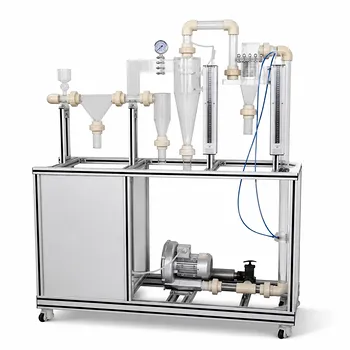
In a chemical engineering laboratory, a single fluidized bed is a master of uniformity, but a slave to statistics. While it provides excellent heat transfer and temperature control, it suffers from a wide solids Residence Time Distribution (RTD) that allows unreacted particles to bypass the system quickly. Staging a fluidized bed reactor—such as splitting a single unit into a three-stage fluidized reduction unit—directly mitigates this bypass. It compels the solids to flow sequentially through discrete mixing zones, which mathematically narrows the overall RTD, enhances gas-solid contact, and drives conversion efficiency toward that of a plug-flow reactor.
Core Takeaway: The fundamental flaw of a single-stage fluidized bed is short-circuiting; some solid particles exit before reacting. Staging solves this by creating a cascade of perfectly mixed compartments. Each stage narrows the distribution of time solids spend in the reactor, ensuring that nearly every particle achieves the required minimum residence time for full conversion without having to massively oversize the vessel.
The Critical Problem: Short-Circuiting in Single-Stage Beds
A standard fluidized bed pilot plant excels at maintaining an isothermal profile, which is critical for exothermic reduction reactions. However, its hydrodynamics create a conversion bottleneck.
The Wide Bell Curve of Residence Time
A single fluidized bed behaves statistically like a single Continuous Stirred Tank Reactor (CSTR) for solids. When solids are continuously fed into a violent, turbulent bed, some particles prematurely escape via elutriation or high-velocity channels within seconds, while others linger for hours. This is known as backmixing.
Local Conversion vs. True Conversion
In laboratory experiments, you may observe that the gas concentration changes across the dense bed. This creates a "local" conversion that masks the true problem. If a solid particle bypasses the reaction zone entirely through a gas bubble (short-circuiting), it doesn't matter how efficient the local gas-solid contact is—that particle exits unconverted.
How Staging Upgrades the System
Connecting multiple distinct fluidized beds in series fundamentally alters the statistical probability of survival for unreacted particles.
Transforming Residence Time Distribution
By staging the unit into three distinct beds, you force the solid flow through boundaries that restrict immediate bypass. The overall RTD of a three-stage reactor is the convolution of three single-tank RTDs. This compresses the probability density function, eliminating the "tail" of fast-escaping particles and creating a delay that ensures a minimum processing time for all solids.
The Cascading Conversion Effect
The solid conversion is no longer a single calculation but a stepwise accumulation. In your pilot plant model, you calculate the unconverted fraction by accounting for the elutriation constant and cyclone efficiency of each stage. Solids that fail to convert in Stage 1 drop into Stage 2, which is exposed to fresh, high-reactivity gas. This counters the driving force decay inherent in a single-stage process.
Eliminating the Gas Bypass Penalty
In a deep single bed, large gas bubbles rise fast, carrying solids in their wakes and creating a bypass. In a multi-stage shallow bed design, bubble sizes are constrained. In these shallower beds, lateral mixing becomes the dominant transport mechanism rather than bubble-driven backmixing. The gas must work harder to escape without reacting, which empirically improves the calculated solid conversion rate.
Unconventional Heuristic: The Drying Analogy
Think of solids conversion like drying a batch of wet sand. A single, deep fluidized bed is like laying all the wet sand on a tray and blasting it with hot air. Some sand at the top dries instantly, some at the bottom stays wet, and the "average" looks fine, but the quality is inconsistent. Staging a fluidized pilot plant is like passing the sand over three successive conveyor belts with dedicated heaters. Every grain must prove it is dry before moving to the next belt. The total time the sand spends in the system is the same, but the guarantee that every single grain has been uniformly processed vastly improves the final yield of dry product.
Understanding the Trade-offs
While staging is functionally superior for conversion, a pilot plant operator must balance this against mechanical reality.
The Catalyst Attrition Penalty
Fluidized beds require smaller catalyst particles (often 0.07 mm to 3.0 mm) to maximize reactive surface area. Adding multiple stages requires additional internal weirs, downcomers, or cyclone transfer lines. Attrition (particle breakage) is magnified in a multi-stage unit, which is a critical consideration if you are running experiments with expensive noble-metal reduction catalysts.
Pressure Drop and Complexity
A single fluidized bed has a stable pressure drop. A three-stage unit requires careful balancing of pressure drops across interconnecting flow orifices to prevent gas leakage or "blowing" of the solids seal. The mechanical design is substantially more complex, introducing potential operational hiccups during a teaching laboratory session.
Bubbling vs. Lateral Mixing Control
If your pilot plant's individual stages are still deep enough to generate large bubbles, staging loses its advantage. The controlling mechanism shifts back to mass transfer across the bubble/emulsion interface, and the RTD benefits are not fully realized. You must design the stages to be shallow enough to suppress excessive bubble growth.
How to Apply This to Your Pilot Plant Experiments
Your choice between a single-stage and a multi-stage fluidized reduction unit should be dictated by the research objective, not just the continuous desire for higher conversion.
- If your primary focus is demonstrating intrinsic catalytic kinetics and eliminating heat transfer disguise: A single dense-phase bed is often superior because it guarantees isothermal conditions. You can mathematically back out the RTD broadening in your data analysis.
- If your primary focus is maximizing solid conversion efficiency for a specific chemical reduction process: The staged fluidized bed is non-negotiable. It physically prevents unreacted solids from exiting, making it essential for high-purity outputs in processes like direct iron ore reduction.
- If your primary focus is teaching industrial scale-up realities: The multi-stage pilot plant is the better educational tool. It forces students to grapple with complex RTD models, cyclonic recirculation rates, and the practical nuances of elutriation constants in a way that a simple single backmixed bed cannot replicate.
By compartmentalizing the chaos of fluidization, staging converts a statistical gamble into an engineering certainty, ensuring that in your laboratory, no particle is left behind.
Summary Table:
| Feature | Single-Stage Fluidized Bed | Multi-Stage (3-Stage) Fluidized Bed |
|---|---|---|
| Residence Time Distribution (RTD) | Wide (high particle backmixing & bypass) | Narrow (approaches plug-flow behavior) |
| Conversion Efficiency | Lower due to particle short-circuiting | Higher through stepwise accumulation |
| Gas Bypass & Bubbling | High bypass; bubble size is unconstrained | Minimized; shallow beds suppress bubble growth |
| Operation Complexity | Low; stable pressure drop | High; requires balancing of stage pressure drops |
| Primary Use Case | Kinetic studies & isothermal reaction modeling | High-purity product yields & scale-up training |
Bring Industrial Scale-Up Reality to Your Lab with LABPARK
Are you looking to equip your laboratory with advanced chemical engineering systems? LABPARK provides state-of-the-art Educational and Vocational Unit Operations Pilot Plants in chemical engineering, bioprocess & biotech, and environmental & water treatment for universities, research institutes, and enterprises.
Whether you need to demonstrate complex RTD models, study fluidization dynamics, or maximize solid conversion efficiency, our pilot plants are engineered to deliver reliable performance and hands-on learning experiences.
Contact LABPARK today to discuss your laboratory requirements and discover how we can add value to your educational and research programs!
Related Products
- Crude Benzene Hydrogenation Educational Unit Operations Pilot Plant
- Fluidized Bed Gas Solid Catalytic Reaction Educational Pilot Plant
- Multi Functional Catalytic Reaction and Reactor Evaluation Educational Unit Operations Pilot Plant
- Gas Phase Mixing and Residence Time Distribution Determination Educational Unit Operations Pilot Plant
- Multi-Stage Stirred Tanks in Series Residence Time Distribution and Mixing Performance Determination Educational Pilot Plant
People Also Ask
- What process control features are essential in a benzene hydrogenation pilot plant? Safe & Efficient Operation
- How can flow-NMR be integrated with pilot plant reactors to monitor kinetics? A Complete Guide
- How to design experiments when runs exceed reactor capacity? Master Statistical Blocking
- How do bulk and solution polymerization compare? Key pilot plant reactor design tips.
- How does gas flow configuration impact reactor pressure drop & catalyst efficiency? Axial-radial vs. axial flow.