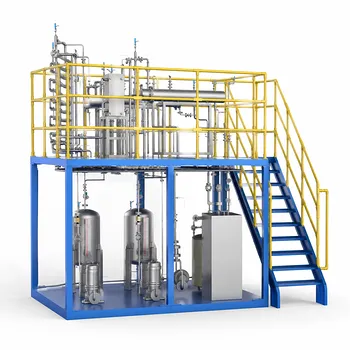
Higher cracking temperatures accelerate primary bond-breaking to produce valuable olefins, but they also trigger secondary coking reactions that destroy product and foul the reactor.
The crux of managing a pilot plant lies not just in setting a single temperature, but in precisely controlling the temperature profile along the reactor length and synergistically adjusting residence time and dilution. At moderate temperatures, primary cracking dominates, giving high yields of ethylene and propylene. Push too high, and the same heat that drives the desirable reactions also fuels dehydrogenation, cyclization, and coke formation that plate walls and plug catalyst beds.
In a unit operations pilot plant, the temperature-yield relationship is a dynamic balance: higher temperatures favor the kinetics of primary olefin formation, but the real yield depends on how quickly you remove products from the heat zone—shorter residence times at higher temperatures suppress secondary coking and maximize net olefin output.
The Kinetic Influence of Temperature on Cracking Reactions
Why Higher Temperatures Shift Selectivity
Cracking is an endothermic process, meaning it absorbs heat. Primary cracking reactions—the cleavage of long-chain hydrocarbons into short-chain olefins like ethylene and propylene—have high activation energies. Raising the temperature dramatically increases the fraction of molecules that can overcome this barrier, accelerating the formation of these target products.
However, the same energy also activates secondary reactions: generated olefins can recombine, dehydrogenate, or cyclize into aromatics and eventually coke. Because primary reactions are kinetically faster at short times, a well-designed pilot plant can exploit this window.
The Window of Optimal Yield
At a given temperature, there is an optimum residence time that maximizes olefin yield. If the feed spends too long in the hot zone, the very products you want are consumed. The supplementary bond energetics clarify why: carbon-carbon double bonds (682 kJ/mol) are reactive intermediates that easily undergo further addition or rearrangement if given enough thermal energy and time. In practice, a 0.1-second reduction in residence time can prevent a significant drop in ethylene yield.
Managing the Temperature-Residence Time Trade-off in a Pilot Plant
Precise Temperature Profiling
Your primary reference underscores that precise temperature profiling along the reactor tube is critical. A single thermocouple at the outlet is insufficient. Educational and research pilot plants must employ multi-zone heating jackets or furnace elements with independent controllers and internal thermocouples placed at multiple axial positions. This allows you to map the endothermic cooling of the reaction and ensure the temperature ramp aligns with the desired cracking zone, preventing hot spots that catalyze coke.
Coupling Temperature with Residence Time
The most powerful knobs you can turn are temperature and residence time in tandem. If you raise the setpoint to boost primary cracking rates, you must simultaneously reduce residence time (e.g., by increasing feed flow rate or decreasing reactor volume). Supplementary data shows that moving from 0.7 s to 0.4 s at elevated temperatures can maintain high ethylene while suppressing secondary products. In pilot-scale operation, this relationship is studied by systematically varying both parameters and analyzing off-gas composition in real time.
Steam Dilution: A Critical Management Tool
In thermal cracking pilot plants, steam injection is non-negotiable. It reduces the partial pressure of hydrocarbons, shifting equilibrium away from polymerization and coking. Steam also serves as a heat carrier, smoothing temperature gradients and extending run time between decoking cycles. Your operating procedure should always include a steam-to-hydrocarbon ratio setpoint and a dedicated mass flow controller.
Distinguishing Thermal, Catalytic, and Hydrocracking Processes
Thermal Cracking: Random vs. Ordered
Thermal cracking uses free-radical mechanisms; temperature directly controls the selectivity. The yields skew toward very light gases (C₂ and C₃), with little branching. In contrast, catalytic cracking works via carbenium ion intermediates, giving more isomerization and a gasoline-range product. In a pilot plant equipped with both modules, you can demonstrate how a catalyst lowers the effective activation energy and allows lower temperature operation (typically 700–800 K) while radically changing the carbon number distribution.
Hydrocracking: The Exothermic Exception
Unlike thermal cracking, hydrocracking is overall exothermic because hydrogenation reactions release far more heat than the cracking step absorbs. The supplementary references note heat releases of 326–374 kJ/mol. In a pilot plant, this demands a fundamentally different thermal management strategy: multi-zone temperature controllers must actively remove heat, often using interbed hydrogen quench gas. Without active cooling, hot spots in the catalyst bed can cause temperature runaways and rapid coking. Students learn to observe the catalyst bed exotherm profile and adjust quench flow to keep the bed within a narrow range (e.g., 610–710 K for first stage).
Practical Temperature Control Strategies for Safe and Productive Experiments
Instrumentation and Safety Interlocks
Your pilot plant must be equipped with:
- Multiple internal thermocouples spaced along the reactor axis.
- High-pressure mass flow controllers for precise feed and steam/quench gas.
- Gas-liquid separators and product sampling loops to generate real-time yield data.
- Over-temperature alarms tied to furnace shutdown.
These allow you to study stage-specific conditions: mild hydrocracking at 670–700 K and 50–80 bar, second stage at 530–650 K with high-pressure H₂, all within the same facility.
Coping with Heat Transfer Resistance and Coke
As coke deposits on the reactor wall, the heat transfer coefficient drops. You'll observe a slow rise in wall temperature for a given heater power, or a drop in outlet temperature if control is feedback-driven. In a research setting, this signals it's time to switch to decoking mode (steam-air cycles). Designing experiments with consistent coking resistance allows you to isolate the kinetic effects of temperature without being confounded by fouling.
Understanding the Trade-offs
Olefin Yield vs. Reactor Integrity
Higher temperatures can push ethylene selectivity to its thermodynamic limit, but coke formation accelerates exponentially past a certain threshold (often around 1100 K for ethane cracking). The resultant carbon deposits increase pressure drop, reduce heat transfer, and eventually choke the reactor. A pilot plant operator must decide whether to optimize for maximum instantaneous yield (accepting shorter run times) or a slightly lower yield with prolonged, stable operation.
Energy Cost and Heat Integration
Endothermic cracking demands substantial furnace duty. Pushing to extreme temperatures without optimizing heat recovery raises energy consumption disproportionately. In a pilot plant, this is a great opportunity to study heat integration schemes—preheating feed with flue gas or product quenching—that are core to industrial cost efficiency.
Catalyst Deactivation in Hydrocracking
For catalytic and hydrocracking modules, higher temperatures initially compensate for catalyst aging, but over time, the required temperature to maintain conversion creeps up. This is a key learning outcome: tracking the “temperature required for constant conversion” over days reveals the deactivation rate, which links directly to feed impurities and coking propensity.
Making the Right Choice for Your Pilot Plant Goal
Your temperature management approach depends entirely on what you want to investigate or demonstrate.
- If your primary focus is maximizing light olefin yield in thermal cracking: Operate at the highest temperature your metallurgy allows while aggressively reducing residence time (0.1–0.4 s) and using a high steam dilution ratio. Use a multi-zone profile that ramps quickly to peak temperature and quenches immediately.
- If your primary focus is observing coking mechanisms and reactor fouling: Run at a deliberately elevated outlet temperature with a longer residence time. Monitor the axial pressure drop and wall thermocouples over time to characterize coking kinetics; this teaches the cost of pushing past the yield optimum.
- If your primary focus is simulating industrial hydrocracking stages: Program multi-zone controllers to mimic the exotherm shape of a commercial bed, use hydrogen quench between beds, and systematically vary temperature to demonstrate “temperature-required” deactivation trends.
- If your primary focus is safe, educational demonstration of reaction kinetics: Keep temperatures in the moderate range (e.g., 700–800 K for thermal), use jacketed CSTR or short-contact-time tubular reactors, and collect data to compute Arrhenius parameters, always prioritizing steady-state control over extreme push conditions.
Temperature is not a set-it-and-forget-it variable—it is a precise tool that, when coupled with residence time, dilution, and active cooling, defines the boundary between a research breakthrough and a plugged reactor. Master that interplay, and your pilot plant becomes a powerful engine for both fundamental insight and operational skill.
Summary Table:
| Cracking Process | Thermal Behavior | Key Yields | Critical Control Strategy |
|---|---|---|---|
| Thermal Cracking | Endothermic | Light Olefins (C₂ & C₃) | Short residence time (0.1–0.4s), steam dilution |
| Catalytic Cracking | Endothermic | Isomerized, gasoline-range | Catalyst integration to lower reaction temp (700–800 K) |
| Hydrocracking | Exothermic | High-quality fuels | Active heat removal, multi-zone hydrogen (H₂) quench |
Optimize Your Research and Training with LABPARK
Achieving precise thermal control is critical for maximizing yields and preventing reactor fouling in hydrocarbon cracking. LABPARK provides high-quality Educational and Vocational Unit Operations Pilot Plants in chemical engineering, bioprocess & biotech, and environmental & water treatment.
Designed specifically for universities, research institutes, and enterprises, our pilot plants empower your students and researchers with hands-on, industry-relevant experience in advanced process control.
Ready to elevate your laboratory capabilities? Contact LABPARK today to find the perfect pilot plant solution for your institution!
Related Products
- Carbon Dioxide Hydrogen Methanol Synthesis Educational Unit Operations Pilot Plant
- Multi Pump Fluid Transport Process Piping Unit Operations Training Pilot Plant
- Natural Product Extraction Unit Operations Training Pilot Plant
- Multi-Modal Distillation Unit Operations Training Pilot Plant
- Multi-Reactor Educational Pilot Plant for Reaction Engineering Unit Operations
People Also Ask
- How do temp & pressure affect methanol synthesis pilot plants? Optimize equilibrium and catalyst performance.
- Why is a purge system necessary when operating a gas recirculation loop in a methanol synthesis pilot plant? (Guide)
- Why do modern methanol pilot plants operate at lower pressures? Catalyst & Feed Requirements Explained
- What are the operational requirements for catalyst activation? Safe Methanol Pilot Plant Operation
- Why is the chemical plant startup schedule crucial? De-risk scale-up with pilot plants.