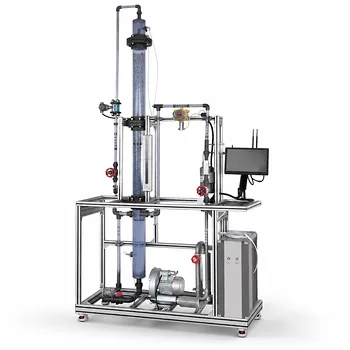
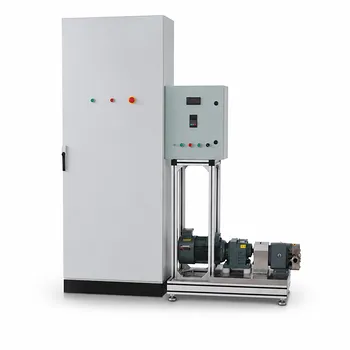
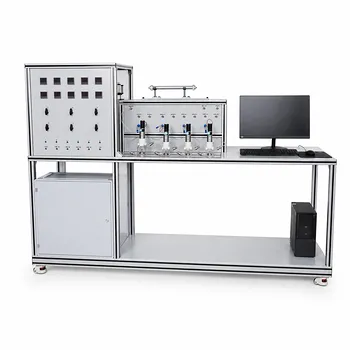
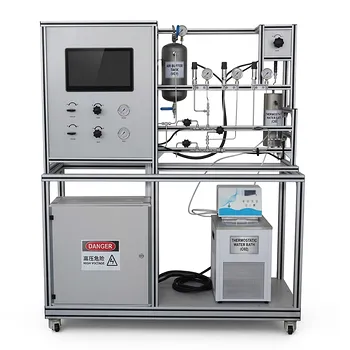
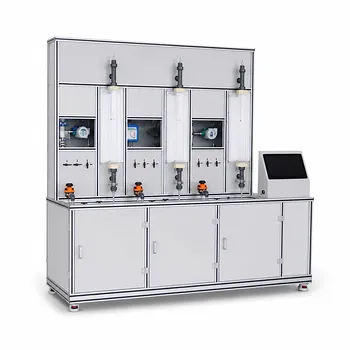
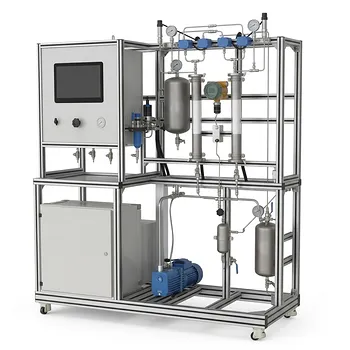
The simple answer is that more pressure forces more carbon dioxide into water. At room temperature, doubling the pressure roughly doubles the amount of CO₂ dissolved, at least up to about 6 atmospheres. In gas-liquid pilot plants, this principle is directly demonstrated by pressurizing a water-filled vessel with CO₂, allowing students to watch the gas dissolve, and then venting the pressure to trigger a visible burst of effervescence as the excess gas rushes out of solution.
Understanding how pressure controls CO₂ solubility is a gateway to mastering absorption, desorption, and the core thermodynamics of gas-liquid separation. Pilot plants make this abstract relationship tangible by letting you flip a valve and see equilibrium shift before your eyes.
The Physics: Henry’s Law in Action
Why Pressure Drives Gas Into Liquid
At a fixed temperature, the amount of carbon dioxide that can dissolve in water is directly proportional to the partial pressure of CO₂ above the water. This is Henry’s law in its simplest form.
When you increase the pressure above the liquid surface, you pack more CO₂ molecules into the gas phase. This raises the frequency of molecules striking the gas-liquid interface and entering the liquid. Equilibrium is established only when the rate of gas entering the liquid matches the rate of gas escaping. A higher pressure shifts that balance point toward a higher dissolved concentration.
A Demonstrably Proportional Relationship
For the CO₂-water system, this proportionality holds exceptionally well up to about 6 atmospheres. At room temperature and normal atmospheric pressure (1 atm), water dissolves approximately its own volume of CO₂. At 6 atm, it will dissolve roughly six times that volume. This straightforward scaling makes the system perfect for educational demonstration.
Pressure’s Limit: Why It’s Not Infinite
Henry’s law is a limiting relationship. At very high pressures or when the dissolved gas concentration becomes substantial, the assumption of an ideal dilute solution breaks down. For CO₂ in water, this means the direct proportionality you see below 6 atm begins to curve at higher pressures, requiring more sophisticated thermodynamic models like Edwards’ correlation or Pitzer’s equation to predict solubility accurately.
How Pilot Plants Demonstrate the Principle
The Carbonation Pressure Window
In educational unit operations pilot plants, the CO₂-water system is typically operated between 4 and 8 atmospheres (60 to 120 psi). This pressure range is deliberately chosen because it sits squarely within the linear Henry’s law regime, giving clean, predictable results.
Students use high-pressure sight glasses or transparent vessels to observe the liquid phase as CO₂ is introduced. At 6 atm, the water remains crystal clear, but the amount of gas dissolved is far above what the liquid could hold at 1 atm.
The Dramatic Decompression Step
The real demonstration happens when the pressure is quickly reduced back to atmospheric. As soon as the gas-phase pressure drops, the equilibrium liquid concentration required by Henry’s law plummets.
The liquid now holds far more dissolved gas than it is allowed to keep at the new, lower pressure. This supersaturated condition drives rapid desorption, and the excess CO₂ nucleates into a storm of bubbles. The effervescence is a direct, visual confirmation that solubility is a pressure-dependent equilibrium, not a permanent state.
Linking to Industrial Absorption and Regeneration
This single vessel demonstration is a miniature version of the cyclic processes used in acid gas removal and carbon capture. Pressurize to absorb, depressurize to regenerate the solvent. By varying the pressure stepwise, students can build absorption curves, verify Henry’s law constants, and measure how much gas is released at each pressure drop.
The Deeper Mechanism: Equilibrium Shift, Not Just Bubbles
The Driving Force for Mass Transfer
At the heart of gas-liquid operations is the difference between the actual dissolved gas concentration and the equilibrium concentration dictated by pressure. When you increase the CO₂ partial pressure, the equilibrium liquid concentration rises. If the actual liquid concentration is lower, CO₂ molecules move from the gas phase into the liquid. This is absorption.
When you cut the pressure, the equilibrium concentration drops sharply. The actual liquid concentration is now much higher than the new equilibrium value, and the direction of mass transfer reverses. CO₂ leaves the liquid. This is desorption. The pilot plant demonstration is not just about bubbles; it is a direct measurement of a thermodynamic driving force.
Why Temperature Matters Too
Pressure is not the only knob you can turn. Gas solubility decreases near-linearly with rising temperature. A well-designed pilot plant exercise often couples pressure changes with temperature changes. For example, running absorption at cooler temperatures (to enhance solubility) and then heating the liquid to strip out the dissolved gas. This shows students how two thermodynamic variables interact to control the same equilibrium line.
Understanding the Trade-offs in High-Pressure Operation
The Cost of Compression
While higher pressure always increases solubility, the mechanical energy required to compress the gas rises significantly. In industrial design, an economic optimum must be struck between the absorption gains and the power cost. In a pilot plant, this translates to a discussion: you could go to 10 atm, but your compressor size and vessel wall thickness would both increase.
Safety and Material Constraints
Demonstration vessels rated for 60–120 psi are common and safe. Moving to higher pressures requires more robust equipment, specialized safety systems, and a greater distance from the clean Henry’s law window. The 4–8 atm range used in teaching labs is a deliberate trade-off: high enough to show dramatic solubility enhancement, low enough to keep the equipment simple, transparent, and safe for hands-on learning.
The Unwanted Escape of Liquid
At low pressures, some water vapor enters the gas phase, and you lose liquid inventory. High-pressure operation suppresses this vaporization, effectively trapping more of the liquid phase in the system. This is a secondary benefit, but in an educational pilot plant it provides a talking point about solvent loss in real absorption columns and why off-gas recovery equipment is sized based on pressure.
Making the Right Choice for Your Goal
Whether you are designing an experiment or selecting a pilot-plant exercise, your objective will determine the pressure regime and the focus of the demonstration.
- If your primary focus is teaching the core physics of Henry’s law: Operate the CO₂-water system at multiple pressures between 1 and 6 atm at constant temperature. The linear solubility data will directly reveal the proportionality constant and make the law tangible.
- If your primary focus is demonstrating a complete industrial absorption cycle: Use a two-step pressure swing: absorb at high pressure (6–8 atm) in a packed column, then regenerate the solvent by dropping to near-atmospheric pressure. This mimics carbon capture processes and quantifies the driving force.
- If your primary focus is exploring advanced thermodynamics: Combine pressure manipulation with deliberate temperature changes and measure solubility over a wider range. Use the deviations from Henry’s law at high pressure or concentration to introduce non-ideal models like Edwards’ correlation.
In every case, the core lesson is the same: pressure is the most direct, reversible lever you can pull to control how much CO₂ stays in—or comes out of—solution.
Summary Table:
| Pressure Range | CO₂ Solubility Level | Observed Phenomenon in Pilot Plants | Key Application / Concept |
|---|---|---|---|
| 1 atm (Low) | Baseline (~1x liquid volume) | Clear liquid, stable equilibrium | Henry's Law baseline |
| 4–8 atm (High) | Proportional increase (~4–8x) | Clear liquid under pressure | Absorption / Carbonation |
| Decompression | Rapid decrease to baseline | Dramatic effervescence (bubbling) | Desorption / Solvent regeneration |
Bring Thermodynamics to Life in Your Lab
Looking to enhance your engineering curriculum or research capabilities? LABPARK provides state-of-the-art Educational and Vocational Unit Operations Pilot Plants in chemical engineering, bioprocess & biotech, and environmental & water treatment.
Designed specifically for universities, research institutes, and enterprises, our pilot plants deliver:
- Hands-on Visual Learning: Turn abstract concepts like Henry's Law, gas absorption, and desorption into interactive, visual lessons.
- Industrial Relevance: Equip students and researchers with practical experience on scalable, industry-standard systems.
- Uncompromised Safety: Engineered with durable materials, transparent sight glasses, and safety systems optimized for educational environments.
Ready to upgrade your laboratory equipment? Contact LABPARK today to find the perfect pilot plant solution!
Related Products
- Two-Dimensional Fluidization Hydrodynamics Educational Pilot Plant for Unit Operations Training
- Packed Bed Absorption Educational Unit Operations Pilot Plant
- Quantitative Dosing and Liquid Flow Control Educational Unit Operations Pilot Plant
- Gas-Solid Heterogeneous Separation Demonstration Educational Unit Operations Pilot Plant
- Fixed-Bed Chemical Reaction and Gas Dust Tar Removal Unit Operations Pilot Plant
People Also Ask
- What pressure drop characteristics should students & researchers monitor in a fluidization pilot plant?
- How does active time pulsing mixing enhance fluid homogenization? Configuration Guide for Educational Pilot Plants
- How can acoustic chemometrics prevent reactor clogging in educational fluidized bed pilot plants?
- What is the operational significance of solids feed rate on emulsion phase dynamics in fluidized bed pilot plants?
- Why is UB/Ui critical in fluidized bed pilot plant modeling? Master Gas-Solid Contact