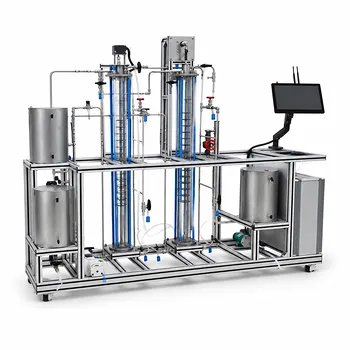
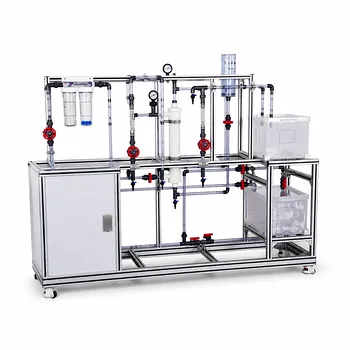
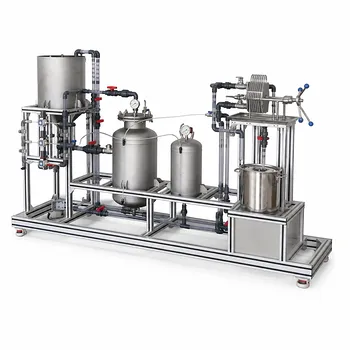
The core innovation of organic solvent nanofiltration is that it swaps a thermal separation for a physical one.
For solvent exchange in pilot plants, OSN uses nanoscale membranes to sieve solvents and retain valuable solutes at ambient temperature—directly avoiding the energy intensity and thermal degradation risks of conventional distillation. Conventional batch distillation operates by boiling off the old solvent, which can compromise heat-sensitive APIs and consumes significant heating and cooling energy. In contrast, OSN-based diafiltration accomplishes the same exchange at room temperature, minimizes solvent waste, and preserves product integrity.
The central trade-off is temperature versus throughput. Traditional distillation excels at high-volume, thermally robust separations, but OSN thrives where thermal sensitivity, solvent recovery at process temperature, and energy savings are paramount. The key design considerations for integrating OSN into a pilot plant center on membrane chemistry, molecular weight cut-off, and precise control of crossflow conditions to maintain stable flux and rejection.
The Fundamental Difference: Heat vs. a Barrier
Conventional distillation for solvent exchange relies on phase change. You heat the mixture, evaporate the lower-boiling solvent, and condense it. This works well for many bulk chemicals but is fundamentally limited by two factors: the relative volatility of the solvents and the thermal stability of the dissolved solids.
Why Distillation Fails for Thermally Sensitive APIs
In pilot plants handling high-value, heat-sensitive molecules—like active pharmaceutical ingredients—elevated temperatures can cause degradation, color formation, or unwanted side reactions. Even a brief temperature spike during a strip-and-replace distillation can destroy an entire batch.
Boiling also requires a full phase change.
That phase change consumes latent heat and demands cooling capacity downstream. In a pilot setting, this often means larger utility infrastructure, higher operating costs, and slower turnover times.
How OSN Circumvents the Heat Problem
An OSN module uses a polymeric membrane with nanoscale pores. You pump the solvent mixture tangentially across the membrane. Smaller molecules (the solvent) selectively permeate through the active layer, while larger solute molecules (your API) are rejected and retained.
The process is isothermal.
No boiling, no condensation, no thermal stress. You simply add fresh replacement solvent while removing the spent solvent through the membrane. This continuous or discontinuous diafiltration allows nearly complete solvent exchange without ever heating the product.
Solvent Consumption Efficiency
A typical batch distillation requires large excesses of the new solvent to push the old solvent out. Constant-level distillation can reduce this, but OSN’s diafiltration mode inherently minimizes solvent usage because the membrane rejects the solute almost quantitatively—commonly >95% to 99%—so only the unwanted solvent is removed.
You can achieve solvent savings well beyond what distillation allows.
Moreover, OSN can selectively recover up to 50% of the solvent in oil-mixture recovery streams by operating directly at or near the process temperature, slashing both heating and cooling loads.
How OSN Works Under the Hood: The Mechanisms You Must Control
Effective design in a pilot plant requires understanding the transport phenomena inside the membrane. This governs flux, rejection, and long-term stability.
Pore-Flow vs. Solution-Diffusion
OSN transport is modeled by two classic theories. The pore-flow model sees the membrane as a network of fine pores; the pressure gradient pushes solvent through, and solute transport reflects a sieving mechanism. The solution-diffusion model treats the active layer as a dense film where molecules dissolve into the polymer and diffuse down a concentration gradient.
In reality, both mechanisms often coexist.
This means you cannot rely on a single model to predict performance. Your pilot plant must allow you to systematically vary pressure and crossflow velocity to isolate the dominant resistance.
The Three Resistances That Dictate Flux
Flux through an OSN membrane is best described by a resistance-in-series approach. Three components oppose solvent flow:
- Surface resistance at the active layer: This is proportional to the difference in surface tension between the solvent and the membrane’s top layer. A poor match increases interfacial resistance and lowers flux.
- Viscous resistance through the nanofiltration pores: Governed by solvent viscosity and pore geometry, this follows a Hagen-Poiseuille–like relationship.
- Viscous resistance through the support layer: The porous backing adds its own frictional loss, again linked to viscosity.
Surface tension, viscosity, and membrane swelling each play a critical role.
Swelling alters pore size and polymer–solvent interactions, directly changing both rejection and permeability. Therefore, predicting flux across different solvents demands characterization of all three—not just viscosity.
Concentration Polarization and Osmotic Pressure
As rejected solutes accumulate near the membrane surface, the local solute concentration can reach 20 wt% or more. This creates an osmotic pressure gradient that opposes the applied pressure, reducing effective driving force.
High crossflow velocity mitigates this effect.
Precision control over crossflow is essential to sweep away the concentrated layer and maintain stable performance. Without it, your pilot data will be clouded by a boundary-layer artifact.
Key Design Considerations for Integrating OSN into Pilot Plants
Moving from theory to a functioning pilot module requires attention to four critical areas.
Membrane Chemical Durability and Swelling
You must match the membrane material to the solvent. Crosslinked polyacrylonitrile (PAN) membranes, for instance, show robust stability in methanol, ethanol, acetone, hexane, toluene, and THF. But not all polymers handle all solvents: a membrane that swells in contact with your target solvent will lose selectivity and mechanical integrity.
Prioritize chemical compatibility first, then optimize MWCO.
Hydrophilic membranes favor polar solvents; hydrophobic ones favor nonpolar media. Misalignment leads to rapid flux decline and potential rupture.
Molecular Weight Cut-Off (MWCO) Selection
The MWCO, typically between 250 and 700 g/mol for OSN membranes, determines what passes and what is rejected. For a quantitative solvent exchange, you need high solute rejection—95% to 99% minimum—to prevent product loss.
Choose an MWCO at least one-third to one-half the size of your solute’s molecular weight.
This gives a safety margin. A membrane that is too tight will sacrifice flux; one too loose will leak your API.
Operating Pressure and Crossflow Velocity Control
OSN is a pressure-driven process. You need accurate, high-precision pressure regulators and flow meters to hold the transmembrane pressure constant. Crossflow velocity must be sufficiently high to suppress concentration polarization but low enough to prevent excessive shear or energy consumption.
A well-instrumented pilot plant enables you to map the trade-off between flux and rejection.
Adjusting crossflow also helps you validate transport models and identify any onset of gel-layer formation.
Data Strategy: Building a Permeability Database
Determining the permeability of large, solid solute-like molecules (like pure solutes before dissolution) is notoriously difficult. You can’t measure a dry solid’s membrane permeability directly.
The solution is to build a comprehensive database of solvent permeabilities.
By characterizing pure solvent fluxes across a range of conditions, you can later predict performance for new solute–solvent combinations using established resistance-in-series correlations—avoiding trial-and-error for every new recipe.
Understanding the Trade-offs: When Distillation Still Wins
OSN is not a universal replacement. There are situations where traditional distillation remains the superior choice.
Throughput and cost. Distillation columns handle enormous mass flows with relatively simple equipment. Membranes, by contrast, scale with area; for very large streams, the capital cost and footprint can balloon. Fouling and long-term stability. Membranes can foul over time, especially in media containing particulates or strongly adsorbing solutes. Backwashing and cleaning protocols add complexity. Thermal robustness of the solute. If your substance can tolerate moderate heat without degradation, energy-efficient configurations like constant-level batch distillation can achieve significant solvent savings with lower membrane-related risk. Relative volatility. For mixtures with a high relative volatility (alpha > 5), simple distillation is extremely effective. OSN’s advantage evaporates when the thermal route is already efficient.
In a pilot plant, the smartest approach is often to showcase both technologies side by side.
Students and engineers can then directly quantify energy consumption, solvent purity, and product integrity—making the trade-off concrete.
Making the Right Choice for Your Pilot Plant Goal
Your objective determines whether OSN or distillation should anchor your solvent-exchange design. Use the following guide to decide.
- If your primary focus is preserving thermally sensitive APIs or high-value molecules: Lead with OSN-based diafiltration. The room-temperature operation and high solute rejection prevent degradation and minimize product loss.
- If your primary focus is rapid, high-volume processing of thermally stable solvents: Equip your pilot plant with a constant-level batch distillation setup. The automation of level control and lower relative volatility scenarios can yield over 50% solvent savings without the complexity of membranes.
- If your primary focus is education and comparative research: Install both an OSN module and a well-instrumented distillation column. Hands-on comparison directly reveals the energy, temperature, and efficiency differences, teaching the core principles that drive modern separations.
- If your primary focus is solvent recovery from mixed oil/solvent streams with no phase change: OSN is the clear winner. It selectively recovers up to half the solvent at process temperature, slashing heating and cooling demands.
The future of pilot-scale separations lies not in choosing one technology over the other, but in matching the tool to the molecule—and understanding exactly why each works.
Summary Table:
| Feature | Organic Solvent Nanofiltration (OSN) | Conventional Distillation |
|---|---|---|
| Separation Mechanism | Physical sieving (membrane barrier) | Thermal phase change (boiling/condensation) |
| Operating Temperature | Isothermal (ambient temperature) | Elevated (boiling point of solvent) |
| Thermal Degradation Risk | Negligible (ideal for heat-sensitive APIs) | High for thermally unstable molecules |
| Solvent Consumption | Minimal (efficient diafiltration mode) | High (requires excess solvent to drive exchange) |
| Primary Limitation | Membrane fouling, solvent compatibility | High energy utility costs, thermal stress |
Bring Next-Generation Separation Tech to Your Facility
Are you looking to enhance your research capability or upgrade your chemical engineering curriculum? LABPARK provides state-of-the-art Educational and Vocational Unit Operations Pilot Plants across chemical engineering, bioprocess & biotech, and environmental & water treatment.
Designed specifically for universities, research institutes, and enterprises, our pilot plants allow engineers and students to compare advanced membrane processes like OSN side-by-side with traditional distillation systems.
Contact LABPARK today to discuss your pilot plant needs and accelerate your scaling and educational goals!
Related Products
- Multifunctional Membrane Separation Educational Pilot Plant with Ultrafiltration, Nanofiltration, Reverse Osmosis
- Multi-Functional Membrane Separation Educational Pilot Plant for Unit Operations Lab
- Natural Product Extraction Unit Operations Training Pilot Plant
- Carbon Dioxide Absorption and Desorption Educational Pilot Plant for Carbon Capture Studies
- Hot Filtration Educational Unit Operations Pilot Plant Laboratory System
People Also Ask
- Pervaporation vs. Vapor Permeation: Handling Suspended Solids in Membrane Pilot Plants
- How do PEI, PVDF, and PSU membranes compare in pilot plants? Find the best fit.
- What are the trade-offs of polymer vs inorganic membranes in teaching pilot plants? Key laboratory comparison.
- How can operators optimize operating conditions and cleaning protocols in membrane separation pilot plants to mitigate fouling?
- What are the advantages of membrane separation in pilot plants? Efficient Organic Vapor Recovery