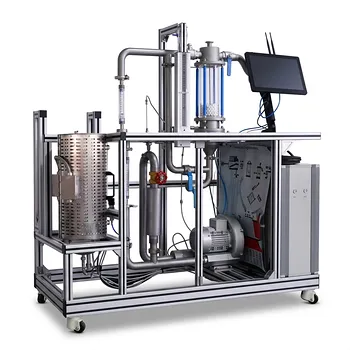
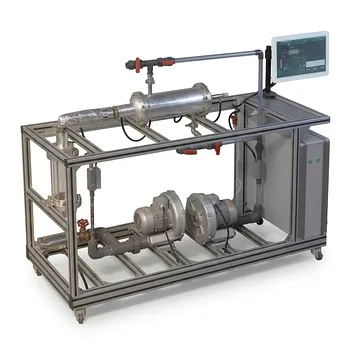
Microwave-assisted heating flips the traditional heating model on its head. Instead of relying on conduction from a hot jacket to slowly warm a reaction, it generates heat directly within the mixture itself. This volumetric heating eliminates the large internal-to-external temperature gradients seen in jacketed systems, vastly increasing the heating rate. For educational synthesis reactors, this means students can witness reactions that once took hours complete in minutes, while gaining direct, real-time control over energy delivery.
Traditional jacketed heating heats from the outside in, creating slow, gradient-limited processes. Microwave-assisted heating heats the entire reaction volume simultaneously, enabling unprecedented speed, precise process control, and a hands-on demonstration of modern process intensification principles that are impossible to replicate with a jacket.
The Fundamental Heating Mechanism
How Jacketed Heating Works — and Its Inherent Limits
In a traditional reactor, a thermal fluid circulates through a jacket surrounding the vessel. Heat transfers from the fluid to the reactor wall, and from the wall to the reaction mixture via convection and conduction.
This chain of thermal resistances introduces a significant time delay. The mixture near the wall gets hot first, while the center remains cool. Stirring helps, but a temperature gradient always exists until the entire volume reaches equilibrium. For students, this means slow, incremental adjustments and a long wait before steady-state conditions are observable.
How Microwave-Assisted Heating Transforms Energy Delivery
Microwave radiation couples directly with polar molecules or ions in the reaction mixture. Instead of depositing energy at the boundary, the electromagnetic field excites the entire exposed volume at once.
This volumetric heating bypasses the thermal bottleneck of conduction through walls and liquids. The reaction becomes the direct absorber of energy, not a passive recipient. As a result, internal temperature gradients shrink dramatically, and the heating rate can be orders of magnitude faster than with a jacket.
Process Control Advantages Over Jacketed Systems
Instantaneous, High-Resolution Power Adjustment
Jacketed heating systems suffer from thermal inertia. Changing the jacket temperature requires heating or cooling a large mass of fluid and metal, with minutes of lag before the reaction feels the effect.
Microwave reactors dose energy electronically by altering the magnetron output. Power can be ramped up or down in less than a second. This gives students the ability to explore dynamic control strategies—stepped profiles, pulses, or immediate shutoff—that are educationally rich but impractical with a jacket.
True Temperature Control Through Energy, Not Equilibrium
With a jacket, temperature control is fundamentally an equilibrium process: you set a jacket target and wait for the reactor contents to catch up. The reaction temperature is a lagging indicator.
In microwave-assisted heating, the power input directly governs how much energy enters the mixture. Modern educational reactors couple this with fast temperature feedback loops, so the system can hold a setpoint by modulating electromagnetic energy in real time. Students see not just the final temperature, but the relationship between power, absorption, and thermal response in a way that clarifies thermodynamic principles.
Drastic Reduction in Reaction Time as a Teaching Multiplier
The primary reference highlights that reactions routinely shift from “hours of conventional heating to minutes.” This compression is a pedagogical asset.
Long reaction times reduce the number of experiments students can run in a lab session. They also obscure the link between input and outcome because the event happens too slowly to observe dynamically. With minute-scale syntheses, students can test hypotheses, adjust parameters, and immediately see results. The feedback loop between decision and outcome shrinks, accelerating learning.
A Direct Window into Process Intensification
Educational reactors exist to teach principles. Microwave-assisted heating is a living illustration of process intensification—doing more with less time, smaller equipment, and better energy efficiency. Students witness how selective energy input can bypass the limitations of heat transfer kinetics. They learn that the same hot wall that transfers energy also creates safety risks and inefficiencies; moving the heat source inside the material changes the entire design philosophy.
Understanding the Trade-offs
No heating technology is universal. For microwave-assisted educational reactors, instructors must be aware of the following limitations:
- Scale sensitivity. Volumetric heating works brilliantly at small scales, but penetration depth limits the maximum reactor size. Large vessels create cold zones and uneven fields.
- Hot-spot risk. Without adequate stirring, selective absorption can create localized superheating. Students must learn that uniform heating depends on both the field and good mixing.
- Material constraints. Reaction vessels must be microwave-transparent (e.g., glass, PTFE). Metal components inside the reactor cause arcing. This limits reactor design flexibility compared to stainless-steel jacketed vessels.
- Non-thermal misinterpretation. Students may incorrectly assume that faster reactions automatically indicate special “microwave effects.” A key teaching point is that many rate enhancements are purely thermal, arising from rapid, uniform heating and higher achievable temperatures under pressure.
- Exotherm management. In exothermic reactions, the ability to rapidly input energy also means the system can overshoot instantly if the control loop is not tuned properly. Jacketed systems, with their built-in thermal inertia, can be more forgiving of control mistakes.
Making the Right Choice for Your Educational Goals
Your choice between microwave and jacketed heating in a teaching reactor should match your pedagogical objectives.
- If your primary focus is teaching classical heat transfer and steady-state reactor design: A jacketed system clearly shows conduction, thermal resistance, and the approach to equilibrium. The slowness is a feature, not a bug.
- If your primary focus is modern process intensification, rapid experimentation, and energy efficiency: Microwave-assisted heating offers unmatched speed and direct control over energy input, allowing students to explore a wider parameter space in the same lab time.
- If your primary focus is comparing both paradigms to build critical thinking: Ideally, provide access to both technologies. The contrast between conduction-limited heating and volumetric heating gives students a visceral, data-backed understanding of why process intensification matters.
The best educational reactor isn’t the one with the most advanced technology—it’s the one that makes the underlying principles unmistakably clear. For illuminating the profound difference between heating the container and heating the reaction itself, nothing replaces microwave-assisted heating in the teaching lab.
Summary Table:
| Feature | Microwave-Assisted Heating | Traditional Jacketed Heating |
|---|---|---|
| Heating Mechanism | Volumetric (heats reaction mixture directly) | Convective/Conductive (heats vessel wall first) |
| Heating Rate | Extremely fast (minutes) | Slow and incremental (hours) |
| Control Response | Instantaneous (electronic power adjustment) | Delayed (due to thermal inertia of jacket fluid) |
| Pedagogical Focus | Process intensification & dynamic control | Classical heat transfer & thermal equilibrium |
| Key Limitations | Vessel material limits, scale sensitivity | High energy waste, slower experimental cycles |
Modernize Your Engineering Labs with LABPARK
Are you looking to equip your students and researchers with advanced reaction technologies? LABPARK designs and manufactures premium Educational and Vocational Unit Operations Pilot Plants in chemical engineering, bioprocess & biotech, and environmental & water treatment.
Our systems help universities, research institutes, and enterprises:
- Accelerate Learning: Bridge the gap between theory and industrial practice with hands-on, interactive pilot plants.
- Master Process Control: Experience real-time thermodynamics and modern process intensification firsthand.
- Ensure Safety & Reliability: Built to rigorous academic safety standards with industrial-grade components.
Boost your department's research and teaching capabilities—contact our engineering experts today to discuss your laboratory requirements!
Related Products
- Multi-Stage Stirred Tanks in Series Residence Time Distribution and Mixing Performance Determination Educational Pilot Plant
- Micro-Scale Gas-Solid Catalytic Reaction Educational Pilot Plant
- Comprehensive Multi-Modal Heat Transfer Unit Operations Pilot Plant for Engineering Training
- Dual Mode Heat Transfer Pilot Plant for Unit Operations Training
- Multi Functional Catalytic Reaction and Reactor Evaluation Educational Unit Operations Pilot Plant
People Also Ask
- CSTR Multiplicity: Which physical variables map to universal unfolding?
- How does impeller configuration affect RTD & reactor performance? Optimize mixing and conversion in pilot plants.
- How do multiple CSTRs in series affect stability? Master Complex Pilot Plant Dynamics
- How does MRF model impeller rotation in CFD? Key Boundary Conditions Explained
- How can a CSTR pilot plant demonstrate reactor staging? Visualize volume savings.