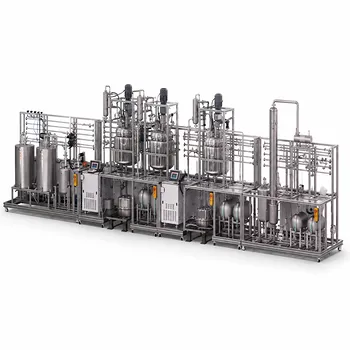
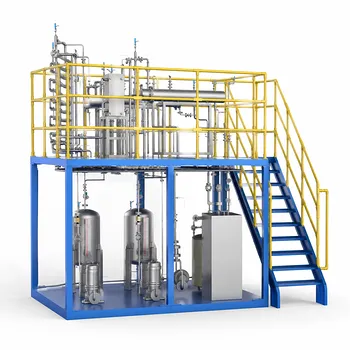
Theoretical modeling sets the stage; physical pilot plants orchestrate the real performance.
Mathematical modeling in MATLAB or ASPEN PLUS builds the theoretical backbone of chemical reactor engineering—solving mass and energy balances and simulating concentration and temperature dynamics over time. Hands-on pilot plant training then validates those models against physical reality, exposing the messy but critical deviations—like heat loss, imperfect mixing, and sensor lag—that pure simulation cannot capture. Together they form a closed-loop learning system: simulation predicts, the pilot plant tests, and the results refine the models, turning textbook equations into actionable operator skill.
The true complement lies in the validation loop. Simulations teach you how a reactor should behave under idealized assumptions; pilot plants show you how it actually behaves. Bridging that gap is what transforms a student into a process engineer who can troubleshoot, scale up, and design safely.
The Limits of Pure Simulation
Mathematical models are built on conservation laws, kinetics, and transport phenomena—but they are only as good as the assumptions they rest on. Understanding their boundaries is the first step to using them effectively.
The Idealized Reactor in a Computer
Software like MATLAB or ASPEN PLUS solves differential equations for concentration and temperature over time, capturing transient heating and cooling phases in batch reactors or the steady-state profiles of a CSTR.
These tools rely on idealized assumptions: perfect mixing, uniform temperature, and instantaneous sensor response.
While they excel at demonstrating theoretical concepts—like conversion, yield, and the influence of activation energy—they cannot replicate the physical world’s nuance.
Where the Model Breaks Down
In a real reactor, heat loss through vessel walls and piping constantly shifts the energy balance. Simulations often assume adiabatic or perfectly controlled conditions, but a benchtop pilot plant reveals uninsulated flanges and draft sensitivity.
Mixing inefficiencies create dead zones and concentration gradients. A CSTR model assumes uniform composition; a physical pilot plant exposes backmixing and bypassing that alter conversion and selectivity.
Sensor dynamics—time lags, noise, and calibration drift—are absent in simulation. In the lab, a thermocouple’s delay during a temperature ramp fundamentally changes the apparent reaction rate.
The Power of Physical Pilot Plants
Unit operations pilot plants transform abstract models into tangible reality. They are the experimental ground where theoretical knowledge meets practical competence.
Validating Models with Real-World Data
A pilot plant allows students and researchers to collect critical performance data—actual mass and energy balances, heat transfer coefficients, and reaction kinetics—under safe, controlled conditions.
By comparing this data to MATLAB or ASPEN predictions, you can calibrate model parameters such as overall heat transfer coefficients or kinetic rate constants until simulation aligns with reality.
This direct comparison is the foundation of model-driven scale-up: validated equations can then be applied to larger designs with confidence, replacing costly trial-and-error.
Experiencing Process Deviations Hands-On
Pilot-scale reactors make you feel what the equations miss. You observe foaming that distorts level measurements, fouling that degrades heat transfer over a campaign, and conversion changes when ambient temperature drops.
These real-world deviations force you to troubleshoot—adjusting PID parameters, changing agitation speeds, or rerouting streams—skills that pure simulation cannot teach.
Researchers also use pilot plants to perform safety-related sensitivity analyses, evaluating scenarios like cooling failure in an exothermic CSTR far more convincingly than a screen can show.
Bridging Scale-Up and Transport Phenomena
Traditional scale-up is plagued by “scale-up effects”: fluid dynamics, heat transfer, and mass transfer shift dramatically from benchtop to production. Pilot plants bridge this gap.
They allow users to define control volumes, solve first-principles transport equations, and then verify flow dynamics such as backmixing using residence time distribution (RTD) studies.
This empirical validation of computational fluid dynamics (CFD) predictions or simple tank-in-series models ensures that the reactor’s mixing behavior is properly captured before scaling.
The Learning Loop: How Simulation and Experimentation Fit Together
The true educational power emerges when modeling and pilot plants are deliberately sequenced—not used in isolation. This creates a continuous improvement cycle.
Visualize Before You Operate
Before entering the lab, students can use MATLAB or ASPEN to simulate time-dependent concentration and temperature curves for a batch reaction or steady-state profiles for a CSTR.
This pre-lab modeling sets a theoretical baseline that primes their intuition: they know what a “normal” exothermic peak looks like, so they can immediately spot an anomaly during the physical run.
The model becomes a hypothesis, and the pilot plant experiment becomes the critical test.
Calibrate and Refine in Real Time
Once real data streams in, you can adjust input parameters—like reaction rate constants, heat transfer coefficients, or feed flow rates—to reconcile the simulated and measured results.
This parameter estimation teaches the iterative nature of engineering: no model is perfect on the first try, and refinement is central to the profession.
For a non-isothermal CSTR, students might compare actual temperature curves against model predictions and learn why the cooling jacket’s effective UA value differs from the theoretical one due to fouling or imperfect contact.
From Single Reaction to Multi-Functional Process
Modern batch reactor pilot plants often replicate multiple unit operations beyond just chemistry: heating/cooling, decantation, extraction-settling, crystallization, or even batch distillation.
This versatility lets students model the entire sequence in ASPEN PLUS and then execute it physically on one compact system—optimizing lab space while reinforcing that industrial reactors rarely perform only one function.
Understanding the Trade-offs: When Each Approach Falls Short
No single tool is perfect. A balanced perspective requires acknowledging the limitations of both modeling and pilot plants so that students develop judgment, not just technique.
Simulation’s Hidden Costs
The most rigorous model is useless if the underlying kinetic data or thermodynamic parameters are wrong. Garbage in, garbage out is a persistent risk.
Complex non-ideal behaviors—like gel-phase kinetics, viscoelastic flow, or precipitation kinetics—may require equations not yet built into standard libraries.
Over-reliance on simulation can also create false confidence, leading engineers to skip critical pilot validation steps, a dangerous shortcut in high-consequence processes.
Pilot Plant Constraints
Educational pilot plants operate at a scale-down compromise: they may be too small for certain flow regimes to fully develop, hiding mixing issues that appear at larger scales.
Budget and safety limits often mean lower temperatures, pressures, or hazardous reactants, which can mask reactivity or corrosivity challenges present in the real industrial environment.
Additionally, data acquisition limitations—sampling frequency, analyte measurement accuracy—can introduce errors that obscure the very deviations you are trying to study.
Making the Right Choice for Your Educational or Research Goals
The optimum blend of simulation and hands-on pilot plant work depends on what you need to achieve. Use these goal-based guidelines to design your curriculum or research plan.
- If your primary focus is building deep theoretical understanding: Start with MATLAB or ASPEN to explore parameter sensitivity and reaction dynamics, then run pilot plant experiments to validate the key trends. The physical data makes the equations stick.
- If your primary focus is industrial readiness and operator skill: Prioritize hands-on pilot plant training. Troubleshooting real equipment—leaks, sensor drift, mixing anomalies—builds the reflexive problem-solving that simulation alone cannot provide.
- If your primary focus is process scale-up and design reliability: Use pilot plants as the critical testing ground for models. Validate kinetic and transport equations at the pilot scale, then use the calibrated model to predict full-scale behavior, reducing risk.
- If your primary focus is resource optimization in education: Leverage multi-functional pilot reactors that demonstrate several unit operations with one system, and complement with simulation for scenarios that are too hazardous, slow, or expensive to run physically.
The engineer who can move fluidly between the simulated ideal and the observed real—questioning both—is the one who will build processes that truly work.
Summary Table:
| Feature | Mathematical Modeling (MATLAB/ASPEN) | Physical Pilot Plants (Batch/CSTR) |
|---|---|---|
| Operating Conditions | Idealized (perfect mixing, zero heat loss) | Real-world (sensor lag, heat loss, dead zones) |
| Primary Utility | Rapid parameter sensitivity & design baseline | Physical validation, scale-up, troubleshooting |
| Safety & Cost | Low risk, low cost per run | Higher safety protocols, physical material costs |
Bridge the Gap Between Simulation and Reality with LABPARK
Equip your students and researchers with the tools to validate theory and master real-world process engineering. LABPARK provides state-of-the-art Educational and Vocational Unit Operations Pilot Plants in chemical engineering, bioprocess & biotech, and environmental & water treatment. Designed for universities, research institutes, and enterprises, our systems turn complex mathematical models into hands-on competence.
Contact us today to find the perfect pilot plant for your lab
Related Products
- Carbon Dioxide Hydrogen Methanol Synthesis Educational Unit Operations Pilot Plant
- Multi Pump Fluid Transport Process Piping Unit Operations Training Pilot Plant
- Natural Product Extraction Unit Operations Training Pilot Plant
- Multi-Modal Distillation Unit Operations Training Pilot Plant
- Multi-Reactor Educational Pilot Plant for Reaction Engineering Unit Operations
People Also Ask
- How do temp & pressure affect methanol synthesis pilot plants? Optimize equilibrium and catalyst performance.
- Why is a purge system necessary when operating a gas recirculation loop in a methanol synthesis pilot plant? (Guide)
- Why do modern methanol pilot plants operate at lower pressures? Catalyst & Feed Requirements Explained
- What are the operational requirements for catalyst activation? Safe Methanol Pilot Plant Operation
- Why is the chemical plant startup schedule crucial? De-risk scale-up with pilot plants.