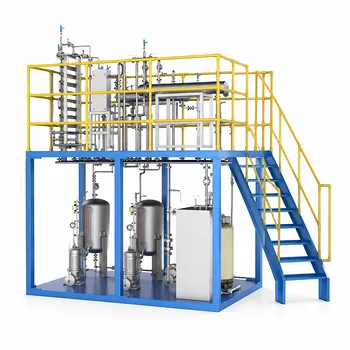
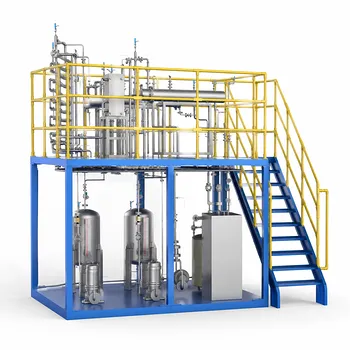
Choosing a stainless steel like 304 over carbon steel immediately scales your equipment purchase cost by a material factor—typically adding 30% or more to the baseline price—and, crucially, it demands a correction to standard installation factors to prevent the total capital estimate from becoming unrealistically inflated. In factor‑based pilot‑plant budgeting, alloy equipment costs are multiplied upward, but the same multiplier must be used as a divisor on installation factors to keep piping, civil, electrical, and instrumentation estimates tied to reality.
The core insight: material selection does more than raise the sticker price of vessels and exchangers—it forces you to re‑calibrate the entire capital cost model. Failing to adjust installation factors when you switch from carbon steel to stainless steel can overstate the budget by tens of percent, while ignoring lifecycle economics can cause you to reject the more cost‑effective material over the plant’s operating life.
The Direct Impact on Equipment Purchase Cost
Factor estimation methods used in pilot‑plant design anchor all costs to a carbon‑steel baseline. A material factor ($f_m$) then adjusts the bare‑module cost upward for alloys.
How Material Factors Work
For a carbon steel vessel, $f_m = 1.0$. A move to 304 stainless steel brings $f_m = 1.3$, while high‑nickel alloys like Hastelloy C push the factor to 1.55. This number directly multiplies the base equipment cost.
Real‑World Magnitudes for Fabricated Equipment
When you purchase a custom heat exchanger, the multiplier becomes even starker. A carbon‑steel shell‑and‑tube unit might carry a baseline cost factor of 1.40. Moving to all‑stainless construction can lift that factor to 3.0, and a fully titanium unit can exceed 11.0. These multipliers reflect both raw material cost and the increased fabrication effort.
The Hidden Trap: Correcting Installation Factors for Alloy Equipment
Simply multiplying the base equipment cost is the easy part. The greater risk in pilot‑plant capital estimation comes from how you handle installation.
Why Standard Installation Factors Break
Standard installation factors—representing civil works, piping, electrical, and instrumentation—were developed using carbon‑steel equipment as the reference. They assume the installation cost scales as a fixed percentage of the equipment cost.
The Correction Formula
When you substitute an alloy vessel, the expensive material makes the equipment cost jump, but the physical size, weight, and connection complexity often stay similar. Therefore, the original installation factor must be divided by the material factor itself: [ \text{Adjusted Installation Factor} = \frac{\text{Standard Installation Factor}}{f_m} ] Without this correction, you would grossly overestimate the cost of pouring a foundation or running power to a stainless‑steel tank. The budget swells, the project looks economically unviable, and you might lose management support for a pilot plant that is actually affordable.
Beyond the Initial Price Tag: Annualized Cost Considerations
Capital estimation is not just about the bill you pay on day one; it must also inform the selection of the most economical material over the plant’s useful life.
The Carbon Steel vs. Stainless Steel Heat Exchanger
Consider a heat exchanger critical to your unit operations lab. A carbon steel unit costs $140,000 and lasts 5 years. Its 304 stainless steel counterpart costs $182,000 but serves for 10 years. At a 12% cost of capital, the stainless option’s annual capital cost is $32,210 versus $38,780 for carbon steel. Despite the higher upfront purchase price, the stainless exchanger lowers the true annual financial burden. This annualized methodology lets you compare materials objectively and build a capital estimate that reflects long‑term value, not just first‑cost.
Piping Material and Its Impact on System-Wide Capital Cost
Material selection ripples through the piping system itself. The optimum pipe diameter for a given flow rate balances capital cost against pumping energy.
Economic Diameter Shifts with Material
Stainless steel pipe (e.g., 304) carries a much higher cost per metre than carbon steel (e.g., A106). This inflates the capital-cost term in the economic‑diameter equation. The result: for the same flow conditions, the economically optimum pipe diameter is slightly smaller for stainless steel than for carbon steel. This can reduce the total installed piping cost, partially offsetting the higher unit material price, but it also raises the pressure drop—an operational trade‑off that must be captured in the overall capital estimate.
Welding and Material Grades: Hidden Cost Planners
Fabrication choices triggered by material selection can bleed into your capital estimate through construction time and post‑weld treatments.
Low‑Carbon Grades Avoid Extra Steps
When welding standard 304 or 316 stainless steel, carbide precipitation can degrade corrosion resistance in the heat‑affected zone. Low‑carbon “L” grades (304L, 316L) circumvent this problem without requiring costly post‑weld heat treatment. Specifying L‑grade from the start may add a small premium to the base material cost, but it removes the need for heat‑treatment equipment and schedule delays, keeping capital and timeline in check.
High‑Temperature Stabilized Grades
For pilot plants running hot, corrosive fluids, stabilized grades like 321 (titanium‑bearing) or 347 (niobium‑bearing) prevent intergranular attack during operation. Including these in your material specification ensures long‑term reliability and avoids re‑work costs that would otherwise distort the capital‑equipment budget.
Understanding the Trade‑offs in Material‑Driven Cost Estimation
No single material wins on every axis. Precision in capital estimation means acknowledging what you give up.
Accuracy vs. Conservatism
Correcting installation factors gives you a more truthful budget, but it removes a built‑in safety margin. If the project’s scope later expands or real‑world fabrication quotes come in higher, you might wish you had kept a cushion. The decision hinges on your risk tolerance and the funding body’s appetite for overruns.
Initial Outlay vs. Experimental Flexibility
Carbon steel keeps capital costs low, but it severely limits the chemicals you can safely handle. An all‑stainless pilot plant opens the door to corrosive and high‑purity experiments that are impossible with mild steel. Choosing the cheaper material might force you to retrofit or rebuild later, destroying the initial savings.
Simple Material Factors vs. Equipment‑Specific Data
Published $f_m$ values like 1.3 for 304 stainless steel are useful first‑pass numbers, but real fabricated equipment often sees a far steeper cost multiplier due to welding, inspection, and surface finish requirements. Relying solely on broad factors without vendor input can leave your estimate dangerously low for exotic alloys.
Making the Right Cost Estimation Choice for Your Pilot Plant
Every pilot‑plant budget must balance accuracy, longevity, and the breadth of research it will support. Tailor your approach to your primary driver.
- If your primary focus is accurate, defensible budgeting with stainless steel: Apply the material factor to equipment purchase costs and strictly divide installation factors by the same $f_m$ to avoid overstatement. This gives your finance board a realistic picture.
- If your primary focus is minimizing initial capital outlay for a short‑term campaign: Baseline on carbon steel and invest in protective linings or coatings where corrosion is a concern. Accept that the plant’s chemical range will be narrow and its life may be limited.
- If your primary focus is long‑term economic value and experimental versatility: Use annualized cost comparisons to justify the higher upfront spend on stainless steel or Ni‑alloys, and factor in the reduced maintenance and expanded research envelope over a 10‑year horizon.
- If your primary focus is training students on the full interaction of materials and economics: Run parallel estimates—one with carbon steel and one with stainless steel—and explicitly show how the economic pipe diameter, installation factors, and annual costs all shift, cementing the lesson that material choice is a system‑level capital decision.
Your final capital estimate is not a single number; it is a model that must faithfully reflect how a change in metallurgy propagates through equipment, installation, piping, and lifecycle cost. Mastering that calibration is what turns a raw budget into a strategic asset for your pilot plant.
Summary Table:
| Material | Material Factor ($f_m$) | Installation Factor Correction | Lifecycle & Longevity |
|---|---|---|---|
| Carbon Steel | 1.0 (Baseline) | Standard (No adjustment) | Shorter lifespan, limited chemical compatibility |
| 304 Stainless Steel | 1.3 | Divided by $f_m$ (Reduce by ~23%) | Longer lifespan (up to 2x), high versatility |
| Hastelloy C | 1.55 | Divided by $f_m$ (Reduce by ~35%) | Superior corrosion resistance, specialized use |
Optimize Your Pilot Plant Budget with LABPARK
Designing a unit operations facility requires balancing performance, durability, and upfront capital costs. LABPARK offers high-quality Educational and Vocational Unit Operations Pilot Plants in chemical engineering, bioprocess & biotech, and environmental & water treatment. Specially designed for universities, research institutes, and enterprises, our systems ensure maximum experimental flexibility with optimized material configurations.
Let our engineering experts help you choose the right materials and scale your equipment cost-effectively. Contact LABPARK today to get a tailored solution for your lab!
Related Products
- Carbon Dioxide Hydrogen Methanol Synthesis Educational Unit Operations Pilot Plant
- Multi Pump Fluid Transport Process Piping Unit Operations Training Pilot Plant
- Natural Product Extraction Unit Operations Training Pilot Plant
- Multi-Modal Distillation Unit Operations Training Pilot Plant
- Multi-Reactor Educational Pilot Plant for Reaction Engineering Unit Operations
People Also Ask
- How do temp & pressure affect methanol synthesis pilot plants? Optimize equilibrium and catalyst performance.
- Why is a purge system necessary when operating a gas recirculation loop in a methanol synthesis pilot plant? (Guide)
- Why do modern methanol pilot plants operate at lower pressures? Catalyst & Feed Requirements Explained
- What are the operational requirements for catalyst activation? Safe Methanol Pilot Plant Operation
- Why is the chemical plant startup schedule crucial? De-risk scale-up with pilot plants.