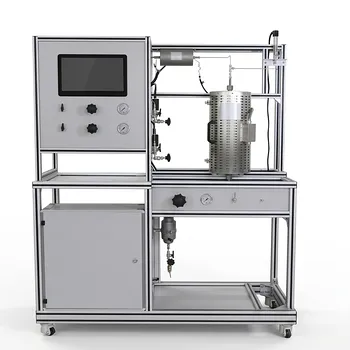
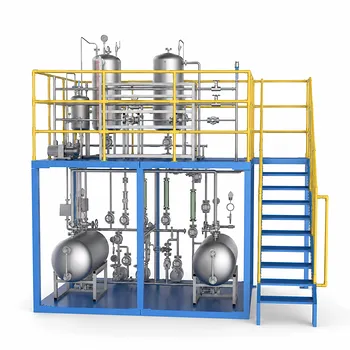
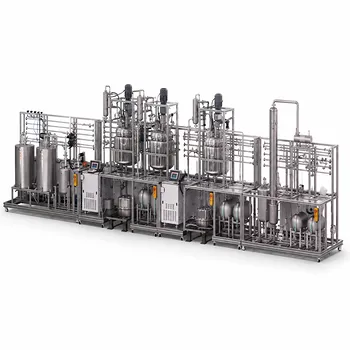
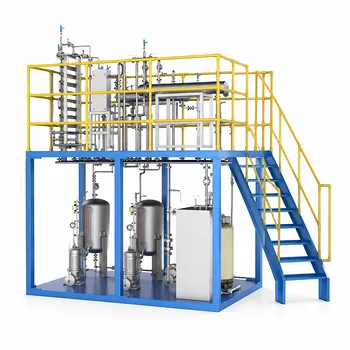
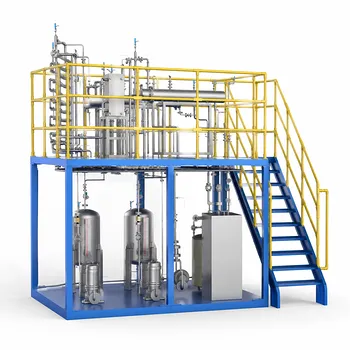
Le Chatelier’s principle is not just a theoretical concept—it’s the operational playbook for every chemical engineering unit operations pilot plant. It directly guides how operators manipulate temperature, pressure, and feed concentrations to shift chemical equilibria toward higher yields of the desired product. In educational and vocational settings, pilot‑scale reactors and absorption columns are built with precise control systems so that students can cause a disturbance, monitor the real‑time response, and quantitatively verify that the equilibrium moves exactly as the principle predicts.
Pilot plants turn Le Chatelier’s principle into a hands‑on control strategy. By systematically adjusting process conditions and observing the shift through online sensors, operators learn to optimize yield and efficiency safely—a skill that translates directly to industrial practice.
Applying Le Chatelier’s Principle in Unit Operations Pilot Plants
Le Chatelier’s principle states that a system at equilibrium will shift to counteract an imposed change. In a pilot plant, that “imposed change” is a deliberate adjustment of a process variable, and the “shift” is a measurable change in product composition or conversion.
Temperature Manipulation: Shifting Exothermic and Endothermic Equilibria
Every equilibrium reaction has a heat of reaction. For an exothermic forward reaction, lowering the temperature forces the system to produce more products to release heat. In an endothermic reaction, raising the temperature does the same.
Operators use this to optimize yield in pilot‑scale continuous stirred‑tank reactors (CSTRs) or tubular reactors. By adjusting the setpoint of the reactor’s jacket temperature controller, they can push the equilibrium toward the desired side and immediately see the effect on product concentration.
Pressure: Driving Gas‑Phase Reactions and Absorption
For reactions involving a change in the number of gas moles, pressure becomes a powerful lever. If the forward reaction reduces the total number of molecules, increasing pressure will force the equilibrium to produce more products.
In absorption columns, higher pressure increases the solubility of the target gas in the liquid phase. Applying Le Chatelier’s principle here means setting the column pressure to maximize the driving force for mass transfer. Pilot plants with back‑pressure regulators and pressure transmitters let operators explore the optimal pressure for a given separation task.
Concentration: Controlling Reactant Feed and Product Removal
Adding a reactant or removing a product continuously shifts the equilibrium forward. Pilot plants use feed‑forward and ratio control strategies to maintain an excess of a key reactant, while simultaneously drawing off the product stream.
This is often the most industrially relevant tactic. The material balance established by the main feed flow controller is the foundation. By manipulating feed ratios, students can directly observe how changing concentrations pushes the equilibrium—exactly as Le Chatelier predicted.
Real‑Time Feedback: Sensors That Validate the Shift
The real power of a pilot plant lies in its inline instrumentation. Temperature probes, pressure transmitters, pH meters, and on‑line chromatographs or spectrometers provide instantaneous confirmation that the equilibrium has moved.
This direct feedback loop closes the gap between theory and practice. Students do not need to wait for a lab analysis; they see the process’s dynamic response on a control panel and can adjust conditions iteratively.
The Control Architecture That Enables Precise Changes
To apply Le Chatelier’s principle safely and repeatably, the pilot plant’s control system must be free of conflicting signals and hydraulic instabilities. This is where practical control engineering meets thermodynamic theory.
Single‑Loop Stability: Avoiding Fighting Controllers
On any given process line, only one control valve is installed. This rule prevents multiple controllers from fighting over the same flow, which would mask the true equilibrium shift. A stable, single‑loop control architecture ensures that a change in temperature or pressure setpoint translates cleanly into a process disturbance the system must counteract.
Material Balance as the Foundation
The overall material balance is set by the flow regulator or ratio controller on the main feed stream. Without a steady, known input, any shift in outlet composition could simply be caused by a drifting feed rate rather than a true equilibrium change.
When operators increase one reactant’s concentration to exploit Le Chatelier’s principle, they rely on this stable baseline to quantify the improvement.
Temperature Control Through Utility Streams
Temperature is typically manipulated by adjusting the flow of steam or cooling water to the reactor jacket or heat exchanger. A bypass stream around a heat exchanger may also be used for fine control. These methods give operators a direct, predictable way to impose the thermal disturbance that Le Chatelier’s principle demands.
Using Thermodynamic Models to Predict and Validate
Le Chatelier’s principle tells you the direction of the shift; thermodynamics and equations of state tell you how far it will go and at what cost.
Equations of State for Consistent Calculations
A single equation of state (EOS) can describe both liquid and vapor phases in a self‑consistent manner. In a pilot‑scale distillation column or gas absorption unit, students use the same EOS to calculate vapor‑liquid equilibria at different pressures and temperatures. By comparing these predictions with actual pilot‑plant data, they learn when the model holds and when real‑world non‑idealities appear.
Bridging Molecular Theory and Industrial Practice
Theoretical computer‑based thermodynamic calculations are paired with experimental pilot‑plant runs. This comparison teaches the transition from molecular‑level physics to large‑scale equipment. The equilibrium shift you calculated from the van’t Hoff equation becomes a tangible change in product purity on the control room screen.
Common Pitfalls and Trade‑offs in Pilot Plant Operation
Applying Le Chatelier’s principle is not a free lunch. Pushing the equilibrium too aggressively introduces engineering constraints that must be managed.
- Extreme conditions compromise safety: High pressures or temperatures can exceed equipment ratings, leading to risks of rupture or runaway reactions.
- Energy costs escalate: Lowering the temperature for an exothermic reaction may require extensive refrigeration, and raising it for an endothermic reaction burns more steam. The economic optimum is rarely at the extreme.
- Side reactions can dominate: A shift that favors the main product may also accelerate an unwanted side pathway, eroding selectivity.
- Sensor and actuator lag: In fast‑moving reactions, the control system may not respond quickly enough, causing the plant to oscillate around the new equilibrium instead of settling cleanly.
Making the Right Choice for Your Training or Optimization Goal
The way you apply Le Chatelier’s principle in a pilot plant depends on what you are trying to achieve.
- If your primary focus is maximizing product yield: Start with concentration‑based shifts—feed excess reactants and continuously remove product. Then fine‑tune temperature and pressure while monitoring energy consumption and by‑product formation.
- If your primary focus is teaching process dynamics: Use pressure or temperature disturbances because they produce a fast, visible response on the inline sensors, making the equilibrium shift immediate and intuitive for students.
- If your primary focus is scaling up to production: Combine EOS‑based simulations with pilot‑plant data to identify the most economically robust operating window, not simply the endpoint that gives the highest single‑pass conversion.
Le Chatelier’s principle gives you the map; a well‑instrumented, correctly controlled unit operations pilot plant lets you explore that map safely, quantitatively, and profitably.
Summary Table:
| Process Variable | Imposed Change | Equilibrium Shift & Operational Goal |
|---|---|---|
| Temperature (Exothermic) | Decrease setpoint | Shifts forward to increase product yield |
| Temperature (Endothermic) | Increase setpoint | Shifts forward to increase product yield |
| Pressure (Gas Phase) | Increase pressure | Shifts toward side with fewer gas moles |
| Concentration | Feed excess reactant / Remove product | Drives continuous forward conversion |
Bring Process Control Theory to Life with LABPARK
Bridge the gap between molecular theory and industrial practice. LABPARK provides state-of-the-art Educational and Vocational Unit Operations Pilot Plants in chemical engineering, bioprocess & biotech, and environmental & water treatment. Specifically designed for universities, research institutes, and enterprises, our systems offer precise real-time control to make thermodynamic principles highly tangible.
Ready to elevate your training and research capabilities? Contact us today to explore our customizable pilot plant solutions!
Related Products
- Carbon Dioxide Hydrogen Methanol Synthesis Educational Unit Operations Pilot Plant
- Multi Pump Fluid Transport Process Piping Unit Operations Training Pilot Plant
- Natural Product Extraction Unit Operations Training Pilot Plant
- Multi-Modal Distillation Unit Operations Training Pilot Plant
- Multi-Reactor Educational Pilot Plant for Reaction Engineering Unit Operations
People Also Ask
- How do temp & pressure affect methanol synthesis pilot plants? Optimize equilibrium and catalyst performance.
- Why is a purge system necessary when operating a gas recirculation loop in a methanol synthesis pilot plant? (Guide)
- Why do modern methanol pilot plants operate at lower pressures? Catalyst & Feed Requirements Explained
- What are the operational requirements for catalyst activation? Safe Methanol Pilot Plant Operation
- Why is the chemical plant startup schedule crucial? De-risk scale-up with pilot plants.