Knowledge Chemical Engineering Education How to Separate NH4Cl from NaCl via Fractional Crystallization? Lab Setup Guide
Author avatar

Tech Team · LABPARK

Updated 2 months ago

How to Separate NH4Cl from NaCl via Fractional Crystallization? Lab Setup Guide


Fractional crystallization selectively recovers ammonium chloride from the sodium–ammonium chloride mixture after sodium bicarbonate removal in the Hou’s process by exploiting the temperature-dependent solubility difference and the common-ion effect.
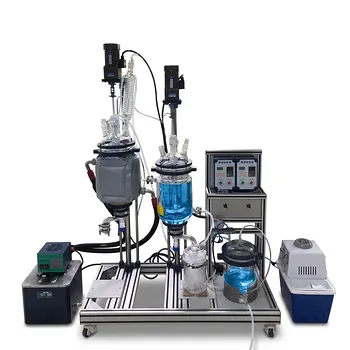
In a unit operations laboratory, the separation is analyzed using a jacketed batch cooling crystallizer fitted with an agitator and online conductivity or concentration sensors. This setup lets you track the precipitation point, plot solubility curves, and measure crystallization kinetics.

The separation works because NH₄Cl solubility drops sharply upon cooling while NaCl solubility stays nearly constant. Adding solid NaCl further reduces NH₄Cl solubility through the common-ion effect. In the lab, a controlled cooling crystallizer with conductivity monitoring makes the phenomenon measurable, turning a complex industrial step into a clear, data‑rich experiment.

The Scientific Principle: Why Ammonium Chloride Crystallizes First

Solubility’s Temperature Sensitivity

Ammonium chloride exhibits a steep decline in solubility as temperature falls.
Sodium chloride’s solubility, by contrast, is almost flat over the same range.
When the mixed mother liquor is cooled, the solution becomes supersaturated only with respect to NH₄Cl, triggering its selective precipitation.

The Common‑Ion Effect Reinforces Selectivity

Solid NaCl is added to the solution, raising the chloride ion concentration.
This shifts the solubility equilibrium for NH₄Cl, depressing its solubility through the common‑ion effect.
The combined action of cooling and salting‑out drives NH₄Cl out of solution while keeping NaCl dissolved, achieving a clean fractional separation.

Lab‑Scale Separation: From Beaker to Batch Crystallizer

The Core Equipment: Jacketed Batch Crystallizer

A typical unit‑ops lab uses a glass or stainless‑steel vessel with a jacket for circulating coolant.
An agitator (paddle or magnetic stirrer) keeps the slurry homogeneous and prevents local concentration gradients.
A precision temperature probe immersed in the liquor tracks the cooling curve, a vital input for solubility and kinetic analysis.

Online Sensors: Conductivity and Concentration Monitoring

Conductivity probes detect the changing ionic content in real time.
As soon as NH₄Cl begins to crystallize, the sudden drop in dissolved ions produces a sharp inflection in the conductivity signal.
This allows you to pinpoint the crystallization onset, construct solubility curves, and study the effect of cooling rate on supersaturation.

Experimental Setup and Procedure

You prepare a synthetic mother liquor containing NH₄Cl and NaCl, add solid NaCl, then cool the mixture at a controlled rate.
Conductivity and temperature are logged continuously, while slurry samples are pulled to measure crystal mass and size.
From the temperature at which conductivity breaks, you can map the phase‑boundary and determine nucleation and growth kinetics.

Scaling Up: Pilot Plant Crystallizers in Education

Draft Tube and Axial Flow Pump Designs

Larger educational crystallizers incorporate internal draft tubes and axial flow pumps to circulate the slurry.
This design maintains a rising velocity of 0.015–0.02 m/s in the clear‑liquid zone and a suspension velocity of 0.025–0.05 m/s in the suspension zone.
A minimum residence time of 8 hours is required to obtain stable crystal quality, teaching students the importance of fluid dynamics in scale‑up.

Material Selection for Corrosive Media

Chloride solutions are highly corrosive.
Pilot units therefore use steel vessels lined with plastic or anti‑corrosive coatings.
This material selection lesson directly extends to industrial ammonium chloride crystallizers, where longevity and product purity depend on corrosion resistance.

Relevance to Unit Operations Laboratories

These pilot‑scale crystallizers let students manipulate cooling rate, circulation velocity, and residence time while comparing results with lab‑scale batch runs.
The combination of small‑scale sensor‑rich experiments and large‑scale fluid‑dynamic control bridges the gap between theory and industrial practice.

Understanding the Trade‑offs in Lab Crystallization Studies

Batch vs. Continuous Operation

The batch crystallizer is simple and yields complete transient data, but it does not replicate the steady‑state conditions of an industrial continuous crystallizer.
In batch mode, uncontrolled supersaturation peaks can cause a burst of nucleation, producing a wider crystal size distribution than intended.

Agitation and Nucleation Control

Too much agitation generates secondary nucleation, creating fine particles that are hard to filter and analyze.
Too little mixing allows crystals to settle, causing non‑uniform cooling and growth.
Striking the right balance is essential to obtain representative kinetic data.

Sensor Limitations

Conductivity measures the bulk ionic concentration, not local supersaturation at the crystal surface.
Calibration is also salt‑mixture dependent; accuracy decreases if the solution composition drifts.
For advanced studies, optical turbidity or focused beam reflectance measurement (FBRM) probes can supplement conductivity and track particle size in real time.

Corrosion Risks in Chloride Environments

Even short‑term lab exposures to hot chloride brines can corrode standard stainless‑steel wetted parts.
Choosing glass vessels or Hastelloy‑grade alloys prevents pitting and contamination, preserving both data quality and equipment life.

Making the Right Choice for Your Goal

  • If your primary focus is demonstrating fractional crystallization: Use a jacketed beaker with a magnetic stirrer, a temperature probe, and a benchtop conductivity meter to show the rapid drop in conductivity as NH₄Cl precipitates on cooling.
  • If your primary focus is measuring solubility curves: Employ a high‑accuracy temperature controller, continuous conductivity logging, and periodic sample titration to build a precise phase diagram for the ternary system.
  • If your primary focus is studying crystallization kinetics: Upgrade to a crystallizer with a draft tube and an in‑situ particle size analyzer (e.g., FBRM) to track nucleation and growth rates under controlled mixing and cooling regimes.
  • If your primary focus is mimicking industrial conditions: Move to a pilot‑scale crystallizer with corrosion‑resistant materials, axial flow pumps, and residence time control, keeping suspension velocities within the 0.025–0.05 m/s range to produce a representative product.

By aligning your equipment selection with your experimental objective, you can transform a simple solubility demonstration into a powerful investigation of fractional crystallization, gaining insights that transfer directly to industrial ammonium chloride recovery.

Summary Table:

Equipment Type Key Features Primary Experimental Focus
Jacketed Batch Crystallizer Temperature probe, agitator, conductivity sensor Solubility curves & crystallization onset
Kinetic-Study Crystallizer High-accuracy controller, FBRM/optical probe Nucleation, growth rates & particle size
Pilot-Scale Crystallizer Draft tube, axial flow pump, corrosion-resistant lining Fluid dynamics, residence time & industrial scale-up

Bring Industrial Crystallization and Unit Operations to Life

Are you looking to enhance your laboratory's hands-on teaching and research capabilities? LABPARK provides premium Educational and Vocational Unit Operations Pilot Plants in chemical engineering, bioprocess & biotech, and environmental & water treatment.

Designed specifically for universities, research institutes, and enterprises, our pilot plants bridge the gap between academic theory and real-world industrial operations.

Contact LABPARK today to discuss your laboratory requirements and get a customized equipment quote!

Related Products

People Also Ask

Related Products

Multi-Modal Distillation Unit Operations Training Pilot Plant

Multi-Modal Distillation Unit Operations Training Pilot Plant

Multi-modal distillation pilot plant for practical unit operations training in chemical engineering education. Features real, analog, and semi-physical simulation modes, industrial construction, customizable for university labs. Hands-on fractionation columns, SCADA control, safety systems. Includes sight glasses, sampling ports, closed-loop recycling.

Potassium Salt Thermal Dissolution and Crystallization Separation Educational Unit Operations Pilot Plant

Potassium Salt Thermal Dissolution and Crystallization Separation Educational Unit Operations Pilot Plant

This educational pilot plant allows chemical engineering students to perform potassium salt thermal dissolution and cooling crystallization experiments, integrating solubility studies, supersaturation control, and solid-liquid separation in a safe, compact, and customizable laboratory system for hands-on unit operations learning.

Multi Functional Membrane Crystallization Educational Unit Operations Pilot Plant

Multi Functional Membrane Crystallization Educational Unit Operations Pilot Plant

Integrated bench-scale membrane crystallization pilot plant for engineering education. Provides hands-on training in advanced separation technologies, combining membrane distillation crystallization and process intensification. Features variable scaling vessels, industrial-grade flow control, and interactive digital data acquisition. Customizable for university labs.

Multi-Functional Membrane Separation Educational Pilot Plant for Unit Operations Lab

Multi-Functional Membrane Separation Educational Pilot Plant for Unit Operations Lab

The Multi-functional Membrane Separation Educational Unit Operations Pilot Plant is an integrated bench-scale laboratory system designed for teaching undergraduate engineering education. It features Ultrafiltration, Nanofiltration, and Reverse Osmosis modules in a compact, mobile unit for practical hands-on learning.

Methane Cracking Educational Unit Operations Pilot Plant

Methane Cracking Educational Unit Operations Pilot Plant

This bench-scale methane cracking educational pilot plant provides hands-on catalytic conversion training with a 1000°C furnace, seven mass flow controllers, and real-time automation for safe, curriculum-aligned experiments. Designed for university teaching of unit operations and reaction engineering.

Bench Scale Dual Column Gas Separation and Capture Educational Pilot Plant

Bench Scale Dual Column Gas Separation and Capture Educational Pilot Plant

This dual-column educational pilot plant provides hands-on teaching of gas adsorption, separation, and capture processes. It features stainless steel columns, regeneration up to 400°C, and a 15.6-inch touchscreen PLC for TSA and PSA studies in chemical engineering curricula, process simulation.

Gas-Solid Heterogeneous Separation Demonstration Educational Unit Operations Pilot Plant

Gas-Solid Heterogeneous Separation Demonstration Educational Unit Operations Pilot Plant

Comprehensive visual transparent gas-solid separation pilot plant for chemical engineering labs. Demonstrates gravity settling inertial settling cyclone and bag filter technologies. Enables real-time analysis of fluid-particle mechanics pressure drop and collection efficiency. Ideal for undergraduate unit operations courses.

Pressure Swing Adsorption Educational Unit Operations Pilot Plant

Pressure Swing Adsorption Educational Unit Operations Pilot Plant

Integrated bench-scale pressure swing adsorption pilot plant for hands-on teaching of gas-solid separation, mass transfer, and process optimization using nitrogen-oxygen model, featuring dual-column design, industrial touchscreen control, digital assessment suite, and customizable hardware and software configurations for educational laboratories.

Multi-Functional Special Distillation Educational Pilot Plant

Multi-Functional Special Distillation Educational Pilot Plant

Versatile multi-functional special distillation pilot plant for chemical engineering education. Supports continuous, vacuum, azeotropic, reactive, extractive distillation. Transparent glass columns enable real-time visual observation of hydrodynamics and separation processes.

Hot Filtration Educational Unit Operations Pilot Plant Laboratory System

Hot Filtration Educational Unit Operations Pilot Plant Laboratory System

This integrated laboratory bench-scale hot filtration pilot plant enables students to study solid-liquid separation under thermal conditions, featuring a stainless steel vessel, removable heating jacket, and multi-layer filter plates for unit operations education, ideal for chemical engineering laboratory curriculum.

Multifunctional Membrane Separation Educational Pilot Plant with Ultrafiltration, Nanofiltration, Reverse Osmosis

Multifunctional Membrane Separation Educational Pilot Plant with Ultrafiltration, Nanofiltration, Reverse Osmosis

An integrated laboratory bench-scale membrane separation system for higher education engineering labs combining Ultrafiltration, Nanofiltration, and Reverse Osmosis processes. Features industrial PLC control with touch-screen HMI, transparent piping, and academic assessment software. Ideal for chemical and environmental engineering curricula.

Dual-Mode Rectification Pilot Plant for Practical Training Unit Operations

Dual-Mode Rectification Pilot Plant for Practical Training Unit Operations

Industrial-scale dual-mode rectification pilot plant for chemical engineering practical training. Features real-material and simulated-material operation modes, sieve-plate column with sight glasses for visual observation of hydrodynamics, and customizable SCADA control for safe, hands-on learning of unit operations and mass transfer.

Gallium and Indium Selective Extraction Educational Pilot Plant

Gallium and Indium Selective Extraction Educational Pilot Plant

Integrated pilot-scale laboratory system for engineering education bridging theoretical concepts with industrial practice enabling hands-on study of liquid liquid extraction reaction kinetics and mass transfer for selective gallium and indium separation featuring real-time IoT connectivity with integrated safety

Photocatalytic Membrane Separation and Degradation Unit Operations Pilot Plant

Photocatalytic Membrane Separation and Degradation Unit Operations Pilot Plant

Bench-scale pilot plant integrating photocatalytic degradation with membrane separation for engineering education. Study advanced oxidation, microfiltration, and hybrid processes using industrial sensors. Features safety light-blocking curtain, low-noise compressor, and durable stainless-steel construction.

Ultrafiltration Membrane Separation Educational Pilot Plant

Ultrafiltration Membrane Separation Educational Pilot Plant

This ultrafiltration membrane separation educational pilot plant enables undergraduate students to process PVA solutions, study hollow fiber membrane dynamics, and perform quantitative analysis with spectrophotometry for hands-on learning of unit operations and industrial maintenance and membrane cleaning protocols.

Multi-Component Gas Pressure Swing Adsorption Pilot Plant for Unit Operations Education

Multi-Component Gas Pressure Swing Adsorption Pilot Plant for Unit Operations Education

Multi-component gas pressure swing adsorption pilot plant designed for unit operations education. Features four-tower configuration, IoT touchscreen control, dual regeneration, and real-time breakthrough curve analysis for engineering training with safety interlocks and mobile frame simulates industrial PSA processes.

Carbon Material Thermal Pretreatment Multiphase Separation Educational Pilot Plant

Carbon Material Thermal Pretreatment Multiphase Separation Educational Pilot Plant

Educational pilot plant for carbon material thermal pretreatment and multiphase separation. Features jacketed agitated reactor, separation column, and modern controls for hands-on unit operations training in heat transfer, fluid flow, and process safety with industrial-grade materials and wireless data acquisition.

Alkaline Membrane Water Electrolysis Educational Pilot Plant Unit Operations Training System

Alkaline Membrane Water Electrolysis Educational Pilot Plant Unit Operations Training System

Hands-on educational pilot plant for alkaline membrane water electrolysis hydrogen production, integrating unit operations training with industrial PLC control, real-time data logging, customizable design, durable 316L stainless steel construction, explosion-proof safety, and modern 5G connectivity for university laboratories.

Multi-Stage Stirred Tanks in Series Residence Time Distribution and Mixing Performance Determination Educational Pilot Plant

Multi-Stage Stirred Tanks in Series Residence Time Distribution and Mixing Performance Determination Educational Pilot Plant

Explore residence time distribution and mixing performance in series stirred tanks with this educational pilot plant. Real-time conductivity sensors, interactive 3D simulation, and industrial-grade PC for chemical engineering lab training. Customizable to curricula.

Electrolyte Distillation Purification and Formulation Educational Pilot Plant

Electrolyte Distillation Purification and Formulation Educational Pilot Plant

Integrated bench-to-pilot scale educational pilot plant for electrolyte distillation, purification, and formulation with borosilicate glass construction, PLC automation, touchscreen HMI, and advanced industrial safety features for hands-on chemical process training, ideal for chemical engineering and materials science curricula.


Leave Your Message