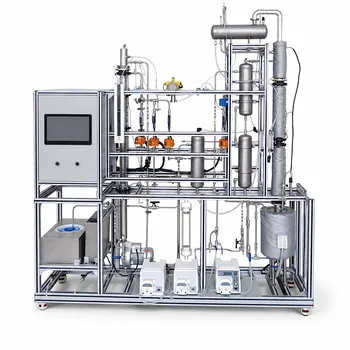
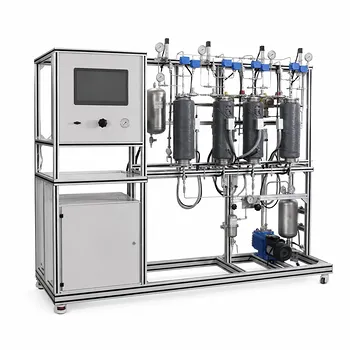
The answer lies not in the chemistry of the poison, but in the stopwatch. The choice of reactor configuration in a pilot plant is dictated almost entirely by the timescale of catalyst deactivation caused by coke. For slow coking that takes months, a simple fixed bed reactor suffices. For moderate coking over days or weeks, a moving bed or swing reactor system is needed. For the near-instantaneous coking of fluid catalytic cracking, only an entrained flow reactor with continuous regeneration is viable.
While coke is the ubiquitous murderer of catalyst activity, its operational impact is defined purely by its rate of formation. A pilot plant isn't just a smaller industrial reactor; it's a physical simulator of this economic trade-off between a catalyst's productive life and the capital cost required to keep it alive.
The Reactor as a Clock: Matching Configuration to Coking Rate
The core principle taught through a pilot plant is that the choice of reactor is a function of reaction kinetics and deactivation kinetics. You must match the reactor's hydrodynamic design to the catalyst's "survival time." This transforms an abstract concept into a tangible, measurable design constraint.
The Long Haul: Tubular Fixed Beds for Slow Deactivation
When coking is a slow process, like in steam reforming where a catalyst bed can last for years, complexity is the enemy. Here, the pilot plant teaches a lesson in elegant simplicity.
A simple tubular fixed bed reactor is the ideal choice. The catalyst pellets remain stationary, and the coking rate is so slow that the system can operate for an entire semester or a full research campaign without a single regeneration cycle. In these cases, the research focus isn't on regeneration logistics, but on studying other core parameters like heat transfer or the effect of promoters on coking resistance. The pilot unit design integrates a strategy to compensate for slow, inevitable activity loss, such as a gradual temperature ramp over the life of the catalyst.
The Daily Grind: Swing and Moving Beds for Moderate Deactivation
For processes where coking drops the catalyst lifetime to days or weeks, the pilot plant must introduce the concept of operational continuity. The catalyst can no longer outlast the experimental run without intervention.
The preferred configuration is a multiple fixed bed reactor system with a swing reactor. This setup embodies the industrial principle of "online regeneration." While one bed is actively processing the feed, a parallel "swing" bed is isolated and undergoing a controlled coke burn-off. Alternatively, a moving bed reactor demonstrates a more elegant, continuous solution. Gravity slowly draws the coked catalyst pellets down through the reactor and into a separate regeneration zone, creating a closed loop that maintains a steady-state of average activity.
The Blink of an Eye: Entrained Flow for Rapid Deactivation
When coking is a matter of seconds, as it is in Fluid Catalytic Cracking (FCC) , the reactor completely loses its traditional static form. The catalyst particle is dead almost as soon as it meets the hydrocarbon feed.
The only viable configuration is an entrained flow reactor (riser) . This is the ultimate pedagogical tool for teaching the coupling of reaction and deactivation. In a pilot-scale riser, the finely powdered catalyst and the feed are co-injected and travel upward as a near-plug-flow mixture. In a few seconds, the reaction is complete and the catalyst is fully coked. The mixture then hits a separator, sending the vapors to a fractionator and the spent catalyst to a regenerator, where coke is burned off with air. The catalyst, now active, is looped back to the riser. This teaches students that when the deactivation rate eclipses the reaction rate, you must fluidize, circulate, and regenerate your catalyst continuously.
Understanding the Trade-offs: The Pedagogy of Complexity
A well-designed pilot plant doesn't just showcase the "right" choice; it exposes the compromises that make it right. The coking rate forces a direct confrontation between operational simplicity and capital intensity.
The Simplicity-Flexibility Spectrum
A fixed bed reactor for slow coking is simple to build, model, and operate. It’s ideal for studying chemical kinetics in isolation. But it has zero tolerance for rapid deactivation; it would plug instantly. A moving bed reactor solves this but introduces the mechanical complexity of a solids handling system. An entrained flow riser offers flawless thermal and catalytic control, but it’s a massive, expensive piece of equipment that requires pristine engineering for the catalyst circulation loop to work. In a pilot plant, every additional pump, valve, and cyclone separator is a lesson in the cost of continuous operation.
Confronting Physical Realities
The interplay between coking and reactor choice also dictates the physical form of the catalyst. In a fixed bed, you might use larger, shaped pellets to minimize pressure drop, even if it slightly increases internal mass transfer resistance. However, these same hard, angular pellets would shatter into choking dust in a fluidized bed or riser. For these configurations, spherical, microspheroidal catalysts with high mechanical strength are non-negotiable to resist attrition. The pilot plant therefore forces a holistic design perspective: the rate of coking determines the reactor type, and the reactor type dictates the required particle dimensions and crush strength.
Engineering the Solution: Deactivation Design Methods
The objective is to create a manageable, reproducible system. The supplementary references highlight practical integration strategies that are directly applicable to modular pilot units.
In-Situ Catalyst Management
When a fixed bed process suffers from moderate coking, the pilot plant can be designed with an embedded thermal regeneration system. Using a mass flow controller, a controlled stream of oxygen-poor air or a nitrogen-oxygen mix is fed into the bed to cleanly burn off the coke. For irreversible poisons that accelerate coking, the primary defense is not reactor configuration but feed engineering, integrating a sacrificial guard bed at the reactor inlet that can be easily swapped without disturbing the main catalytic charge.
Uncovering Fundamental Mechanisms
A pilot plant's true value is in making the invisible visible. It allows students to track how the chemistry of carbenium and carbonium ions—the fleeting intermediates in a cracking reaction—lead inexorably to cyclization, condensation, and the formation of a soft or hard carbonaceous deposit. By sampling at various points in a riser or at different times in a fixed bed, one can directly observe the dynamic relationship between catalyst activity, product selectivity, and the growing carbon content.
Making the Right Choice for Your Pilot Plant Goal
Your goal dictates which compromise you must embrace. Select your reactor configuration for your pilot plant based on the primary educational or research outcome you require.
- If your primary focus is teaching intrinsic kinetics and catalyst development: Choose a simple tubular fixed-bed reactor and operate with a reaction system where coke forms slowly. Integrate a mass spectrometer to demonstrate transient activity loss over a long, stable run.
- If your primary focus is teaching continuous process simulation and mechanical operability: Select a moving-bed or swing-reactor setup. This forces students to manage a controlled regeneration loop, exposing them to the critical solids handling and purge-gas automation challenges of a modern plant.
- If your primary focus is demonstrating the ultimate coupling of reaction and regeneration: A cold-flow model of an entrained flow riser, or a full FCC micro-activity test (MAT) unit, is essential. This configuration is the only way to physically illustrate how a catalyst's second-scale life dictates a fully fluidized, circulatory reactor architecture.
- If your primary focus is optimizing catalyst stability: Design a fixed-bed reactor with upstream purification and a built-in cyclical regeneration system, allowing for precise control over the coke-burning air mixture. Use this setup to directly compare the longevity of pelletized versus spherical catalysts of identical chemical composition.
The coking of a catalyst is not a failure; in a pilot plant, it is the central drama. By recognizing that the rate of this deactivation is the master variable, you transform your reactor from a simple vessel into a powerful simulator of real-world economic and engineering constraints.
Summary Table:
| Reactor Type | Coking/Deactivation Rate | Operating Strategy | Key Educational Focus |
|---|---|---|---|
| Tubular Fixed Bed | Slow (Months/Years) | Stationary catalyst with gradual temp ramp | Intrinsic kinetics & heat transfer |
| Swing / Moving Bed | Moderate (Days/Weeks) | Online swing regeneration or gravity loop | Solids handling & automation |
| Entrained Flow (Riser) | Rapid (Seconds) | Continuous circulation & regeneration | Fluidization & reaction-regeneration coupling |
Bring Real-World Process Dynamics to Your Lab with LABPARK
To effectively teach catalyst deactivation and reactor design, students and researchers need physical, hands-on systems. LABPARK provides premium Educational and Vocational Unit Operations Pilot Plants in chemical engineering, bioprocess & biotech, and environmental & water treatment for universities, research institutes, and enterprises.
From simple fixed-beds to complex fluidized circulation loops, our custom pilot plants match your pedagogical and research goals. Contact us today to request a quote or custom design consultation!
Related Products
- Methanol Synthesis and Catalyst Performance Evaluation Educational Unit Operations Pilot Plant
- Educational Unit Operations Pilot Plant for Intraparticle Diffusion Effective Factor Measurement
- Ethylbenzene Dehydrogenation Educational Unit Operations Pilot Plant
- Fixed-Bed Chemical Reaction and Gas Dust Tar Removal Unit Operations Pilot Plant
- Carbon Dioxide Absorption and Desorption Educational Pilot Plant for Carbon Capture Studies
People Also Ask
- Why is a purge system necessary when operating a gas recirculation loop in a methanol synthesis pilot plant? (Guide)
- How do temp & pressure affect methanol synthesis pilot plants? Optimize equilibrium and catalyst performance.
- Why do modern methanol pilot plants operate at lower pressures? Catalyst & Feed Requirements Explained
- What are the operational requirements for catalyst activation? Safe Methanol Pilot Plant Operation
- How do steady-state and dynamic simulations complement pilot plants? Validate scale-up and controllability