Acid mist removal isn’t filtration—it’s a growth game.
In an adiabatic hot acid washing process, the sub-micron sulfuric acid mist that forms when SO₃ reacts with water vapor is not simply filtered out. Instead, the process makes the mist droplets grow until they become large enough for downstream electrostatic mist precipitators to capture with high efficiency. This is achieved through a two-step cycle: first, hot, concentrated acid washing evaporates water into the gas to build humidity, and second, cooling condenses that water vapor directly onto the mist particles, swelling them from an invisible haze into droplets easily collected by electrostatic demisters.
The true enabler is humidity management: evaporate water into the gas to create a condensation-ready environment, then cool to force water vapor onto the acid droplets. This physical enlargement is what transforms an almost uncapturable submicron aerosol into droplets that a wet electrostatic precipitator can remove to levels below 5 mg/m³.
Why Sulfuric Acid Mist Defies Conventional Capture
Before the mist can be controlled, its sheer elusiveness must be appreciated. A gas stream from a roaster contains not only SO₃ but also water vapor, and their sudden encounter produces a fog of acid mist.
The Subcellular-Sized Challenge
Sulfuric acid mist typically forms as droplets between 0.1 and 1 micron in diameter—far smaller than the 10–50 micron droplets a standard scrubber can intercept. At this scale, inertial impaction and simple filtration are nearly useless.
Why Dry Electrostatic Precipitators Fall Short
Conventional dry ESPs rely on particle charging and migration to collection plates, but capture efficiency drops sharply for sub-micron particles. The mist remains in the gas, causing corrosion, opacity, and non-compliance with emission limits.
The Two-Step Growth Cycle: Making Invisible Mist into Removable Droplets
Adiabatic hot acid washing turns this problem on its head by deliberately manipulating the droplet size.
Step 1 – Hot Acid Washing Builds Humidity
The gas is first contacted with recirculated hot, concentrated sulfuric acid (often >93% H₂SO₄) in a packed tower.
Because the acid is hot, water evaporates from the liquid phase into the gas, dramatically raising the absolute humidity.
This step cools the gas adiabatically (no external heat exchange) while saturating it with water vapor—priming the system for the next stage.
Step 2 – Cooling-Induced Condensation: The Growth Engine
Next, the gas is cooled, typically by passing it through a heat exchanger or by further evaporative cooling.
As the temperature drops, the high water vapor content condenses preferentially onto the existing acid mist droplets because they are extremely hygroscopic, acting as ideal condensation nuclei.
Each tiny mist particle becomes coated with a layer of liquid water, and the droplet diameter increases tenfold or more, moving from the sub-micron range into the 5–20 micron range.
Electrostatic Demisting: Harvesting the Enlarged Droplets
Only now, after the growth phase, does the mist removal step occur—and it works because the physical rules have changed.
Why Larger Droplets Capture Easily
Electrostatic mist precipitators charge the droplets and drive them to a grounded collection surface.
For large droplets, the drag force is low relative to the electric force, and the droplet’s own mass aids migration.
This makes collection efficiencies of 99% and higher achievable, where the same ESP would have been nearly blind to the original sub-micron mist.
Achieving the 5 mg/m³ Benchmark
The progressive growth ensures that the final mist concentration leaving the demister can be consistently reduced to under 5 mg/m³.
This ultra-low level protects downstream catalyst beds and allows safe venting, meeting even the tightest environmental specifications.
Understanding the Trade-offs and Pitfalls
No process is without its boundary conditions. The adiabatic hot acid washing method demands precise control and material discipline.
Acid Strength and Temperature Precision
If the circulating acid is too weak, the water vapor driving force diminishes and SO₃ absorption may dominate over evaporation, stifling the condensational growth step.
If the cooling step is too gentle, insufficient condensation occurs; if too aggressive, new homogeneous nucleation can spawn a fine secondary mist that defeats the demister.
Material Corrosion and Thermal Stress
Hot, concentrated sulfuric acid is relentlessly aggressive. Wetted components—spray nozzles, packing, tower shells—must be constructed from high‑alloy materials like Hastelloy C‑276 or protected with PTFE linings.
Temperature excursions during start‑up or process swings can push even resistant metals into rapid failure.
The Risk of Re-entrainment
Excessively large droplets generated by over‑condensation can be carried out of the demister by the gas flow.
This requires careful management of gas velocity through the ESP and appropriate demister design to avoid secondary liquid discharge.
Making the Right Choice for Your Pilot Plant
Your specific goals will dictate how you balance these factors. Use the following guidelines to steer the design and operation.
- If your primary focus is hitting the <5 mg /m³ specification: Tune the humidification rate and cooling ∆T so that condensation growth maximizes droplet size just before the ESP, while avoiding new mist formation or re‑entrainment.
- If your primary focus is plant longevity: Invest in corrosion‑resistant materials (alloy C‑276, PTFE‑lined internals) and implement rigorous temperature control to keep all surfaces above the acid dew point during cold spots.
- If your primary focus is scaling from pilot to production: Validate condensation kinetics through modeling and pilot tests—the growth window from submicron to capturable 5+ micron droplets is narrow, and reproducing the exact evaporation–condensation profile is essential for linear scale‑up.
Master the humidity swing, and you master the mist.
Summary Table:
| Process Step | Key Mechanism | Target & Parameters |
|---|---|---|
| 1. Hot Acid Washing | Evaporates water into the gas stream to build absolute humidity. | Hot, concentrated sulfuric acid (>93% H₂SO₄) |
| 2. Cooling Condensation | Condenses water vapor onto existing mist droplets (nuclei) to grow them. | Droplet size increases from <1 µm to 5–20 µm |
| 3. Electrostatic Demisting | Charges and collects the physically enlarged droplets on grounded surfaces. | Ultra-low emission level of <5 mg/m³ |
Optimize Your Gas Purification Research with LABPARK
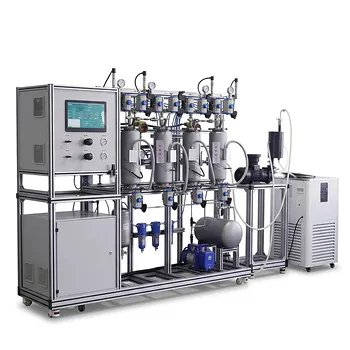
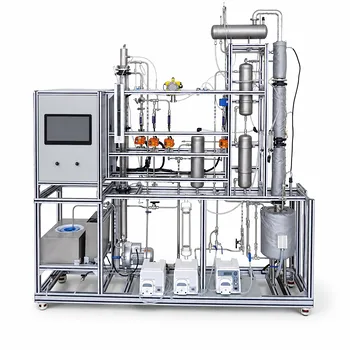
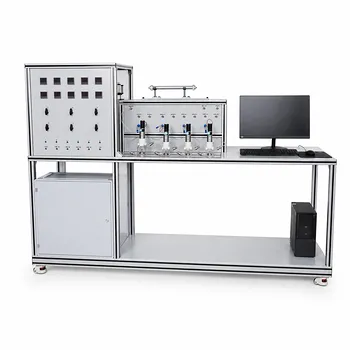
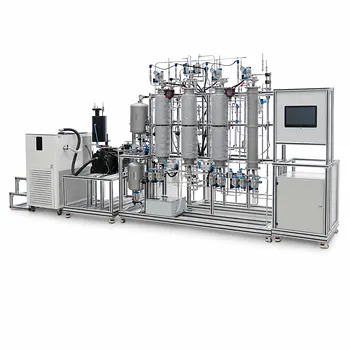
Need to validate complex gas purification, absorption, or acid mist control processes? LABPARK provides state-of-the-art Educational and Vocational Unit Operations Pilot Plants in chemical engineering, bioprocess & biotech, and environmental & water treatment. Designed specifically for universities, research institutes, and enterprises, our pilot plants ensure precise control, reliable scaling data, and robust corrosion-resistant designs.
Ready to elevate your chemical engineering labs or industrial scale-up research? Contact our technical specialists today to discuss your pilot plant requirements!
Related Products
- Fixed-Bed Chemical Reaction and Gas Dust Tar Removal Unit Operations Pilot Plant
- Bench Scale Carbon Dioxide Capture Educational Unit Operations Pilot Plant
- Green Anhydrous Ethanol Purification Extractive Distillation Unit Operations Training Pilot Plant
- Electrolyte Distillation Purification and Formulation Educational Pilot Plant
- Steam Methane Reforming Hydrogen Production and Purification Educational Pilot Plant
People Also Ask
- When to transition from PID to adaptive control in pilot plants? Key process indicators.
- How do deviations in estimating latent heat impact pilot plant thermal systems? Avoid hardware mis-sizing.
- Why Compare Predicted and Experimental Excess Enthalpy? Key to Accurate Pilot Plant Scale-up
- How to study gasification in pilot plants? Compare exit gas composition & efficiency
- Why Use PTFE & Hastelloy in Chemical Pilot Plants? Prevent Corrosion & Ensure Safety