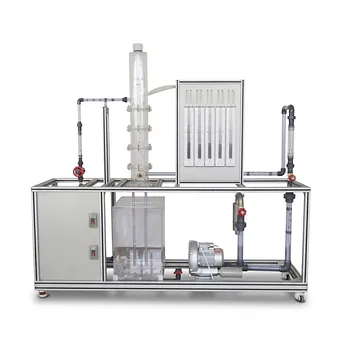
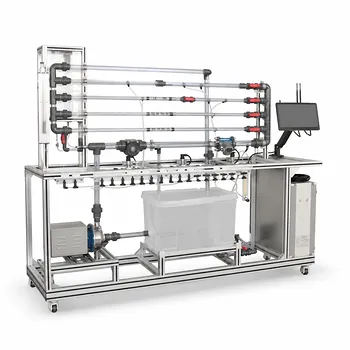
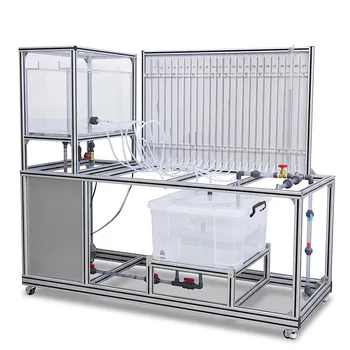
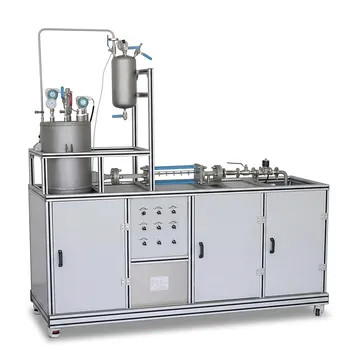
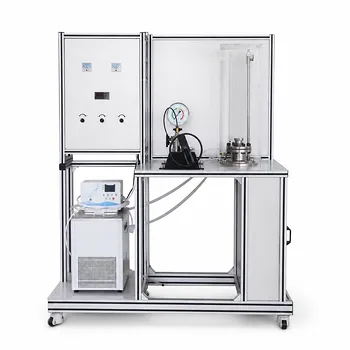
A wetted-wall column pilot plant turns a fundamental mass transfer experiment into a clear, calculable demonstration.
It does this by providing a geometrically simple, well-defined contact area—a smooth liquid film flowing down a tube’s inner wall. Because the interfacial area is known and constant, students can directly calculate the mass transfer coefficient from basic measurements, bypassing the ambiguous effective area found in packed beds. This clean experimental platform then lets them compare results directly with dimensionless empirical correlations, such as the Sherwood–Reynolds–Schmidt relationship expressed through a ( j_D )-factor equation, bridging fluid mechanics theory and practical design.
The real power of a wetted-wall column is that it eliminates the surface-area unknown. Students can focus on the physics of mass transfer itself—measuring flux, varying flow rates to change Reynolds numbers, and then validating an established empirical correlation like ( j_D = 0.0328,(Re')^{-0.23} )—without the added complexity of a packing’s indeterminate geometry.
The Educational Power of a Known Interface
Eliminating the Interfacial Area Unknown
In most industrial gas–liquid contactors, the actual interfacial area is hidden within a complex packed bed or a swarm of bubbles. A student cannot simply measure it with a ruler. The wetted-wall column solves this: the liquid film coats the inner surface of a vertical tube, making the gas–liquid contact area exactly the tube’s internal surface area.
That means the mass transfer coefficient can be isolated by dividing the total absorption flux by the driving force and this known area. There is no need to estimate a wetted area or guess an effective area factor.
Step-by-Step Determination of the Mass Transfer Coefficient
A typical experiment begins by establishing a steady, thin liquid film on the column wall and a co‑current (or counter‑current) gas stream through the core. Students measure:
- Inlet and outlet concentrations of a solute (e.g., CO₂, NH₃) in both phases.
- Gas and liquid flow rates, along with temperature and pressure.
From a material balance, the solute absorption rate (( G_A )) is calculated. The log‑mean driving force (( \Delta Y_m )) is computed using Henry’s Law at the operating conditions. Because the interfacial area (( A )) is known, the overall gas‑phase mass transfer coefficient drops out directly:
[ K_Y = \frac{G_A}{A \cdot \Delta Y_m} ]
This transforms a textbook formula into a concrete, hands‑on calculation.
Bridging Theory and Empirical Correlations
The Language of Dimensionless Numbers
Mass transfer correlations are almost never expressed in raw units; they speak in dimensionless groups. The Sherwood number (( Sh )) represents the dimensionless concentration gradient, Reynolds number (( Re )) describes the flow regime, and Schmidt number (( Sc )) captures the fluid’s physical properties.
A common way to summarize mass transfer data is through the ( j_D )-factor: a Chilton–Colburn analogy group that packs ( Sh ), ( Re ), and ( Sc ) into a single value. For a wetted‑wall column, the primary correlation cited is:
[ j_D = 0.0328,(Re')^{-0.23} ]
Here, ( Re' ) is the film Reynolds number (often ( 4\Gamma/\mu )), directly controlled by the liquid flow rate. This correlation tells the student that, all else equal, the mass transfer coefficient falls as the film flow rate (or ( Re' )) increases—a concrete, testable prediction.
From Experimental Data to Correlation Validation
The pilot plant makes the correlation tangible. After collecting ( K_Y ) at several liquid flow rates, students back‑calculate ( Sh ) (assuming the Sc number is known) and plot the resulting ( j_D )-factor against ( Re' ) on a log‑log scale. The slope they observe should be very close to –0.23, and the intercept near –1.48 (log₁₀ of 0.0328).
This visual agreement validates the empirical correlation and demonstrates how dimensionless analysis predicts behavior even when the underlying physics involves complex diffusion and convection. It builds confidence that the same ( j_D )-factor approach works in more complicated geometries, as long as the appropriate Reynolds number definition is used.
Comparing with Packed Bed Complexities
Once students master the wetted‑wall column, they appreciate why packed‑bed correlations often look different. In a packed column, the effective interfacial area is not a simple geometric quantity; it depends on flow rates, packing shape, and liquid distribution. Wetted‑wall data thus serve as a benchmark of simplicity—showing what a mass transfer coefficient becomes when the area is not in question.
Understanding the Trade-offs
Idealized Geometry vs. Realistic Industrial Conditions
A wetted‑wall column is an educational and research tool, not an industrial absorber. The liquid film is often laminar and the hydrodynamics are far simpler than in a turbulent packed bed. The correlation derived on the wall (e.g., ( j_D, \propto, Re^{-0.23} )) is specific to this geometry and may not transfer directly to a random packing, where different exponents and ( j )-factor definitions apply.
Students must learn that every empirical correlation has a limited range of validity—in Reynolds number, Schmidt number, and column geometry.
Handling Non‑Idealities in the Experiment
Real experiments may encounter end effects, rippling, or incomplete wetting at very low liquid rates. These deviations show students how experimental scatter can mask the true correlation. By learning to identify and mitigate these issues, they gain the critical ability to design a clean experiment and interpret data honestly.
How to Apply This to Your Learning Goals
Let your primary objective guide how you leverage the wetted‑wall column pilot plant.
- If your primary focus is understanding fundamental mass transfer principles: Use the column to plot the raw flux against driving force, and then see how the coefficient emerges when you divide by area. This makes mass transfer real and intuitive.
- If your primary focus is validating empirical correlations: Vary the liquid flow rate systematically, compute ( j_D ) and ( Re' ), and fit the data to a power‑law. Compare your exponent directly with the published value of –0.23 to judge the correlation’s accuracy.
- If your primary focus is bridging to industrial design: After mastering the wetted‑wall experiment, compare your results to a packed‑bed column experiment. Contrast the clean, single‑parameter ( Re' ) dependence with the more complex effective‑area‑dependent correlations used in industry.
- If your primary focus is developing experimental skills: Focus on achieving a stable, ripple‑free film, calibrating concentration sensors, and performing a proper error analysis. The simplicity of the geometry makes it easier to isolate and correct measurement errors.
A wetted‑wall column pilot plant is the clearest bridge between the abstract concept of a mass transfer coefficient and the tangible world of fluid dynamics—use it to build a foundation that will make any later, more complex contactor feel like a manageable extension of these core principles.
Summary Table:
| Key Aspect | Mechanism / Definition | Educational Value |
|---|---|---|
| Known Interfacial Area | Liquid film flows down a tube's inner wall, providing a precise, measurable contact area. | Eliminates geometric unknowns, allowing direct calculation of the mass transfer coefficient. |
| Dimensionless Groups | Incorporates Sherwood ($Sh$), Reynolds ($Re$), and Schmidt ($Sc$) numbers into the $j_D$-factor. | Bridges fluid mechanics theory with practical chemical engineering correlations. |
| Correlation Validation | Students plot experimental $j_D$ vs. film Reynolds number ($Re'$) on a log-log scale. | Confirms empirical power-law relationships (e.g., $j_D \propto Re^{-0.23}$) through physical data. |
| Process Comparison | Contrast simple film geometry with complex, indeterminate packed-bed contactors. | Teaches students the boundary limits and scalability of empirical engineering designs. |
Bring Hands-On Mass Transfer Principles to Life
Are you looking to enhance your laboratory's learning outcomes and research capabilities? LABPARK provides top-tier Educational and Vocational Unit Operations Pilot Plants in chemical engineering, bioprocess & biotech, and environmental & water treatment. Designed specifically for universities, research institutes, and enterprises, our wetted-wall columns and unit operations equipment bridge the gap between complex thermodynamic theory and practical, real-world application.
Contact LABPARK today to explore how our pilot plants can elevate your engineering curriculum and training facilities!
Related Products
- Educational Rotary Disc Liquid-Liquid Extraction Pilot Plant
- Plate Column Hydrodynamics Tray Demonstration Educational Pilot Plant
- Ion Exchange Water Purification Educational Pilot Plant for Engineering Unit Operations
- Packed Bed Absorption Educational Unit Operations Pilot Plant
- Fluid Friction Resistance Determination Educational Unit Operations Pilot Plant
People Also Ask
- How do density and IFT affect liquid-liquid extraction pilot plants? Optimize Column Performance
- How to Estimate KD for Liquid-Liquid Extraction Pilot Plants Using Henry's Law when Lab Data is Limited
- How to Select a Liquid-Liquid Extraction Pilot Plant with Space Constraints: Key Factors
- In a liquid-liquid extraction pilot plant, how is a ternary-phase diagram utilized to determine solvent feed requirements?
- How to resolve emulsion in liquid-liquid extraction? 5 ways to ensure efficient phase separation