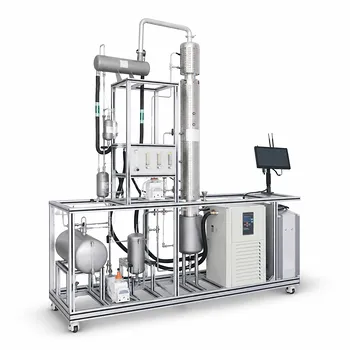
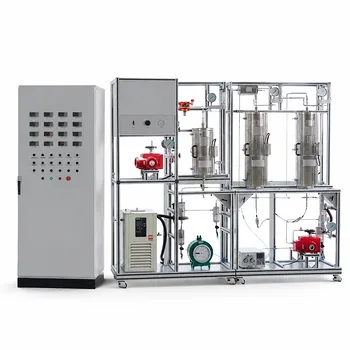
Shortcut distillation models are not just academic exercises—they are the foundational calculator that turns a separation goal into a physical pilot plant. By defining the light and heavy key components and target recoveries, a shortcut model instantly outputs the minimum number of theoretical stages, the minimum reflux ratio, and the optimal feed stage location. For an educational fractional distillation pilot plant, these numbers directly dictate column height, the number of trays or packing height, and where feed ports must be placed. Students therefore establish a theoretical blueprint before they ever touch a valve, transforming the plant from a mysterious device into a predictable investigative tool.
By executing rapid Fenske‑Underwood‑Gilliland (FUG) calculations, educators and students derive a rigorous set of baseline specifications that physically shape the pilot plant—determining its height, feed port positioning, and initial operating conditions. This prevents the column from becoming a “black box” and instead makes it a tangible test of thermodynamic theory.
From Textbook to Blueprint: How Shortcut Models Define Column Parameters
The Minimum Requirements for Separation: Theoretical Stages and Reflux Ratio
A shortcut fractionation method solves for the absolute limits of separation first. Using the Fenske equation, students calculate the minimum number of theoretical stages required under total reflux. Using the Underwood equation, they determine the minimum reflux ratio—the lowest energy input that could ever achieve the desired split.
These two numbers are not just academic benchmarks. They define the physical height of a packed column or the number of trays in a tray column. Without them, students would have no rational basis for selecting the column internals or setting the operating reflux.
Locating the Feed: Why the Optimal Feed Stage Matters for Physical Configuration
A shortcut model doesn’t just count stages; it identifies where the feed should enter. The optimal feed stage location is calculated so that the composition on that tray most closely matches the feed composition.
In a pilot plant, this translates directly to drilling a feed port at a specific height or selecting a tray entry point. A wrongly positioned feed nozzle makes the separation thermodynamically harder and can completely invalidate experimental comparisons with the theory.
Translating Theory into Hardware: Sizing the Column and Packing Height
Once the minimum theoretical stages are known, the designer introduces a practical reflux ratio (a multiple of the minimum) and applies the Gilliland correlation to estimate the actual number of theoretical stages. From there, knowing the height equivalent to a theoretical plate (HETP) for a given packing or the tray efficiency for sieve trays yields the physical column height.
The shortcut model therefore directly answers: “How tall must the column be? How many trays or how much packing should we install? At what elevation does the feed pipe belong?” This is how an idea becomes a piece of hardware a student can touch.
Building a Theoretical Baseline for Hands-On Learning
Predicting Distillate and Bottoms Compositions
Before any heater is switched on, a shortcut model predicts the expected top and bottom compositions based solely on component volatilities and recovery specifications. Students enter the lab with a clear hypothesis: “At total reflux, the overhead should contain X% of the light key.”
When they later sample the pilot plant and see a deviation, that discrepancy becomes a teachable moment—not a confusing anomaly. The model sets the target that real-world hydrodynamics and finite efficiencies will inevitably alter.
Setting Operating Limits Before the First Run
The derived minimum reflux ratio serves as a hard lower boundary: no amount of tinkering will make the column work below it. Shortcut models also provide first estimates of top and bottom temperatures, heat duties, and the overall mass balance.
Operators can therefore pre-set the preheater temperature, configure the condenser cooling water flow, and anticipate the column’s thermal profile. This prevents wasted experimental time and safety incidents from uninformed guesswork.
Avoiding the “Black Box” Trap in Student Labs
Without a priori modeling, a pilot plant is intimidating. Students might randomize feed rates and reflux ratios without knowing the consequences. A shortcut model arms them with logical, accurate initial specifications that anchor their experiments.
By forcing them to designate Light Key (LK) and Heavy Key (HK) components, the model teaches multicomponent thinking. The physical column then becomes a validation instrument, not a mystery box—they are constantly asking, “Does the real column match what the Fenske-Underwood method predicted?”
The Shortcut-to-Rigorous Bridge: Enabling Successful Simulations
Preventing Convergence Failures in Rigorous Tray-by-Tray Simulations
Modern rigorous simulators use complex convergence algorithms—such as the Naphtali‑Sandholm method solving MESH (Material, Equilibrium, Summation, Heat) equations—often coupled with equations of state like the Soave‑Redlich‑Kwong (SRK) model. These algorithms demand precise initial guesses for temperatures, flows, and stage counts.
Without good initial values, the solver diverges. A shortcut model supplies exactly those guesses: top and bottom temperatures, reflux rates, and the number of theoretical stages. Plugging these in ensures mathematical convergence on the first attempt, letting students focus on analysis rather than debugging a crashing simulator.
Using Shortcut Estimates as Accurate Initial Guesses for SRK-Based Programs
Even when using advanced thermodynamic packages, the starting point matters. A shortcut distillation approach provides the initial column profile that a rigorous Jacobian inside‑out algorithm needs. Students quickly learn that a 10‑minute FUG hand calculation saves hours of simulation frustration.
More importantly, this workflow mirrors industrial practice: every tray‑by‑tray design starts with a shortcut estimate. Teaching this sequence instills a habit of principled problem‑solving—simplify first, then refine.
Closing the Loop: Comparing Theory, Simulation, and Physical Data
Calculating Murphree Tray Efficiency from Experimental Data
Once the pilot plant is running, students sample vapor and liquid compositions at various stages and analyze the temperature profile. Using vapor‑liquid equilibrium (VLE) data, they compute the Murphree tray efficiency for each real tray.
That efficiency instantly reveals the gap between the theoretical stages from the shortcut model and the actual stages needed in the hardware. A column designed with 10 ideal stages might need 15 real trays if the efficiency is 67%. This brings the entire design process full circle.
Validating VLE Predictions and Non-Ideal Behavior
Shortcut methods assume constant relative volatility, which is often reasonable for close‑boiling homologs but breaks down for strongly non‑ideal mixtures. By comparing real pilot plant data against both the simplified shortcut results and rigorous simulation predictions, students observe thermodynamic non‑idealities firsthand.
They can see, for example, how an ethanol‑water binary’s azeotropic behavior invalidates the constant‑volatility assumption, and why rigorous tray‑by‑tray enthalphy balances become necessary. This teaches the limits of simplified models in a way that lectures never can.
Understanding the Trade-offs
The Constant Relative Volatility Assumption and Its Limits
The FUG shortcut methods assume the column operates under constant relative volatility throughout all stages. For many hydrocarbon separations this holds; for polar, hydrogen‑bonding, or azeotropic mixtures, it does not. Students must recognise that the theoretical blueprint is only as accurate as this thermodynamic assumption.
When Shortcut Models Fail: Non-Ideal Mixtures and Azeotropes
For systems like acetone‑water or ethanol‑water, the vapor‑liquid equilibrium deviates so strongly that the predicted minimum stages can be far off. Shortcut models also cannot predict azeotropic compositions or the need for extractive agents. In such cases, the physical pilot plant quickly highlights the model’s breakdown, teaching an equally valuable lesson—knowing when not to trust a simplified method.
Accuracy vs. Speed: Why You Still Need Rigorous Methods for Final Design
A shortcut model gets you close in minutes, but modern industrial practice relies on rigorous tray‑by‑tray simulations with detailed thermodynamic models. The pilot plant experiment must therefore be followed by rigorous re‑simulation. The educational value lies in the triangulation: shortcut baseline → rigorous simulation → physical data. Each method corrects the other’s blind spots.
Making the Most of Shortcut Models in Your Teaching Lab
The deepest learning emerges when you weave shortcut calculations, rigorous simulation, and physical experimentation into a single coherent narrative. Your specific teaching goal will dictate where to place the emphasis.
- If your primary focus is teaching fundamental distillation principles: Have students manually complete the Fenske‑Underwood‑Gilliland calculation as a pre‑lab design exercise. They will determine column height and feed location themselves before seeing the hardware.
- If your primary focus is demonstrating the power and limits of process simulation: Ask students to run the shortcut model first, then feed those results into a rigorous SRK‑based simulator. They will see how good guesses prevent convergence failures and how the simulation refines the temperature profile.
- If your primary focus is validating real column performance: task students with collecting pilot plant temperature and composition data to compute Murphree tray efficiencies. Then compare the actual stages required with the theoretical stages predicted by the shortcut model, shining a light on the efficiency gap.
When you place a shortcut distillation model at the start of every design workflow, the fractional distillation pilot plant ceases to be an intimidating piece of hardware and becomes a transparent, predictable laboratory—one that makes the abstract science of separation instantly tangible.
Summary Table:
| Parameter | Model Output (FUG) | Pilot Plant Application |
|---|---|---|
| Theoretical Stages | Minimum stages (Fenske) | Determines column height & tray/packing count |
| Reflux Ratio | Minimum reflux (Underwood) | Establishes operational baseline & energy limits |
| Feed Stage | Optimal stage location | Directs physical feed port nozzle positioning |
| Simulation Guesses | Initial temp, flow & compositions | Prevents convergence failures in rigorous simulators |
Bring Chemical Engineering Theory to Life with LABPARK
At LABPARK, we help universities, research institutes, and enterprises bridge the gap between classroom calculations and physical unit operations. We design and manufacture state-of-the-art Educational and Vocational Unit Operations Pilot Plants in chemical engineering, bioprocess & biotech, and environmental & water treatment.
Whether you need a fractional distillation column optimized for FUG model validation or a customized chemical engineering laboratory setup, our systems are built to turn theoretical formulas into hands-on student mastery.
Ready to elevate your department's learning capabilities? Contact LABPARK today to request a custom quote and explore our pilot plant solutions!
Related Products
- Multi-Modal Distillation Unit Operations Training Pilot Plant
- Multi-Functional Special Distillation Educational Pilot Plant
- Continuous Sieve-Plate Distillation Pilot Plant for Unit Operations Laboratory Education
- Green Anhydrous Ethanol Purification Extractive Distillation Unit Operations Training Pilot Plant
- Dual-Mode Rectification Pilot Plant for Practical Training Unit Operations
People Also Ask
- How can energy balance equations for condensers & reboilers be validated experimentally? Guide
- How does catalyst water concentration affect distillation pilot plant design? Key separation train choices.
- What are the primary reflux ratio control strategies? Master Distillation Unit Operations
- How can real-time carbon number prediction improve distillation pilot plants? Optimize control.
- Why is vacuum operation capability an essential feature for a distillation unit operations pilot plant? Unlock Efficiency