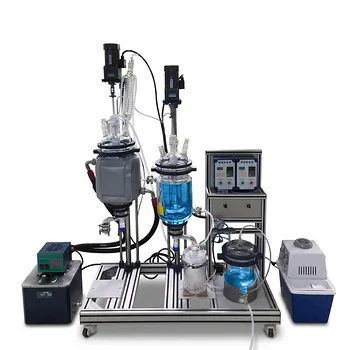
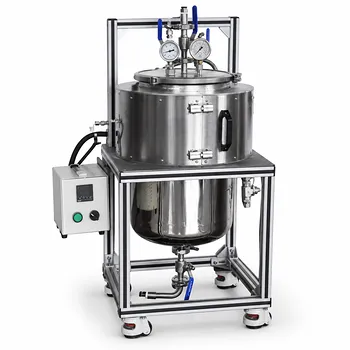
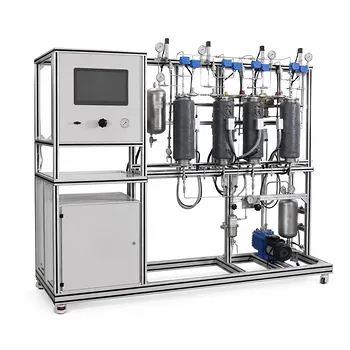
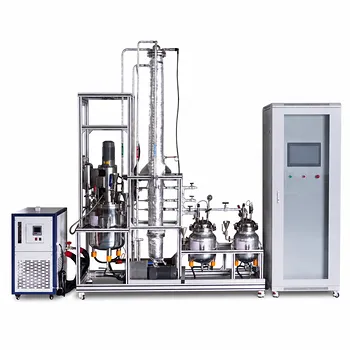
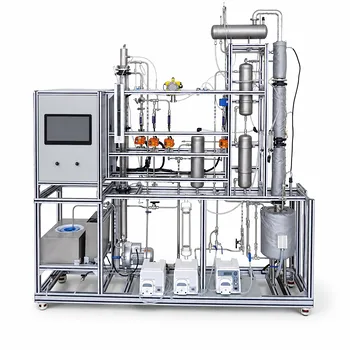
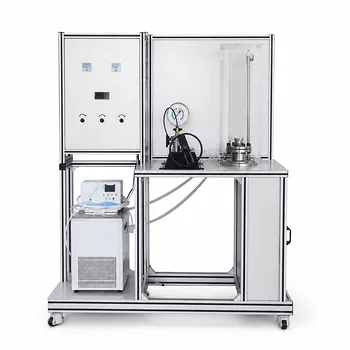
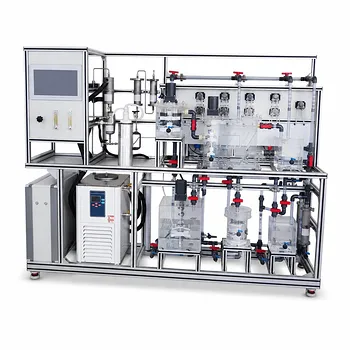
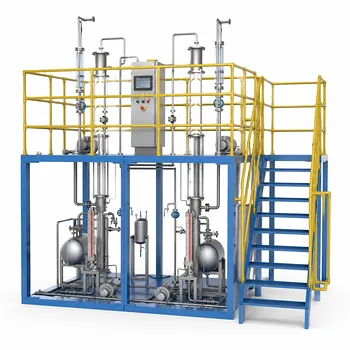
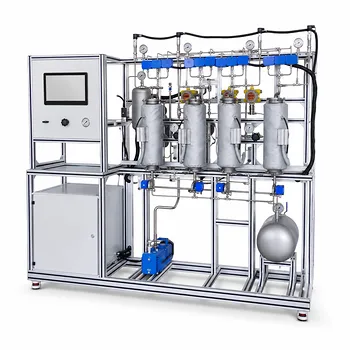
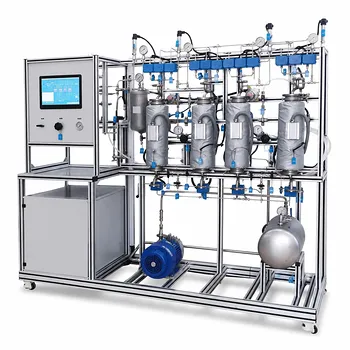
The pilot-scale hot potassium carbonate (Benfield) unit makes energy-saving visible by physically recirculating a chemical solvent through a closed loop where waste heat is recovered at multiple points. In this training system, the hot, CO₂-rich solution leaving the absorber is routed through a flash drum to drop its pressure and release dissolved gases, then passes through a lean/rich cross heat exchanger that preheats the incoming saturated solvent before it enters the regenerator. This integration shows students exactly how a well-designed heat exchange network and pressure reduction steps can slash the external steam demand for stripping CO₂ from the solvent.
The Benfield pilot plant’s core educational value is to turn abstract heat integration theory into a measurable, visible demonstration. Trainees observe that by capturing heat from the regenerated lean solution to warm the rich solution, and by using a flash stage to reduce the energy load on the main reboiler, the process dramatically lowers steam consumption—a fundamental lesson in energy-conscious process design.
How the Benfield Process Demonstrates Energy-Saving Principles
The Basic Chemistry and the Energy Challenge
The Benfield process uses a hot aqueous potassium carbonate solution to chemically absorb CO₂, forming potassium bicarbonate. Reversing this reaction in the regenerator requires substantial thermal energy input to strip the CO₂ and restore the lean solvent.
In a pilot plant, the energy penalty of direct steam injection is made painfully clear when the heat recovery loops are bypassed. Students first run the unit without integration, measure the high steam flow, and then activate the heat recovery features. The drop in steam demand becomes a memorable lesson in why thermal integration is non-negotiable for industrial carbon capture.
Flash Drums: Teaching the Thermodynamics of Pressure Reduction
The rich solution leaving the absorption column is under pressure and saturated with dissolved CO₂. By routing it into a flash drum, the pressure is lowered significantly before the solution reaches the hot regenerator.
This triggers a spontaneous “flash” of CO₂ and some water vapor, removing a portion of the acid gas without any additional steam. The pilot plant’s sight glasses and pressure gauges let trainees directly observe the vapor breakthrough. They can then calculate the fraction of CO₂ removed by flashing alone and correlate it with the pressure drop across the drum—a vivid application of Henry’s Law and vapor–liquid equilibrium.
The Lean/Rich Cross Heat Exchanger: A Living Heat Integration Network
After the flash step, the still-cool rich solution must be heated to the regenerator’s operating temperature. Simultaneously, the hot lean solvent leaving the reboiler must be cooled before returning to the absorber. The pilot plant solves both problems with a single shell-and-tube or plate heat exchanger.
Trainees measure the temperature profiles on both sides of this exchanger. They calculate the heat recovered and, by extension, the reduced burden on the utility steam. The unit becomes a hands-on instrument to teach the pinch principle: by matching hot and cold streams, the process recycles its own thermal energy, shrinking the external energy footprint. Comparing runs with and without the exchanger gives a direct, quantitative link between heat integration design and steam savings.
Measuring the Combined Effect on Regenerator Steam Demand
The Benfield pilot plant is instrumented to show the cascading benefits. A flash drum removes some CO₂ with zero steam; the heat exchanger preheats the feed, so less sensible heat is needed in the column. The result is a markedly lower steam requirement in the reboiler compared to a non-integrated base case.
Students can perform an energy balance around the entire regeneration section. They log steam flow, temperature changes, CO₂ loading, and flash gas composition. These numbers feed directly into discussions about specific reboiler duty (MJ per kg CO₂ captured), setting the stage for deeper studies of solvent optimization and process economics.
Understanding the Trade-Offs and Real-World Constraints
The Energy Savings Are Real but Not Infinite
Even with full heat integration, hot potassium carbonate processes still require significant steam because the chemical regeneration reaction is endothermic and the solvent must be kept at a high temperature to avoid precipitation. The pilot plant teaches trainees that while heat recovery cuts energy demand dramatically, there is a thermodynamic minimum that cannot be circumvented without switching to a fundamentally different solvent or separation method.
Flash Drum Operation Introduces Complexity
Flashing reduces steam load, but it also releases water vapor alongside CO₂. If the flash conditions are not carefully controlled, excessive water loss can upset the solvent concentration. In the pilot plant, students see that maintaining a stable water balance requires either a water wash or a partial condenser on the flash gas line—adding capital cost and operational nuance to the energy-saving feature.
Corrosion and Solvent Degradation Lurk in the Background
Hot potassium carbonate is corrosive, particularly under the high-temperature regenerator conditions. The pilot plant often uses stainless steel components or corrosion inhibitors to replicate industrial practice. Trainees learn that selecting materials and managing inhibitor levels are essential hidden costs that must be weighed against steam savings. The educational takeaway: energy efficiency is never evaluated in isolation; it is part of a broader plant-wide techno-economic analysis.
Making the Right Choice for Your Training Goal
The Benfield decarbonization pilot unit serves different learning outcomes depending on how it is used within a chemical engineering unit operations course.
- If your primary focus is mastering heat integration: Run the unit with and without the cross exchanger, and have students calculate the recovered heat duty. Compare these numbers to the theoretical maximum from pinch analysis.
- If your primary focus is gas absorption and regeneration kinetics: Operate the flash drum at varying pressures and log how much CO₂ is flashed versus removed in the stripper. Use the data to build a simple stage-wise model linking pressure, temperature, and mass transfer.
- If your primary focus is industrial carbon capture feasibility: Use the pilot plant’s energy balance to project the steam cost per tonne of CO₂ captured, then discuss how this figure must be reduced for commercial deployment. Layer on discussions about alternative solvents, advanced distillation configurations, and heat pump integration featured in other unit operations pilots.
- If your primary focus is troubleshooting and process control: Introduce deliberate upsets—like a drop in flash drum level or a fouled heat exchanger—and task students with diagnosing the root cause using temperature, pressure, and flow trends. This builds the operational mindset needed to sustain energy-efficient performance over time.
A pilot-scale hot potassium carbonate unit transforms energy saving from a lecture slide into a tangible system. By physically manipulating heat exchangers, flash drums, and steam flows, trainees internalize the art of squeezing every possible joule out of a process before accepting the inevitable external energy input.
Summary Table:
| Energy-Saving Feature | Thermodynamic Principle | Training & Educational Value |
|---|---|---|
| Flash Drum | Pressure reduction & vapor-liquid equilibrium (Henry's Law) | Students observe vapor breakthrough and calculate CO₂ removed without steam. |
| Lean/Rich Cross Exchanger | Heat integration (Pinch principle) | Trainees measure temperature profiles and calculate recovered thermal energy. |
| System Integration | Overall mass & energy balance | Enables comparison of steam consumption with and without heat recovery loops. |
Elevate Your Chemical Engineering Lab with LABPARK
Ready to bring hands-on thermodynamic and heat integration concepts to life? LABPARK provides premium Educational and Vocational Unit Operations Pilot Plants in chemical engineering, bioprocess & biotech, and environmental & water treatment.
Engineered specifically for universities, research institutes, and enterprises, our pilot plants—including advanced decarbonization and absorption units—equip trainees with the practical skills needed to design and operate energy-efficient industrial processes.
Contact LABPARK today to explore our pilot plant solutions and request a detailed technical proposal!
Related Products
- Potassium Salt Thermal Dissolution and Crystallization Separation Educational Unit Operations Pilot Plant
- Hot Filtration Educational Unit Operations Pilot Plant Laboratory System
- Bench Scale Carbon Dioxide Capture Educational Unit Operations Pilot Plant
- Carbon Material Thermal Pretreatment Multiphase Separation Educational Pilot Plant
- Carbon Dioxide Absorption and Desorption Educational Pilot Plant for Carbon Capture Studies
People Also Ask
- What are the benefits of integrating online PAT tools like ATR-FTIR into crystallization unit operations pilot plants?
- How do crystallization pilot plants improve student learning? Shift from manual observation to process control.
- Why is precise temperature control critical in crystallization pilot plants? Key to Scale-Up Success
- Control Crystallization Pilot Plant Secondary Nucleation: 4 Key Adjustments
- What key factors should be considered when configuring a crystallization unit operations pilot plant?