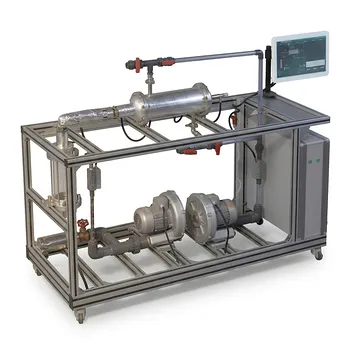
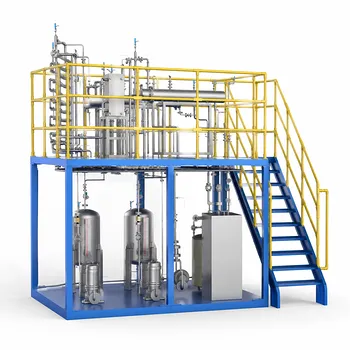
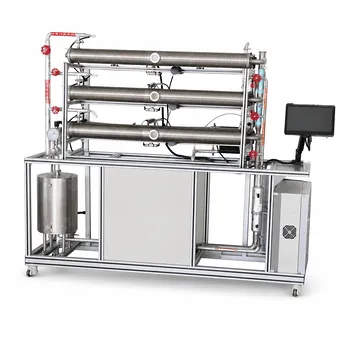
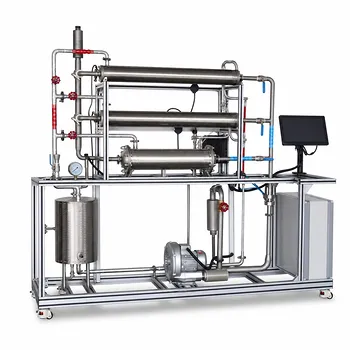
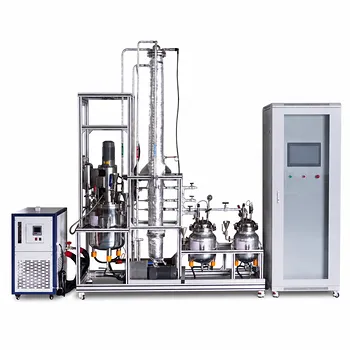
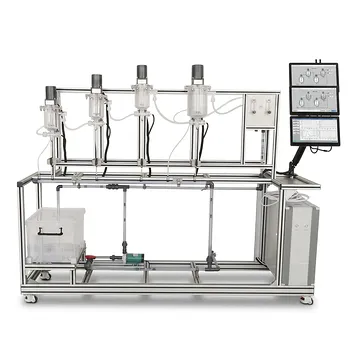
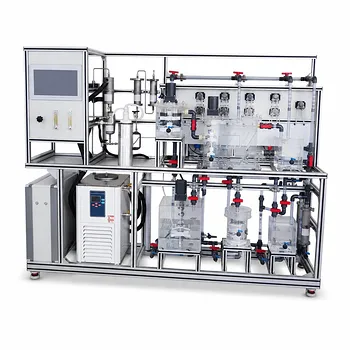
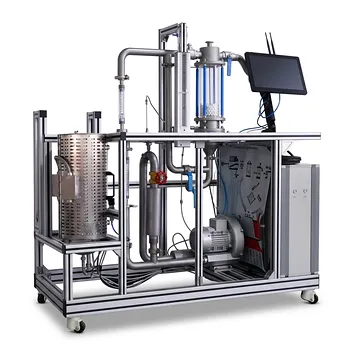
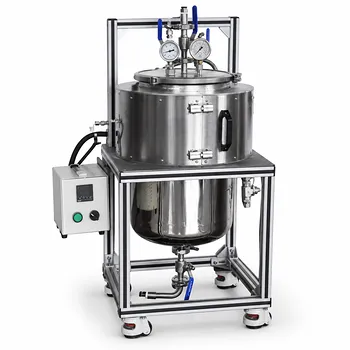
The physical meaning of HTU and NTU becomes tangible when a trainee physically decomposes a fixed-length heat exchanger.
In a shell-and-tube heat exchanger pilot plant, the total tube length ($L$) is a fixed, physical object you can see and touch. The equation $L = H_o \times NTU$ breaks this object into two powerful abstract concepts. The Number of Transfer Units (NTU) represents the thermal "difficulty" of the job—the dimensionless temperature change demanded of that specific fluid stream. The Height (or length) of a Transfer Unit ($H_o$) is the physical chunk of tube length required to accomplish one of those units of difficulty. The pilot plant makes $H_o$ a direct measure of the equipment's thermal efficiency under current operating conditions.
A pilot plant transforms NTU from a dimensionless number into a measure of the "thermal distance" a fluid must travel. $H_o$ becomes the physical ruler that measures this distance, changing its scale based on flow rate and fouling, proving that an exchanger's performance is a dynamic system, not a static label.
Decomposing a Fixed Object into Dynamic Concepts
The core pedagogical power comes from manipulating a single, unchanging piece of hardware. The total tube length ($L$) is constant, but the components that define it—$H_o$ and NTU—are in a constant tug-of-war that trainees can control.
The Fixed Length as a Constant Constraint
The pilot plant's tube bundle has a physical, measurable length that cannot be altered. This provides a concrete, visual anchor for abstract concepts. The fundamental equation $L = H_o \times NTU$ is no longer just a formula; it's a physical constraint. If one variable increases, the other must proportionally decrease for the equation to hold true over the same physical equipment. This demonstrates that a heat exchanger’s physical size is the product of a performance requirement and an efficiency metric.
NTU as the Measure of Thermodynamic "Difficulty"
The NTU quantifies the "thermal length" or the difficulty of the heat transfer task. It’s directly linked to the required temperature change. A small temperature change, like cooling fluid by 2°C, is a "short" thermal distance, resulting in a low NTU. A large temperature change, like cooling fluid by 50°C, is a "long" thermal distance, resulting in a high NTU. The pilot plant allows trainees to demand these different NTU values from the exact same heat exchanger, making the concept of dimensionless thermal scale immediately intuitive.
H_o as the Real-Time Efficiency "Yardstick"
Since $L$ is fixed, $H_o = L / NTU$. As the thermal task’s difficulty (NTU) increases, the length required for each transfer unit ($H_o$) must shrink to fit the job into the fixed physical length. This makes $H_o$ a direct, inversely proportional indicator of the exchanger's operational efficiency. A small $H_o$ means the equipment is highly efficient, packing a lot of thermal difficulty into a short physical length. A large $H_o$ signals poor efficiency, where even a simple thermal task consumes a lot of physical tube length.
Using Flow Rate to Make Thermodynamics Visible
The primary control knob on a pilot plant is flow rate, which trainees can manipulate to see an immediate, cause-and-effect relationship between hydrodynamics and thermal performance that is otherwise hidden inside the pipes.
The Invisible Chain: Velocity, Coefficient, and H_o
Changing the flow rate of the tube-side fluid directly changes its velocity. A higher velocity increases turbulence, which dramatically improves the convective heat transfer coefficient. An improved coefficient directly increases the overall heat transfer coefficient ($U$). Since the definition of $H_o$ is inversely tied to $U$ (and directly to factors like tube diameter and count), a higher flow rate causes a measurable drop in $H_o$.
The Visual Payoff: A Shift in Required NTU
With two exchangers or sequential runs, a trainee can observe the following chain reaction live. For an exchanger performing the identical thermal task (e.g., heating a cold stream from 20°C to 60°C), the required NTU is fixed. By increasing the flow rate, the overall heat transfer coefficient improves, and $H_o$ shrinks. Since the required NTU hasn’t changed, a smaller $H_o$ means the total required physical length ($L_{required} = H_o \times NTU$) is now much shorter. The pilot plant, with its fixed length, becomes dramatically oversized for the task, causing the outlet temperature to quickly approach the hot inlet temperature. The trainee sees a high-performance outcome emerge directly from a hydrodynamic change, all interpreted through the $H_o$-NTU lens.
Demonstrating the Physical Impact of Configuration
The concept of $H_o$ fully materializes when a pilot plant is reconfigured for different pass arrangements. This shows that efficiency is a physical design choice, not a given constant.
Multi-Pass Conversion as an H_o Optimization Strategy
Converting a single-pass unit to a double-tube-pass unit by adding a baffle demonstrates a classic industrial trade-off. This change halves the flow cross-sectional area, doubling the tube-side fluid velocity for the same volume flow rate. The turbulent convective heat transfer coefficient improves by a factor of roughly $2^{0.8}$, or about 74%. This substantial improvement in the overall heat transfer coefficient directly collapses the $H_o$ value. The trainee witnesses that adding a baffle physically drills multiple shorter, highly efficient transfer units into the same shell, rather than one long, inefficient one.
The Trade-off: Efficiency vs. Pressure Drop
This is a crucial moment for understanding real-world constraints. The same velocity increase that shrank $H_o$ also causes a dramatic increase in fluid pressure drop, often proportional to the square of the velocity. This trade-off is best demonstrated by setting a constant heat load. The double-pass unit will handle it with a much lower temperature approach (due to its higher effectiveness and lower $H_o$). A trainee directly observes that superior thermal performance is not free; it’s bought with higher pumping costs, making an optimal $H_o$ an economic decision, not just a thermal one.
How to Use This to Train Your Team
To maximize understanding, structure the pilot plant exercises around the $L = H_o \times NTU$ framework.
- If your primary focus is teaching core concepts: Base the exercise on calculating $H_o$ from $L/NTU$ and having trainees plot how $H_o$ changes with tube-side velocity. The goal is to visualize $H_o$ as a dynamic variable.
- If your primary focus is process optimization: Set a required heat load (a fixed NTU) and challenge trainees to reconfigure the tube passes to find the configuration that balances the smallest possible $H_o$ with an acceptable pressure drop.
- If your primary focus is troubleshooting and maintenance: Deliberately foul one tube pass. Have trainees calculate the new, larger $H_o$ for a given heat load and observe the failing outlet temperature, demonstrating how fouling directly steals effective length by inflating $H_o$.
Mastering the $H_o$-NTU decomposition turns a pilot plant from a simple heater into a transparent diagnostic tool, making the invisible physics of heat transfer visible.
Summary Table:
| Parameter | Formula / Concept | Physical Meaning in Pilot Plant | Impact of High Flow Rate |
|---|---|---|---|
| Total Length ($L$) | $L = H_o \times NTU$ | Fixed physical tube length (constant constraint) | Remains unchanged |
| HTU ($H_o$) | $H_o = L / NTU$ | Thermal efficiency yardstick (smaller = more efficient) | Decreases (due to higher turbulence & $U$) |
| NTU | $NTU = L / H_o$ | Thermodynamic "difficulty" of the temp change | Constant for a fixed thermal task |
Bring Heat Transfer Theory to Life with LABPARK
Bridge the gap between complex thermodynamic equations and practical engineering skills. LABPARK provides premium Educational and Vocational Unit Operations Pilot Plants in chemical engineering, bioprocess & biotech, and environmental & water treatment.
Our advanced pilot plant systems enable universities, research institutes, and enterprises to:
- Visualize Abstract Concepts: See and feel how physical tube length relates to HTU ($H_o$) and NTU through real-time data.
- Master Process Dynamics: Train operators on the direct impacts of flow velocity, turbulence, and fluid routing.
- Optimize System Configurations: Hands-on experience balancing thermal efficiency against pressure drop constraints.
Ready to elevate your engineering curriculum or technical training program? Contact LABPARK today to explore our customizable solutions.
Related Products
- Shell and Tube Heat Exchanger Heat Transfer Coefficient Determination Educational Pilot Plant
- Comprehensive Multi-Modal Heat Transfer Unit Operations Pilot Plant for Engineering Training
- Three-Tube Heat Transfer Educational Pilot Plant for Unit Operations Training
- Dual Mode Heat Transfer Pilot Plant for Unit Operations Training
- Multi-Reactor Educational Pilot Plant for Reaction Engineering Unit Operations
People Also Ask
- Why Apply LMTD Correction in Shell-and-Tube Pilot Plants & How to Determine It
- How is the fouling factor (Rd) evaluated? Key Pilot Plant Insights for Students
- How is fouling factor demonstrated using shell and tube pilot plants? Practical Lab Guide
- Why is simulating and calculating fouling factors crucial when operating educational heat exchanger pilot plants?
- Why Keep Shell-Side Reynolds Number Above 2100? Maximize Pilot Plant Heat Transfer