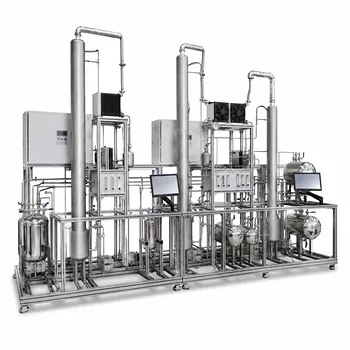
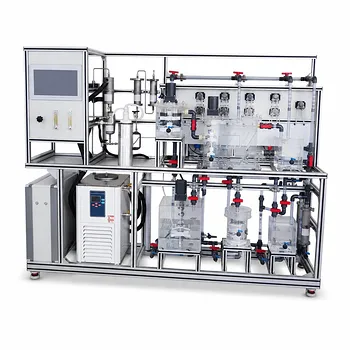
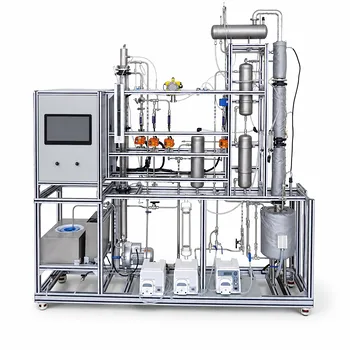
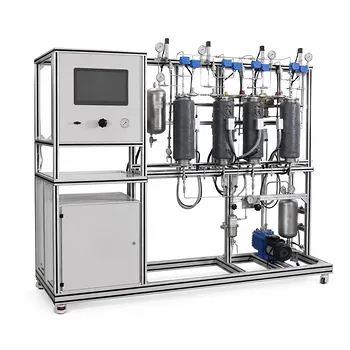
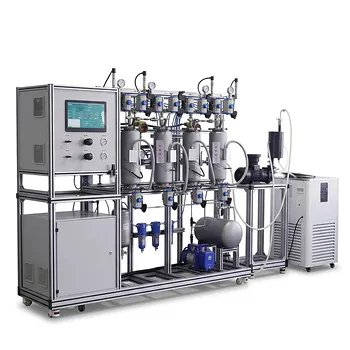
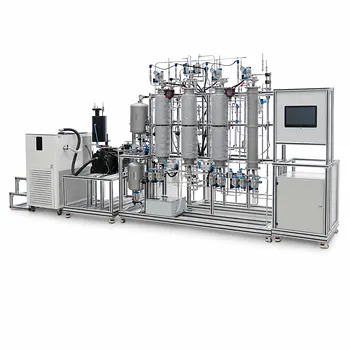
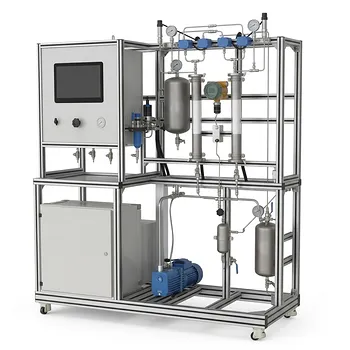
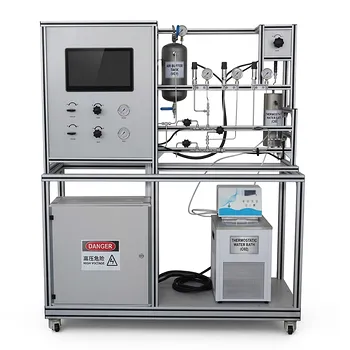
A gas dehydration pilot plant brings the invisible physics of mass transfer to life. It demonstrates that membrane drying is not a passive filter but an active separation process governed by the difference in water vapor partial pressure across the membrane. By deliberately introducing a sweep gas—a fraction of the dry product—on the permeate side, the pilot plant shows exactly how you maintain that partial pressure differential along the entire module, enabling dew points as low as -40°C or colder.
The core takeaway: A membrane dryer works only as hard as its partial pressure driving force, and that force collapses the moment moisture accumulates on the permeate side. A pilot plant makes this thermodynamic truth tangible by showing that the dew point of the outlet gas is directly controlled by the sweep flow. No sweep, no deep drying.
The Invisible Engine: Partial Pressure as a Driving Force
Membrane gas drying relies on a simple but unforgiving principle: water vapor moves from a region of high partial pressure to a region of low partial pressure. The membrane itself is a selective barrier that allows fast permeation of water vapor while restricting the bulk gas (air or methane).
Why Partial Pressure Matters More Than Total Pressure
Total pressure provides the overall push, but it’s the partial pressure of water that dictates exactly how many water molecules migrate. If the permeate side has a high water vapor concentration, the transfer stalls—even if the total pressure difference across the membrane is large.
That’s because the membrane’s selectivity translates to an equilibrium that depends on the local chemical potential of water, which is essentially its partial pressure.
The Permeate Side: Where Driving Force Lives or Dies
The driving force is the difference between the water partial pressure in the feed gas and that on the permeate side. On the feed side, the partial pressure is set by the inlet humidity and temperature.
On the permeate side, if no gas extraction occurs, water vapor accumulates and the partial pressure rises quickly. The result: the driving force collapses, and the membrane stops drying effectively, regardless of how high the feed pressure is.
How a Pilot Plant Makes the Driving Force Observable
A pilot plant translates this principle into a controlled experiment. It typically uses a feed air or gas stream at a known pressure and dew point, a membrane module, and instrumentation to measure inlet and outlet humidity.
Demonstrating the 10 atm/-40°C Benchmark
In educational and research units, compressed gas is routed through the membrane at around 10 atm. At this pressure, the partial pressure driving force is strong enough that, with proper sweep gas management, the pilot plant can achieve a -40°C dew point—a standard industrial dryness target.
By varying only the sweep gas flow rate while keeping all other variables constant, the operator sees a direct, repeatable link between sweep volume and outlet moisture content.
Simulating High-Pressure Industrial Conditions
To model real-world scenarios, such as natural gas processing or naval compressed air, the pilot plant can be configured to operate between compressor stages at 30 to 70 bar. This demonstrates how a membrane dryer protects downstream equipment by removing moisture before final compression—a critical lesson that only a hands-on pilot system can convey.
The Critical Role of Sweep Gas in Depressing Partial Pressure
Sweep gas is the active tool that keeps the permeate side dry. In a membrane dryer, a small fraction of the dried product gas is expanded to a lower pressure and passed along the permeate side in a countercurrent flow arrangement.
Sweep Gas Maintains a Flat Driving Force Profile
Without sweep gas, the water partial pressure on the permeate side would rise continuously from the inlet to the outlet, creating a steep decline in the driving force. The sweep flow flushes away the permeated moisture, keeping the permeate side near the partial pressure of the dry sweep stream along the entire membrane length.
This ensures that even at the far end of the module—where you need to pull out the last traces of moisture—the driving force remains robust enough to achieve sub-zero dew points.
Four-Ported Membrane Design as a Visual Aid
Many pilot plants use a four-ported membrane module, where the feed, retentate, permeate, and sweep connections are clearly separated. This design makes the countercurrent flow visible: dry sweep gas enters at the retentate end and travels back against the feed flow, picking up moisture before exiting.
By measuring the humidity of the sweep gas exhaust and the retentate dew point, the pilot plant illustrates the mass balance of water removal in real time.
Understanding the Trade-offs
Sweep gas is not free—it’s an essential part of the dryer’s operating cost. A pilot plant is also the perfect setting to explore the economic and technical compromises involved.
Sweep Gas Consumption vs. Dew Point
The deeper the target dew point, the more sweep gas you need. There is a diminishing return: beyond a certain sweep ratio (sweep flow relative to net dry product flow), you waste a significant portion of your compressed gas for only a marginal improvement in dryness.
In a pilot test, you can plot the dew point depression vs. sweep ratio curve to identify the optimal operating point for your application.
Pressure Drop and Energy Cost
Passing sweep gas across the permeate side introduces additional pressure drop that must be accounted for in the system design. In high-pressure (30–70 bar) demonstrations, this pressure drop becomes significant, translating directly to higher compression energy.
Balancing energy efficiency with required dryness is a practical lesson that only a well-instrumented pilot plant can teach.
Membrane Life and Contamination
The sweep gas must be clean and dry; otherwise, it can reintroduce contaminants or cause back-diffusion of moisture if not managed correctly. Pilot plant tests often reveal the long-term stability of the membrane under varying sweep conditions, highlighting the need for proper pre-filtration.
Making the Right Choice for Your Goal
A pilot plant doesn’t just prove a theory—it gives you the data to decide how to run a commercial membrane dryer.
- If your primary focus is achieving ultra-low dew points (below -40°C): Prioritize a high sweep ratio in a countercurrent configuration; the extra gas consumption is the price of deep drying.
- If your primary focus is minimizing operating cost and sweep gas waste: Find the sweet spot on the sweep ratio vs. dew point curve in your pilot tests—excess sweep beyond that point is wasted energy.
- If your primary focus is high-pressure, interstage drying (30–70 bar): Use your pilot plant to validate membrane performance at full pressure and confirm that the sweep system can handle the pressure drops without choking.
- If your primary focus is educational or training purposes: Use the four-ported membrane module to physically demonstrate the countercurrent flow and let students or operators see the immediate dew point change when sweep flow is adjusted.
Ultimately, a gas dehydration pilot plant turns the abstract concept of partial pressure driving force into a practical, controllable variable, and proves that sweep gas is the most direct lever you have to make a membrane dryer perform exactly as needed.
Summary Table:
| Key Concept / Parameter | Operational Role in Membrane Dryer | How the Pilot Plant Demonstrates It |
|---|---|---|
| Partial Pressure | Primary driving force for water vapor mass transfer | Shows drying performance at varying inlet pressures and humidity levels. |
| Sweep Gas | Lowers permeate-side moisture to maintain driving force | Demonstrates direct control of outlet dew point by adjusting sweep flow. |
| Countercurrent Flow | Optimizes driving force profile along the membrane | Visualized using a four-ported module measuring inlet/outlet dew points. |
| Sweep Ratio Trade-off | Balances gas consumption against dew point targets | Plotted as dew point depression vs. sweep flow to find optimal efficiency. |
Bring Mass Transfer Theories to Life with LABPARK
Looking to equip your laboratory or training center with advanced, hands-on learning systems? LABPARK provides premium Educational and Vocational Unit Operations Pilot Plants in chemical engineering, bioprocess & biotech, and environmental & water treatment.
Designed specifically for universities, research institutes, and enterprises, our rugged pilot plants turn abstract physics—like partial pressure driving forces and sweep gas mechanics—into interactive, observable experiments.
Ready to elevate your engineering curriculum or research capabilities? Contact us today to request a quote or discuss custom configurations!
Related Products
- Green Anhydrous Ethanol Purification Extractive Distillation Unit Operations Training Pilot Plant
- Absorption and Desorption Educational Unit Operations Pilot Plant
- Dual-Mode Gas Absorption and Desorption Unit Operations Training Pilot Plant
- Thermal Desorption Exhaust Gas and Tail Water Treatment Educational Pilot Plant
- Carbon Dioxide Absorption and Desorption Educational Pilot Plant for Carbon Capture Studies
People Also Ask
- How can energy balance equations for condensers & reboilers be validated experimentally? Guide
- Fugacity vs Activity Coefficient: How to Choose VLE Models for Distillation Pilot Plants
- How can real-time carbon number prediction improve distillation pilot plants? Optimize control.
- How Reflux Ratio Affects Distillation Pilot Plant Separation Efficiency & Limits
- Why is vacuum operation capability an essential feature for a distillation unit operations pilot plant? Unlock Efficiency