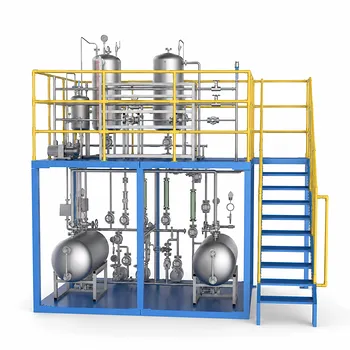
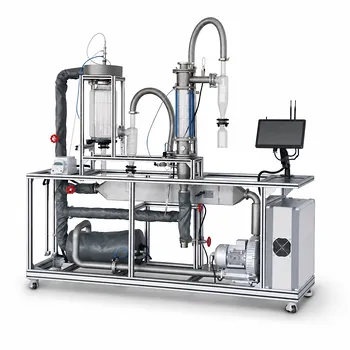
Increasing the reflux ratio immediately improves separation efficiency in your pilot plant by boosting the liquid-vapor contact that drives mass transfer, delivering a purer distillate. However, this improvement is not infinite. The physical ceiling is defined by three hard limits: the onset of column flooding from excessive internal traffic, the fixed number of theoretical plates in your column, and the unyielding constraints of the material balance.
The reflux ratio is the single most powerful control knob for distillate purity, but it governs a fundamental trade-off between product quality and energy cost. Its physical limits are an absolute boundary—you can increase reflux only until you flood the column, and even then, your separation is still capped by the number of trays and the feed's composition.
How a Higher Reflux Ratio Improves Purity
Adjusting the reflux ratio ($R = L/D$) is not just about returning more liquid to the column. It fundamentally alters the thermodynamic pathway for separation. On a pilot plant, this translates into a measurable shift in the column's internal profile.
The Direct Impact on the Operating Line
The reflux ratio mathematically defines the slope of the rectifying section's operating line on a McCabe-Thiele diagram.
Increasing $R$ steepens this slope, moving the operating line further away from the equilibrium curve. This creates a larger concentration gradient between the liquid and vapor phases on every tray. A larger driving force means more efficient mass transfer occurs at each stage, producing a higher distillate purity ($x_D$) for the same number of physical trays.
Observing the Shift in Your Pilot Plant
In an educational pilot plant with real-time data acquisition, you can see this principle in action. As you increase the reflux ratio, the temperature profile along the column will steepen and the top temperature will drop, reflecting the lighter, purified composition.
The improved purity is not a free performance gain. The vapor load ($V$) inside the column increases directly with $R$, as $V = L + D$. Your reboiler heat duty and condenser cooling water demand will rise immediately, confirming the link between separation quality and energy cost.
Understanding the Physical Boundaries
You cannot increase the reflux ratio indefinitely. The pilot plant itself imposes hard, physical constraints that define the maximum achievable separation and the safe operating window. Ignoring these limits leads to operational failure.
Limit 1: Hydraulic Capacity and Flooding
Increasing $R$ increases both the internal liquid downflow and vapor upflow. At a certain point, the column's trays or packing can no longer handle this traffic.
The vapor velocity becomes too high, entraining liquid droplets and preventing the downcomers from draining properly. This is the flooding point. The pressure drop skyrockets, separation efficiency collapses to zero, and the operation becomes hazardous. Once hydraulic limits are reached, you have no choice but to reduce the feed rate or other loads.
Limit 2: The Tray-Limited Ceiling at Total Reflux
The fixed number of physical trays in your pilot plant is an uncompromising boundary. This limit is found at total reflux ($R \rightarrow \infty$), where you take no distillate product ($D=0$) and return all condensed vapor to the column.
Under total reflux, the operating line merges with the 45-degree diagonal, providing the maximum possible driving force for your column's specific number of stages. Even at this theoretical maximum, the distillate composition is bounded. You simply cannot surpass the separation capability provided by your column's physical hardware.
Limit 3: The Unyielding Material Balance
This is the most fundamental, non-negotiable constraint. The maximum amount of a component you can draw off in the distillate stream is the amount that enters the column in the feed.
Increasing the reflux ratio cannot change this overall balance. The maximum distillate concentration cannot exceed $F z_F / D$, where $F$ is feed rate and $z_F$ is feed composition. This often explains why a purity target remains out of reach despite a very high reflux ratio—you are trying to pull out more light component than the feed is supplying.
Finding the Operational Optimum
Blindly maximizing the reflux ratio is an amateur's mistake. Expert operation involves targeting the economically and technically optimal range, which balances separation power against its costs.
Why You Must Exceed the Minimum Reflux Ratio ($R_m$)
The minimum reflux ratio ($R_m$) is the theoretical point where the operating line and equilibrium curve intersect, creating a "pinch point."
At this pinch, the driving force for mass transfer becomes zero. In a real pilot plant with a finite number of trays, you can never achieve your target purity at $R_m$. You must operate above it, typically at $1.1$ to $1.5$ times $R_m$, to provide enough driving force for your column's physical stages to work.
A Key Warning for Specialized Applications
There is a critical exception to the general rule. In extractive distillation, where a solvent is used to alter relative volatility, mindlessly increasing the reflux ratio can backfire disastrously.
A higher reflux ratio dilutes the solvent concentration on the trays, reducing its effectiveness and potentially worsening the separation. In this specific context, you must balance the reflux ratio against the solvent-to-feed ratio to find a true process optimum, not just a hydraulic maximum.
Understanding the Trade-offs
This is where your theoretical knowledge becomes practical skill. Adjusting the reflux ratio is an exercise in balancing competing economic and technical factors in real time.
The Capital vs. Operating Cost Dilemma
A higher $R$ saves on capital cost by reducing the number of theoretical stages needed, which is critical for a pilot plant with a fixed, limited height. But you pay for this with operating costs.
Your utility meters will show a direct spike in steam and cooling water consumption. Furthermore, because most of the condensed material is being sent back to the column, your net product flow rate decreases. In an educational setting, this clarifies why the optimum economic reflux ratio usually falls between $1.1$ and $2.0$ times $R_m$ — it balances equipment depreciation against direct energy bills.
The Risk of an Overspecified Simulation
When using process simulators to guide your pilot plant runs, it's tempting to specify an unrealistically high reflux ratio to make a separation "work" on the screen.
This creates a dangerous disconnect from reality. A simulation that calls for a physically unattainable reflux ratio, one that implies flooding, will produce useless predictions. Always cross-reference the simulation's required vapor and liquid loads against your pilot plant's hydraulic performance data to ensure the spec is physically achievable.
Making the Right Choice for Your Goal
Your adjustment strategy must be dictated by your primary objective for the pilot plant run. Use the following guide to align your actions with your goals.
- If your primary focus is maximizing distillate purity: Increase the reflux ratio while continuously monitoring the column's pressure drop and top/bottom temperatures. Stop increasing immediately if gauges indicate the onset of flooding, or if purity stops rising, which signals you've hit the plate or material balance limit.
- If your primary focus is minimizing energy consumption for a given purity spec: Start at a higher reflux ratio to comfortably meet specs, then methodically reduce it in small steps. Stop reducing when the product purity drops below your target tolerance, then set $R$ just above that point to find the most efficient operating condition.
- If your primary focus is an educational demonstration of the McCabe-Thiele method: Vary the reflux ratio across a wide range while students collect temperature and composition data. Use this data to plot the operating lines, prove the existence of the material balance limit, and calculate the column's effective number of theoretical plates at different operating conditions.
The reflux ratio is not a purity setpoint to be maximized, but a powerful lever that you must precisely control to navigate the physical and economic constraints of your pilot plant's universe.
Summary Table:
| Physical Limit | Cause / Mechanism | Operational Impact |
|---|---|---|
| Flooding | Excessive liquid/vapor traffic | Pressure drop spikes; separation efficiency drops to zero. |
| Tray Ceiling | Fixed physical stage count | Maximum purity is capped, even at total reflux ($R \rightarrow \infty$). |
| Material Balance | Feed composition boundary | Purity is strictly limited by the amount of light component in feed. |
Bring Hands-On Chemical Engineering Concepts to Life
Are you looking to provide your students or researchers with real-world experience in distillation column hydraulics, McCabe-Thiele verification, and process optimization?
LABPARK provides state-of-the-art Educational and Vocational Unit Operations Pilot Plants in chemical engineering, bioprocess & biotech, and environmental & water treatment. Designed specifically for universities, research institutes, and enterprises, our pilot plants feature real-time data acquisition and robust safety systems, enabling users to safely explore reflux ratios, column flooding, and thermodynamics.
Ready to upgrade your laboratory capabilities? Contact us today to discover how LABPARK can customize the perfect unit operations pilot plant for your institution!
Related Products
- Continuous Sieve-Plate Distillation Pilot Plant for Unit Operations Laboratory Education
- Multi-Modal Distillation Unit Operations Training Pilot Plant
- Green Anhydrous Ethanol Purification Extractive Distillation Unit Operations Training Pilot Plant
- Dual-Mode Rectification Pilot Plant for Practical Training Unit Operations
- Ethyl Acetate Synthesis Unit Operations Pilot Plant for Practical Training
People Also Ask
- How to select the right activity coefficient model (Wilson, NRTL, UNIQUAC) for distillation pilot plants?
- What are the primary reflux ratio control strategies? Master Distillation Unit Operations
- How does catalyst water concentration affect distillation pilot plant design? Key separation train choices.
- How can real-time carbon number prediction improve distillation pilot plants? Optimize control.
- Why is vacuum operation capability an essential feature for a distillation unit operations pilot plant? Unlock Efficiency