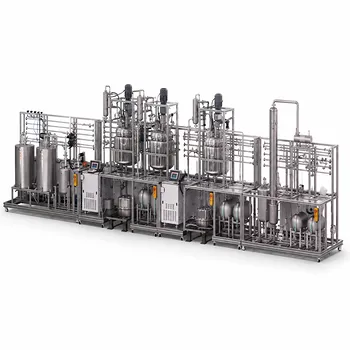
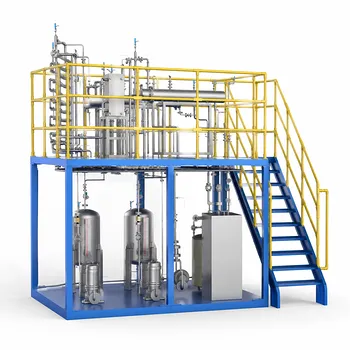
The heartbeat of pinch analysis shifts from an abstract graph to a physical sensation when you stand in front of a pilot plant. A chemical engineering unit operations pilot plant facilitates practical learning by transforming pinch analysis and heat exchanger network (HEN) design into a hands-on, data-driven exploration. You manipulate real hot and cold streams, manually adjust valves, and witness temperature profiles shift in real time. This immediate feedback loop turns the theoretical concept of a pinch point into an observable system behavior, allowing you to collect the data needed to construct temperature-enthalpy diagrams and physically test heat recovery strategies that minimize utility consumption.
The pilot plant bridges the critical gap between textbook principles and operational intuition. It forces you to confront the physical reality of thermodynamic rules—such as CP matching constraints—and to see, rather than just calculate, how process-to-process heat integration directly slashes steam and cooling water demand. The lesson sticks because you've touched the equipment.
From Theory to Tangible: Building Temperature-Enthalpy Diagrams
The foundational task of pinch analysis—constructing composite curves—becomes a live experiment rather than a spreadsheet exercise. A pilot plant equipped with multiple configurable heat exchangers gives you a physical playground of thermal sources and sinks.
Configurable Streams as the Canvas
You start by setting flow rates and initial temperatures for several hot and cold liquid streams. As data pours in from temperature sensors, you plot the heat load versus temperature for each stream. By physically adjusting a stream’s flow, you immediately see how the shape of its temperature-enthalpy profile changes, teaching you the direct relationship between heat capacity flowrate (CP) and the slope of those composite curves.
Locating the Pinch Point by Touch, Not Just Calculation
Once the individual curves are built, you combine them into hot and cold composites. The point of closest approach—the pinch—appears on your graph. In the pilot plant, you can verify this point by observing the minimum driving force across a heat exchanger. When you attempt to transfer heat between streams that approach the pinch too closely, the required minimum temperature approach (ΔT_min) is physically violated, and you see the outlet temperatures fail to reach the target. This visceral experience cements the concept that the pinch defines the bottleneck for heat recovery.
Embedding the Pinch Design Rules into Muscle Memory
The physical act of matching streams according to the CP rules transforms abstract guidelines into an unforgettable lesson.
Verifying CP Matching Above the Pinch
Above the pinch, the system is a heat sink—only hot utility is allowed. The rule demands that CPh ≤ CPc to keep temperature profiles from pinching together. On the pilot plant, you deliberately pair a high-CP hot stream with a low-CP cold stream above the pinch. The cold stream’s temperature shoots up too fast, and the hot stream’s temperature drops too slowly, causing the profiles to converge and violate ΔT_min. The temperature sensors show the violation. You then swap the match to satisfy CPh ≤ CPc and watch the profiles diverge safely—an instant, physical proof of a thermodynamic boundary.
Witnessing the Consequence of Violating ΔT_min
Below the pinch, the system is a heat source, and the rule inverts to CPh ≥ CPc. In the pilot plant, you can force a match that breaks this rule. The immediate result is a temperature cross—the hot stream outlet temperature sinks below the cold stream inlet, a thermodynamic impossibility. The plant’s readings make it painfully clear why cold utility is forbidden above the pinch and hot utility below it. This experimental verification of the pinch division solidifies your ability to correctly place heaters and coolers in any network.
Designing and Testing Heat Exchanger Networks in Real Time
Beyond individual rules, the pilot plant allows you to compose a full HEN and evaluate its performance against theoretical models.
Iterative Network Configuration and Reconfiguration
You physically connect heat exchangers in series and parallel, split streams, and bypass flows—all while monitoring heat duties. If a shell-and-tube exchanger gives a low tube-side velocity, you can switch from a 2-pass to a 4-pass configuration right on the unit and watch the heat transfer coefficient improve. This live iteration mirrors the iterative nature of HEN design, showing how a small change (like adding a pass) can lift the velocity and overall heat transfer dramatically. You aren't just calculating an area; you're manipulating the geometry to hit a performance target.
Direct Comparison with Mathematical Spreadsheet Models
After gathering experimental data—outlet temperatures, flow rates, and utility consumption—you compare the pilot plant’s performance with your pinch analysis spreadsheet. This side-by-side check reveals the gap between idealized calculations and real-world operation. Did the plant need slightly more cooling water? That’s the heat loss to the environment speaking. Did a match deliver less heat than predicted? Fouling or a lower-than-expected overall coefficient might be the culprit. These discrepancies teach you the true meaning of safety factors and the importance of practical overdesign.
Navigating the Real-World Messiness: Heat Loss, Scheduling, and Scale
The unit operations pilot plant introduces complexities that no simulation can fully emulate, forging a more complete engineer.
Quantifying Non-Idealities Like Heat Loss
When you run a material and energy balance on the entire pilot plant, the numbers rarely close perfectly. You measure the actual heat loss to the surroundings, account for mass loss from sample ports, and find that the latent heat of a condenser is slightly off due to subcooling. These discoveries drive home the importance of practical energy targeting—the pinch method gives you the theoretical minimum utilities, but the plant shows you what’s achievable in a real, imperfectly insulated world.
Simulating Batch Scheduling and Indirect Heat Recovery
Some pilot plants can simulate batch operations. Here, you learn that direct heat recovery is often impossible because the hot and cold streams don’t exist at the same time. You physically route a hot product stream to a thermal storage tank or an intermediate utility loop, later releasing that stored heat to a cold feed stream. This direct demonstration of indirect heat recovery solves the scheduling challenge and illustrates the trade-off: you gain operational flexibility but lose some thermal efficiency due to the extra temperature driving force needed.
Understanding the Trade-offs of the Pilot Plant Approach
While the learning is profound, leaning solely on a physical unit operations plant has its limits. The scale is small, so heat losses are disproportionately large, potentially skewing your perception of industrial efficiencies. Measurement accuracy is limited by lab-grade sensors, and the time to physically reconfigure a network is far longer than clicking in a simulator. Moreover, the plant offers only a finite set of exchanger types and cannot explore the vast combinatorial space of a superstructure optimization. The true power emerges when the pilot plant is paired with process simulation—the plant validates the model, and the model explores designs you can’t physically build.
Making the Right Choice for Your Learning Goal
How you leverage the pilot plant should match your specific educational objective.
- If your primary focus is internalizing the pinch concept and CP rules: Spend your time deliberately violating the matching rules and observing the temperature crossover. No textbook can match that moment of direct feedback.
- If your primary focus is designing and optimizing a full heat exchanger network: Use the pilot plant to confirm your model’s predictions for a few key matches, then use the validated model to optimize the rest of the network iteratively.
- If your primary focus is understanding real-world discrepancies and plant data reconciliation: Run a full energy balance on the pilot plant, quantify all losses, and reconcile the data with your pinch-calculated minimum utilities. This is the skill that translates directly to commissioning an industrial plant.
- If your primary focus is batch process integration: Seek a pilot plant that can store intermediate thermal energy. Physically scheduling the charging and discharging loops will make the challenges of indirect heat recovery unforgettable.
That hands-on moment when the thermocouple reading refuses to move because you’ve placed a utility on the wrong side of the pinch—that’s the instant theory becomes lifelong competence.
Summary Table:
| Learning Concept | Theoretical Principle | Pilot Plant Practical Application |
|---|---|---|
| Composite Curves | Plotting heat load vs. temperature | Real-time plotting using live sensor data and flow rate adjustments |
| Pinch Point | Defining thermodynamic bottlenecks ($\Delta T_{min}$) | Directly observing minimum driving force and temperature limits |
| CP Matching Rules | Stream matching constraints ($CP_h \le CP_c$ / $CP_h \ge CP_c$) | Deliberately violating rules to witness physical temperature crosses |
| HEN Optimization | Mathematical network configurations | Physically reconfiguring shell-and-tube passes, series, and parallel flows |
| Real-world Losses | Idealized energy balance equations | Quantifying heat losses and assessing practical energy targets |
Empower Your Students & Researchers with LABPARK
Ready to transform complex thermodynamics into practical engineering intuition? LABPARK designs and manufactures premium Educational and Vocational Unit Operations Pilot Plants specializing in:
- Chemical Engineering (including heat integration, HEN design, and distillation)
- Bioprocess & Biotech
- Environmental & Water Treatment
We help universities, research institutes, and enterprises build world-class lab environments that prepare students and engineers for real-world operations.
Contact LABPARK today to discuss your curriculum requirements or request a custom pilot plant configuration!
Related Products
- Carbon Dioxide Hydrogen Methanol Synthesis Educational Unit Operations Pilot Plant
- Multi Pump Fluid Transport Process Piping Unit Operations Training Pilot Plant
- Natural Product Extraction Unit Operations Training Pilot Plant
- Multi-Modal Distillation Unit Operations Training Pilot Plant
- Multi-Reactor Educational Pilot Plant for Reaction Engineering Unit Operations
People Also Ask
- How do temp & pressure affect methanol synthesis pilot plants? Optimize equilibrium and catalyst performance.
- Why is a purge system necessary when operating a gas recirculation loop in a methanol synthesis pilot plant? (Guide)
- Why do modern methanol pilot plants operate at lower pressures? Catalyst & Feed Requirements Explained
- What are the operational requirements for catalyst activation? Safe Methanol Pilot Plant Operation
- Why is the chemical plant startup schedule crucial? De-risk scale-up with pilot plants.