The contradiction is resolved by design.
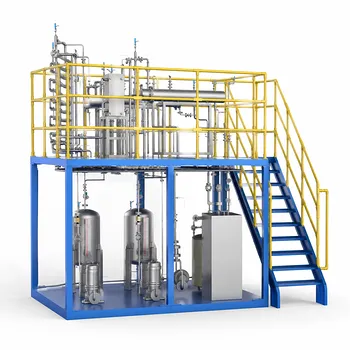
A chemical engineering unit operations pilot plant demonstrates the trade-off between reaction rate and equilibrium conversion in exothermic reversible reactions like SO₂ oxidation by physically implementing a multi-stage catalytic reactor with interstage cooling. This configuration allows you to maintain high kinetic rates in hot beds while repeatedly using cooling steps to shift the thermodynamic equilibrium back toward the product side, ultimately achieving conversions exceeding 99%—a feat impossible in a single adiabatic stage.
The pilot plant makes the abstract conflict between fast kinetics and high yield tangible: a single hot bed gives rapid reaction but low conversion (60–70%), while stepwise cooling between multiple beds resets the thermodynamic driving force, letting you chase both speed and completeness across the entire process.
The Core Contradiction: Rate vs. Equilibrium in Exothermic Reversible Systems
An exothermic reversible reaction pits two temperature dependencies directly against each other. Understanding this conflict is the first lesson the pilot plant teaches.
Higher Temperatures Boost Kinetics but Erode Thermodynamic Potential
Reaction rate increases with temperature because molecules collide more frequently and with greater energy. For SO₂ oxidation (2SO₂ + O₂ ⇌ 2SO₃), a practical minimum operating temperature of 680–715 K is needed just to get the kinetics moving.
Equilibrium conversion drops as temperature rises in exothermic systems. Le Chatelier’s principle dictates that adding heat shifts the equilibrium toward the endothermic reverse reaction, reducing the maximum possible yield. The chemical equilibrium constant K shrinks, capping the conversion you can achieve at a given temperature.
The Adiabatic Trap
In a single fixed catalyst bed, the heat released by the reaction cannot escape rapidly—the bed operates near-adiabatically. The temperature rises along the bed, and with it, the equilibrium limitation tightens.
A single adiabatic stage for SO₂ oxidation typically limits conversion to 60–70%, no matter how active the catalyst is. The bed simply gets too hot for the equilibrium to allow further progress, even though the rate stays high.
The Optimum Temperature Trajectory
There exists an optimum temperature (Topt) for each level of conversion where the overall reaction rate is maximized. As conversion increases, Topt falls along a descending curve—the T–XA trajectory.
Following this curve requires cooling while reacting, a path a simple adiabatic bed cannot provide. The pilot plant’s multi-stage design is built precisely to approximate this ideal trajectory in a practical, stepwise manner.
How the Pilot Plant Transforms Contradiction into Comprehension
The unit operations pilot plant uses a multi-bed, intercooled converter to let you observe, manipulate, and internalize the solution.
The Multi-Stage Fixed-Bed Reactor as a Physical Demonstration
Instead of one long bed, the reactor is split into multiple shorter catalyst beds separated by cooling stages. Operators can inject cold quench gas or route the process stream through heat exchangers between beds.
This configuration directly demonstrates the temperature–equilibrium relationship. You measure a high outlet temperature after the first bed and see conversion plateau at a modest value. Then you cool the gas stream—watching the equilibrium favor shift—and send it into the next bed, where the lower inlet temperature offers a new, higher thermodynamic ceiling, and the high catalyst temperature once again delivers a fast reaction rate.
Real-Time Observation of the Thermodynamic–Kinetic Compromise
The pilot plant’s instrumentation allows you to collect temperature, pressure, and concentration data at multiple points. You can:
- See that after cooling, the reaction mixture becomes thermodynamically “fresh” again, restoring a large driving force for conversion.
- Correlate cooling duty with conversion jumps, learning that each interstage cooling step is not just heat removal—it’s a deliberate equilibrium reset.
- Observe diminishing returns if too many stages are added, teaching the economic trade-off between capital cost and incremental yield.
Following the Optimum Temperature Curve
By dynamically adjusting the intercooler setpoints or cold-shot flow rates, operators can approximate the Topt trajectory. The pilot plant lets you try different cooling strategies and immediately see how closely you track the optimal path.
This hands-on operation bridges the gap between abstract thermodynamic formulas and industrial reactor design. It demonstrates that the best overall rate—and therefore the highest space-time yield—comes not from running constantly hot or cold, but from a controlled, descending temperature profile across stages.
Understanding the Trade-offs
While multi-stage intercooling elegantly resolves the rate–equilibrium contradiction, the pilot plant also reveals its practical costs and limitations.
Added Complexity and Capital Cost
Each additional bed and intercooler increases equipment count and instrumentation complexity. The pilot plant allows you to compare a two-stage versus a four-stage configuration and weigh the incremental conversion gain against the extra hardware. In many SO₂ oxidation processes, three to four beds with intercooling are the commercial sweet spot, achieving 98–99% conversion without an excessive number of stages.
Temperature Control Precision
Overcooling can quench the reaction entirely. If the gas temperature drops below catalyst light-off, the next bed will not ignite, and conversion stops. The pilot plant teaches the importance of maintaining a minimum inlet temperature (typically ≥ 680 K) to the downstream beds, combining thermodynamic driving force with kinetic viability.
Pressure Drop and Catalyst Stability
More beds mean more pressure drop across the reactor, which increases compression costs. High temperatures also accelerate catalyst deactivation, so while you want hot beds for rate, you must stay within the catalyst’s thermal stability limits. The pilot plant’s pressure transmitters and long-run deactivation studies make these hidden constraints tangible.
Making the Right Choice for Your Learning or Process Goal
The pilot plant’s value shifts depending on what you need to extract from it. Tailor your approach accordingly.
- If your primary focus is mastering thermodynamic fundamentals: Spend time mapping the T–XA curve by running the reactor at different single-stage temperature setpoints and recording the limiting conversions. Then compare with the multi-stage results to see how intercooling restores conversion headroom.
- If your primary focus is reactor design and optimization: Use the pilot plant’s multi-stage flexibility to collect kinetic data across the temperature range, fit rate equations, and calculate the optimal number of stages and intercooling duties for a given target conversion.
- If your primary focus is process safety and scale-up: Study the adiabatic temperature rise in each bed and use the data to size intercoolers and design quench systems, all while learning to prevent thermal runaway risks without endangering full-scale equipment.
Operating a multi-bed converter with interstage cooling transforms the textbook conflict between rate and equilibrium into an intuitive reality—one where you can see that success lies not in choosing one over the other, but in orchestrating a controlled, stepwise dance between the two.
Summary Table:
| Factor | High Temperature | Low Temperature | Multi-Stage Pilot Plant Solution |
|---|---|---|---|
| Reaction Rate (Kinetics) | Fast (High molecular collision) | Slow (Can quench reaction) | Fast (Maintained in hot initial catalyst beds) |
| Equilibrium Conversion | Low (Le Chatelier's limit) | High (Favors product) | High (Reset continuously via interstage cooling) |
| Overall Conversion Yield | Poor (Capped at 60–70%) | Poor (Fails to light off) | Maximized (>99% conversion achieved) |
Bring Industrial Reality to Your Lab with LABPARK
Bridging the gap between abstract thermodynamic theory and practical reactor design requires hands-on experience. LABPARK provides premium Educational and Vocational Unit Operations Pilot Plants across chemical engineering, bioprocess & biotech, and environmental & water treatment.
We empower universities, research institutes, and enterprises to visualize complex thermodynamic-kinetic compromises and master process scale-up.
Ready to elevate your training and research capabilities? Contact LABPARK today to find the perfect pilot plant solution for your facility!
Related Products
- Carbon Dioxide Hydrogen Methanol Synthesis Educational Unit Operations Pilot Plant
- Multi Pump Fluid Transport Process Piping Unit Operations Training Pilot Plant
- Natural Product Extraction Unit Operations Training Pilot Plant
- Multi-Modal Distillation Unit Operations Training Pilot Plant
- Multi-Reactor Educational Pilot Plant for Reaction Engineering Unit Operations
People Also Ask
- How do temp & pressure affect methanol synthesis pilot plants? Optimize equilibrium and catalyst performance.
- Why is a purge system necessary when operating a gas recirculation loop in a methanol synthesis pilot plant? (Guide)
- Why do modern methanol pilot plants operate at lower pressures? Catalyst & Feed Requirements Explained
- What are the operational requirements for catalyst activation? Safe Methanol Pilot Plant Operation
- Why is the chemical plant startup schedule crucial? De-risk scale-up with pilot plants.