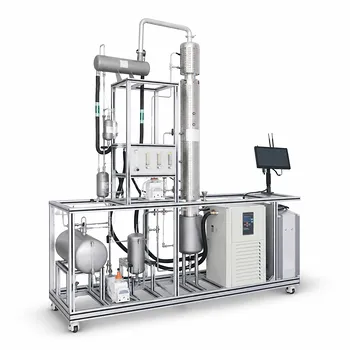
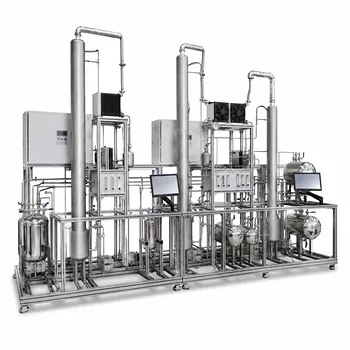
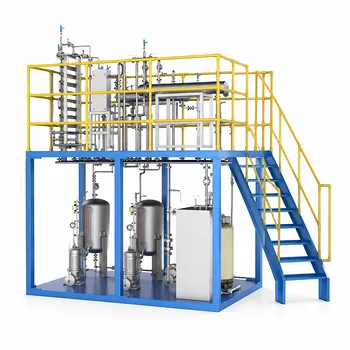
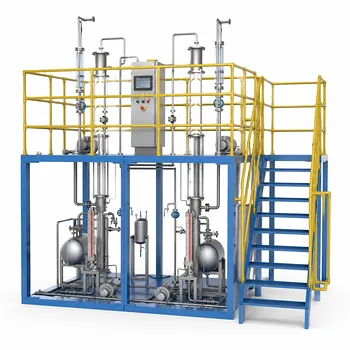
Here's how it works: In a chemical engineering education setting, a distillation pilot plant's design and operation are fundamentally dictated by the equilibrium ratio, or K-value (K = y/x). This single thermodynamic parameter allows students to directly connect abstract phase equilibrium theory to the physical world, predicting how many stages a column needs, where the feed should enter, and at what temperature and pressure the separation will actually work. Without accurate K-values, the pilot plant is just a tower; with them, it becomes a precise tool for validating scientific models against real experimental data.
The core challenge addressed by pilot plants is the gap between idealized thermodynamic models and the non-ideal reality of chemical mixtures. K-values are the bridge, but their inherent inaccuracy, particularly near azeotropes or high pressures, makes the pilot plant the ultimate arbiter of truth. It teaches engineers that a column's capital cost and its energy appetite are direct functions of thermodynamic precision, or the lack thereof.
From Theory to Physical Reality: The K-Value as a Rosetta Stone
The primary function of an educational distillation pilot plant is not simply to separate a mixture, but to prove why separation happens. The K-value is the translator between the abstract theory in a textbook and the physical liquid and vapor flows measured in the plant.
Decoding the Phase Distribution
The K-value (K = y/x) is the most fundamental metric for separation. If K is 1, no separation is possible; the component is equally happy in the vapor and liquid phases. A high K-value for a light component means it strongly prefers the vapor phase, making it easy to separate.
By studying how a component's K-value changes with temperature and pressure inside the pilot column, students can literally track the separation's driving force at each stage. It visualizes what is otherwise a purely mathematical concept.
Predicting the Column's Blueprint
From a design standpoint, K-values are the input to calculating the number of theoretical stages required for a given separation. The relationship between the K-values of two components—the relative volatility (α)—is the direct link to a column's capital cost.
Capital cost varies approximately as (ln α)^-1. This means that when α is close to 1, the cost to build a taller, more complex column skyrockets. The pilot plant demonstrates this powerfully, showing why separating isomers with very similar K-values is inherently expensive and difficult.
The Limitation of Models: Why We Need Pilot Plants
If K-values could be perfectly predicted by a computer, pilot plants would be obsolete. The educational value comes from seeing the deviations between a model's prediction and physical reality.
Demonstrating Non-Ideality
Classical thermodynamic equations are often simplified for ideal solutions. Educational pilot plants reveal the failure of these assumptions. The computer simulation might use a programmed K-value loop, but students can manually input their own values to see how non-ideal behavior forces the column to operate differently than the "perfect" model suggests.
This is the core pedagogical insight: a simulator using inaccurate activity coefficients or vapor fugacities will predict the wrong liquid composition on every tray. The pilot plant’s physical measurements are the ground truth that exposes these errors.
Bridging Theory and Industrial Scale
Historically, process designers used short-cut methods and over-designed columns to compensate for thermodynamic imprecision, leading to oversized reboilers and condensers. The pilot plant curriculum takes a more modern approach. Instead of just applying a 20% safety factor, students learn how to use high-accuracy VLE predictions from their pilot data to scale up with confidence, directly seeing the trade-off between a conservative, costly design and a precise, efficient one.
The Pitfalls of Thermodynamic Imprecision
An objective understanding of VLE means accepting that K-value models are powerful but fallible tools. The pilot plant is the only way to quantify the risk.
The Danger of a Wrong Correlation
The choice of a K-value correlation is a critical operational and design decision. Two different respected models can produce wildly different predictions from the same data. In a high-pressure system, one model might predict a methane K-value 11% lower while another predicts it 28% higher, leading to a variance in predicted condensed liquid of -47% to 96%.
For a demethanizer or a cryogenic separator, this error would be catastrophic for compressor and cooling duty sizing. Running pilot tests at these conditions is the only reliable way to select the correct model and avoid a fundamental design flaw.
Navigating the "Difficult" Regions
The most profound learning moments in a pilot plant occur near separation limits. Near an azeotrope or at infinite dilution, relative volatility approaches 1.0. In these regions, a tiny error in a K-value prediction—perhaps from an inaccurate liquid activity coefficient model—does not just lead to a slightly off column. It can lead to a prediction that separation is possible when in reality it is thermodynamically impossible. The pilot plant provides the physical proof of this constraint.
Making the Right Choice for Your Educational Goal
How you integrate K-values and VLE analysis depends on your primary learning objective. Use the pilot plant to focus your investigation.
- If your primary focus is understanding core thermodynamics: Use the pilot plant to manually validate a single K-value against phase composition samples. Disable the simulator's auto-calculation loops and force students to see the deviation between ideal predictions and real-world data firsthand.
- If your primary focus is process design and economics: Run the pilot plant at different reflux ratios. Have students calculate how a small change in relative volatility (α) dramatically alters the capital cost and energy consumption, connecting a thermodynamic property directly to an economic penalty.
- If your primary focus is model evaluation and scale-up: Operate the pilot plant near a "difficult" condition, like an azeotropic composition. Compare the experimental results against multiple VLE correlations to clearly demonstrate that no single model is universally applicable and that physical validation is non-negotiable before industrial investment.
A distillation pilot plant is not just a piece of equipment; it's a thermodynamic interrogation device. Its ultimate lesson is that the economic viability and physical possibility of a chemical separation hinge entirely on a number that changes with every degree of temperature and bar of pressure.
Summary Table:
| Key Concept | Role of K-Values (K = y/x) | Educational & Practical Impact |
|---|---|---|
| Phase Distribution | Defines separation capability (K = 1 means no separation) | Visualizes thermodynamic driving forces at each stage |
| Column Blueprint | Determines theoretical stages and relative volatility (α) | Links thermodynamic properties directly to column capital costs |
| Model Validation | Exposes deviations in idealized activity coefficient models | Teaches students to validate simulation data with physical ground truth |
| Operational Risk | High sensitivity near azeotropes and high pressures | Prevents catastrophic sizing errors in industrial scale-up |
Bring Thermodynamic Theory to Life with LABPARK
Bridging the gap between simulation models and physical reality requires robust, high-performance equipment. LABPARK provides state-of-the-art Educational and Vocational Unit Operations Pilot Plants in chemical engineering, bioprocess & biotech, and environmental & water treatment.
Designed specifically for universities, research institutes, and enterprises, our pilot plants empower students and researchers to validate VLE K-values, analyze non-ideal mixtures, and master real-world process design.
Ready to elevate your engineering laboratory? Contact LABPARK today to discuss your project needs and request a quote!
Related Products
- Continuous Sieve-Plate Distillation Pilot Plant for Unit Operations Laboratory Education
- Multi-Modal Distillation Unit Operations Training Pilot Plant
- Green Anhydrous Ethanol Purification Extractive Distillation Unit Operations Training Pilot Plant
- Dual-Mode Rectification Pilot Plant for Practical Training Unit Operations
- Ethyl Acetate Synthesis Unit Operations Pilot Plant for Practical Training
People Also Ask
- How can real-time carbon number prediction improve distillation pilot plants? Optimize control.
- How to select the right activity coefficient model (Wilson, NRTL, UNIQUAC) for distillation pilot plants?
- Why is vacuum operation capability an essential feature for a distillation unit operations pilot plant? Unlock Efficiency
- What are the primary reflux ratio control strategies? Master Distillation Unit Operations
- How does catalyst water concentration affect distillation pilot plant design? Key separation train choices.