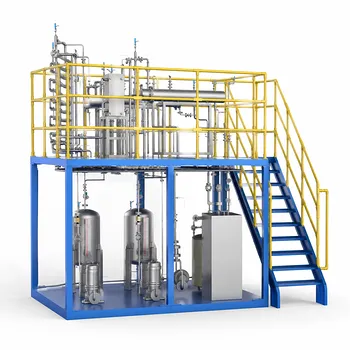
The direct link is that chemical engineering unit operations pilot plants physically scale up the exact same sequential mass transfer steps. In an ion-exchange controlled release system, the process hinges on counterion diffusion into a matrix, electrostatic exchange, and the diffusion of the released molecule out. This mirrors the operation of a pilot-scale ion-exchange column, where you observe these diffusion and exchange kinetics dynamically through breakthrough curves and regeneration cycles, making the invisible transport phenomena visible and measurable.
At its core, the microscale mechanism of controlled drug release and the macroscale operation of an industrial water-softening column are the same physical story. Chemical engineering pilot plants are the essential bridge that transforms these fundamental transport equations from theoretical textbook concepts into tangible, operational knowledge. They prove that mastering a unit operation means mastering the transport phenomena within it.
The Shared Language of Transport Phenomena
The behavior of an ion-exchange resin bead releasing a drug and a packed column in a pilot plant is governed by a universal set of physical laws. Understanding this connection is what separates a theoretical chemist from a practical chemical engineer.
Deconstructing the Core Mechanism
The primary mechanism you're asking about is a three-part, sequential mass transfer process. First, counterions from the external fluid must diffuse through the boundary layer and into the pores of a polymer matrix. Second, a stoichiometric electrostatic exchange occurs at the fixed ionic sites, releasing the bound active molecule. Third, the freed molecule must diffuse back through the matrix and into the bulk solution. This entire sequence is a concentration-gradient-driven process.
The Pilot Plant as a Macro-Scale Model
In an educational pilot plant, typically a cylindrical column packed with ion-exchange resin, this very sequence is scaled up for direct observation. The "external medium" becomes the feed solution pumped at a controlled flow rate. The "polymer matrix" is the bed of resin particles. By monitoring the effluent concentration over time, students generate a breakthrough curve, which is a direct macro-scale signature of the micro-scale diffusion and exchange kinetics happening inside each bead.
Bridging the Gap from Bench to Plant
A bench-top beaker experiment can prove that an ion-exchange reaction occurs. A pilot plant teaches you how to make it efficient, safe, and profitable on a real-world scale.
Visualizing Scale Sensitivity and Rate-Limiting Steps
This is where the concept of scale sensitivity becomes critical. The rate of physical transport (diffusion) is often the bottleneck, not the chemical exchange itself. In a pilot plant, students can change the flow rate and instantly see the effect on the breakthrough curve's sharpness. A sharp curve indicates that film diffusion or intraparticle diffusion is fast and not limiting. A broad, stretched curve shows the physical transport process is the rate-limiting step, a lesson no beaker can teach.
From Glassware to an Industrial Prototype
A pilot plant is the definitive bridge between laboratory chemistry and industrial production. A bench-top experiment validates the reaction. A pilot plant validates the process. Operating a distillation or ion-exchange column requires grappling with fluid dynamics, mass transfer coefficients, and system control in ways that a round-bottom flask simply cannot replicate. This hands-on experience with physical transport limitations is the core of chemical engineering training.
Applying Core Governing Principles in Unit Operations
Pilot plants are not just for ion exchange; they are a living laboratory for the fundamental principles that govern all unit operations. These principles directly inform how you would scale up a controlled-release manufacturing process.
The Inescapable Role of Fluid Mechanics
The transport of a counterion to a resin bead depends on the fluid velocity and channeling in the bed. This is a fluid transport problem. In a pilot plant, students learn to apply the mechanical energy balance to calculate the correct pipe size and pump specification to deliver the mobile phase. They see how an incorrect fluid velocity leads to poor flow distribution, which in turn causes uneven diffusion and a premature breakthrough, directly linking pipe sizing to mass transfer efficiency and energy consumption.
Thermodynamic Optimization Through Le Chatelier’s Principle
The stoichiometric exchange in ion release is a reversible equilibrium. To control loading and release, you manipulate this equilibrium. Pilot plants apply Le Chatelier’s principle directly for process optimization. For example, in a regeneration cycle, students use an overwhelming concentration of a desired salt (like NaCl brine) to shift the equilibrium and drive counterions back onto the resin. Manipulating concentration, not just temperature or pressure, becomes a visual and quantitative tool for controlling product yield and column efficiency.
Understanding the Trade-offs
The ion-exchange pilot plant model is not a perfect one-to-one analogy for a complex drug delivery system. It is a simplified, idealized version that isolates the core physics.
The primary limitation is that a pilot plant usually studies a single, well-defined chemical system. A real controlled-release application inside a body involves a complex, multi-component, and evolving environment. The pilot plant's steady-state or cyclical operation does not fully capture the non-steady-state diffusion and potential matrix degradation in a complex biological setting. Furthermore, the goal in a pilot plant is often efficient separation or purification. In controlled release, the goal is a specific, often constant, release rate profile over time. The pilot plant teaches you the physics inside the column, but the application of that physics to a pharmaceutical dosage form requires a separate engineering step focused on formulation and geometry.
Making the Right Choice for Your Goal
The relationship between these two fields dictates where you should focus your experimental work. The choice depends entirely on whether you are studying the fundamental interaction or trying to build a functional product.
- If your primary focus is fundamental mechanism research: Use a pilot-scale ion-exchange column. Manipulate flow rates and concentrations to dynamically analyze breakthrough curves and precisely calculate diffusion coefficients and mass transfer resistances under ideal, controlled conditions.
- If your primary focus is developing a specific drug delivery system: Use the principles learned from the pilot plant—the dominance of diffusion, the criticality of flow distribution, and equilibria manipulation—to design your microscale system. Then, you must validate the actual release profile in a biorelevant dissolution apparatus, which is the true pilot model for a dosage form.
- If your primary focus is chemical engineering education: Run the ion-exchange column experiment repeatedly. It is the perfect synthesis of transport phenomena, thermodynamics (Le Chatelier’s principle), and fluid mechanics (the mechanical energy balance), teaching you how a change in a pump's setting translates directly to a change in the mass transfer zone.
The pilot plant gives you the foundational vocabulary of transport phenomena. You then use that language to write the specific story of your controlled-release technology.
Summary Table:
| Physical Principle | Micro-Scale (Controlled Release Bead) | Macro-Scale (Pilot Plant Column) |
|---|---|---|
| Mass Transfer | Counterion diffusion & drug release | Breakthrough curves & regeneration cycles |
| Rate-Limiting Step | Film & intraparticle diffusion resistance | Flow rate adjustments & curve sharpness |
| Thermodynamics | Reversible electrostatic exchange | Le Chatelier’s principle (regeneration via brine concentration) |
| Fluid Mechanics | Local boundary layer diffusion | Pipe sizing, pump specifications & mechanical energy balance |
Bring Chemical Engineering Theory to Life with LABPARK
Are you looking to bridge the gap between molecular transport phenomena and industrial scale-up? LABPARK provides premium Educational and Vocational Unit Operations Pilot Plants in chemical engineering, bioprocess & biotech, and environmental & water treatment.
We help universities, research institutes, and enterprises transform textbook equations into hands-on operational expertise. Our systems allow students and researchers to master fluid mechanics, mass transfer kinetics, and thermodynamic controls in a safe, controlled environment.
Ready to elevate your laboratory’s training and research capabilities? Contact LABPARK today to request a quote!
Related Products
- Carbon Dioxide Hydrogen Methanol Synthesis Educational Unit Operations Pilot Plant
- Multi Pump Fluid Transport Process Piping Unit Operations Training Pilot Plant
- Natural Product Extraction Unit Operations Training Pilot Plant
- Multi-Modal Distillation Unit Operations Training Pilot Plant
- Multi-Reactor Educational Pilot Plant for Reaction Engineering Unit Operations
People Also Ask
- How do temp & pressure affect methanol synthesis pilot plants? Optimize equilibrium and catalyst performance.
- Why is a purge system necessary when operating a gas recirculation loop in a methanol synthesis pilot plant? (Guide)
- Why do modern methanol pilot plants operate at lower pressures? Catalyst & Feed Requirements Explained
- What are the operational requirements for catalyst activation? Safe Methanol Pilot Plant Operation
- Why is the chemical plant startup schedule crucial? De-risk scale-up with pilot plants.