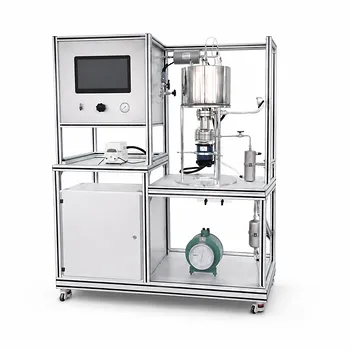
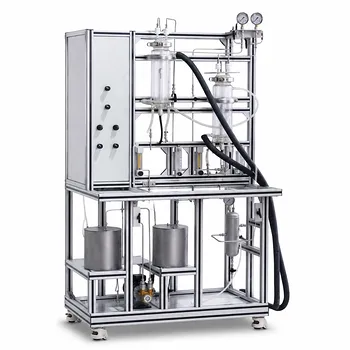
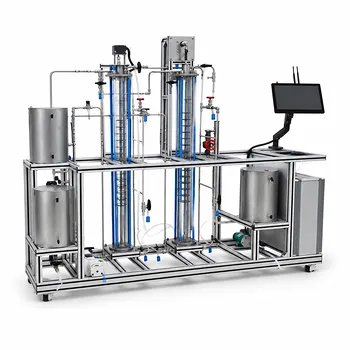
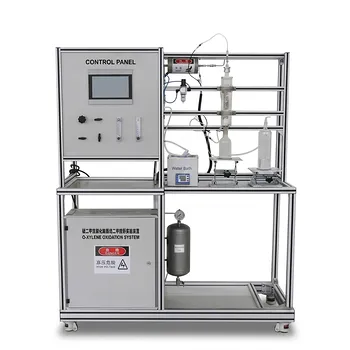
The core design chasm between simulating LDPE and HDPE synthesis is pressure. In chemical engineering training equipment, replicating low-density polyethylene (LDPE) production demands reactors and auxiliary systems built to withstand extreme pressures of 150–250 MPa (often exceeding 2000 bar) and high temperatures, requiring thick-walled tubular or autoclave designs. Simulating high-density polyethylene (HDPE), by contrast, operates at much lower, moderate pressures using coordination catalysts, so the pilot plant pivots to slurry or gas-phase reactor configurations with a focus on precise catalyst delivery and control.
Understanding the pressure gap is the foundation: LDPE simulation is an exercise in ultra-high-pressure safety and mechanical design, while HDPE simulation is an exercise in catalytic precision and versatile low-pressure operation—making it inherently safer and more practical for most training environments.
The Pressure Divergence: Why Two Polyethylenes Demand Opposite Worlds
The same monomer, ethylene, follows two radically different reaction pathways to create these polymers. This difference dictates everything about the equipment.
The Free-Radical Roots of LDPE’s Extreme Conditions
LDPE is produced via free-radical polymerization. To initiate and sustain this reaction and to achieve the desired molecular weight and branching, extremely high pressure is thermodynamically and kinetically essential.
Without a catalyst to stabilize the growing chain, the high ethylene density in the supercritical state is required to drive propagation. This means that training pilot plants must replicate a process that is fundamentally a high-pressure engineering challenge first and a chemistry experiment second.
Coordination Catalysis Unlocks HDPE’s Gentler Profile
HDPE relies on coordination catalysts—Ziegler-Natta, Phillips, or metallocene systems. These transition-metal catalysts create active sites that allow polymerization to proceed efficiently at much lower pressures and temperatures.
The catalyst does the heavy lifting that pressure does in the LDPE process. As a result, the equipment’s design burden shifts from containing explosive force to mastering the metering, distribution, and removal of catalytic activity.
LDPE Simulation: Engineering for the Ultra-High-Pressure Domain
Training equipment for LDPE must be a scaled-down fortress. Every component is selected to survive and safely manage the extreme operating envelope.
The Reactor as a Thick-Walled Vessel
The reactor itself is either a thick-walled autoclave for batch studies or a long, narrow-bore tubular reactor for continuous process simulation. The wall thickness is designed to handle 150–250 MPa, often requiring specialty high-strength steels and multi-layer construction.
In a pilot plant, the tubular design also mimics the heat removal and residence time distribution of industrial LDPE lines, but on a microscale. The selection between autoclave and tubular is driven by the specific mixing and residence time characteristics you wish to study.
High-Pressure Compressors and Feed Systems
Getting ethylene gas to over 2000 bar demands a specialized multi-stage compressor train. For training equipment, this often means a diaphragm compressor or a hydraulic intensifier to safely achieve the required feed pressure without lubricant contamination.
These systems are complex, noisy, and require rigorous maintenance protocols. They become a significant part of the curriculum, teaching students about non-ideal gas behavior, compression work, and material fatigue.
Safety Relief as a First-Class Design Parameter
The stored energy at these pressures is immense. Training equipment must integrate advanced safety relief systems, including rupture discs, pressure relief valves, and extensive containment shielding.
The design focus is on controlled decompression and explosion prevention. This makes LDPE pilot plants a prime educational tool for process safety engineering, but it dramatically increases their cost, footprint, and operational risk.
HDPE Simulation: Mastering the Catalyst-Driven Process
For HDPE, the equipment design is liberated from extreme pressure but becomes deeply intertwined with the chosen reactor phase and catalyst management.
Slurry and Gas-Phase Reactor Configurations
Training units typically adopt either a slurry reactor, often a continuously stirred tank reactor (CSTR) with a liquid hydrocarbon diluent, or a fluidized-bed gas-phase reactor. Both operate at pressures an order of magnitude lower than LDPE units.
The CSTR slurry design is excellent for direct visual observation of particle formation. The gas-phase design excels at demonstrating mass transfer limitations and heat removal through gas recirculation, all at pressures generally under 3-5 MPa.
The Critical Role of Catalyst Feed Systems
Since the catalyst dictates the reaction rate, molecular weight, and comonomer incorporation, the catalyst feed system is the heart of the HDPE pilot plant. It must deliver a precise, consistent amount of air- and moisture-sensitive catalyst slurry or dry powder against the reactor pressure.
This requires gloveboxes, lock-hoppers, or high-precision syringe pumps, shifting the training focus from mechanical compression to inert atmosphere handling and metering of trace quantities.
Understanding the Trade-offs in Training Equipment
Choosing one simulation over the other involves a stark compromise between educational value, safety, and resource intensity.
The Safety and Practicality Gap
Coordination polymerization for HDPE is demonstrably safer and more practical for most educational and research pilot plants. The lower operating pressure eliminates the risk of catastrophic vessel rupture and simplifies equipment construction.
This allows students to directly interact with the process, take samples, and experiment with variables without the same level of hazard. LDPE simulations, while powerful, often require remote operation and far more stringent infrastructure.
Cost, Footprint, and Visibility
An LDPE pilot plant, with its thick-walled vessels, high-pressure compressors, and blast shielding, has a significantly higher capital and maintenance cost. It also occupies a larger footprint and is inherently a “black box” process where the reaction itself is invisible.
An HDPE slurry reactor, conversely, can be built with glass viewing windows, allowing students to visually track catalyst fragmentation and polymer particle growth in real-time, a profound learning advantage that the LDPE process cannot offer.
Illustration of Polymerization Principles
The LDPE simulation uniquely teaches principles of supercritical fluid phase behavior, free-radical kinetics, and high-pressure thermodynamics. The HDPE simulation excels at illustrating heterogeneous catalysis, particle morphology control, and copolymerization kinetics. The deeper educational need you are serving must dictate the choice.
Making the Right Choice for Your Training Goal
The decision should align the equipment’s operational demands with your specific educational objectives.
- If your primary focus is process safety and high-pressure engineering: An LDPE autoclave or tubular simulator is unmatched, as it forces students to master a high-hazard operating envelope and the principles of mechanical integrity under extreme conditions.
- If your primary focus is practical, hands-on polymerization and catalysis: An HDPE slurry or gas-phase unit is the superior choice, providing a safer, more visible platform to manipulate catalyst chemistry and directly observe polymer growth.
- If your primary focus is broad fundamentals at minimal risk: The HDPE coordination polymerization pathway is the logical starting point, offering the widest window into modern polymer science without the overwhelming complexity of ultra-high-pressure systems.
By matching the starkly different equipment paradigms to the core learning outcome, you transform a choice between two processes into a deliberate strategy for building lasting engineering intuition.
Summary Table:
| Feature | LDPE Simulation | HDPE Simulation |
|---|---|---|
| Operating Pressure | Ultra-high (150–250 MPa / >2000 bar) | Low to moderate (<5 MPa) |
| Reactor Type | Thick-walled autoclave or tubular | Slurry CSTR or gas-phase fluidized bed |
| Reaction Mechanism | Free-radical polymerization | Coordination polymerization |
| Key Equipment Focus | High-pressure safety, compressors | Catalyst metering, inert feed systems |
| Primary Learning Value | Process safety, extreme thermodynamics | Catalysis, particle morphology |
Bring Advanced Polymer Engineering to Your Lab
Looking to equip your institution with state-of-the-art training systems? LABPARK provides premium Educational and Vocational Unit Operations Pilot Plants in chemical engineering, bioprocess & biotech, and environmental & water treatment for universities, research institutes, and enterprises.
Whether you need to simulate high-pressure LDPE systems or catalytic HDPE processes, our custom solutions are engineered for maximum safety, durability, and deep hands-on learning. Help your students and researchers bridge the gap between theory and industrial reality.
Contact LABPARK today to discuss your lab requirements and request a custom proposal!
Related Products
- Methanol Synthesis and Catalyst Performance Evaluation Educational Unit Operations Pilot Plant
- Carbon Dioxide Hydrogenation Methanol Synthesis Educational Unit Operations Pilot Plant
- Ethylbenzene Dehydrogenation Educational Unit Operations Pilot Plant
- Ethyl Acetate Synthesis Unit Operations Pilot Plant for Practical Training
- Electrolytic Hydrogen Production Educational Unit Operations Pilot Plant
People Also Ask
- Why is a purge system necessary when operating a gas recirculation loop in a methanol synthesis pilot plant? (Guide)
- How do temp & pressure affect methanol synthesis pilot plants? Optimize equilibrium and catalyst performance.
- Why do modern methanol pilot plants operate at lower pressures? Catalyst & Feed Requirements Explained
- What are the operational requirements for catalyst activation? Safe Methanol Pilot Plant Operation
- Why Compare Predicted and Experimental Excess Enthalpy? Key to Accurate Pilot Plant Scale-up