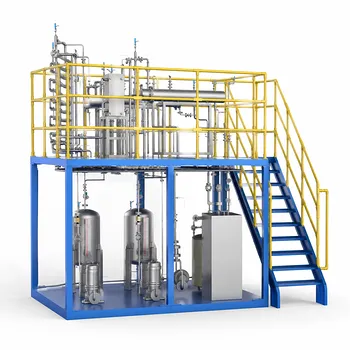
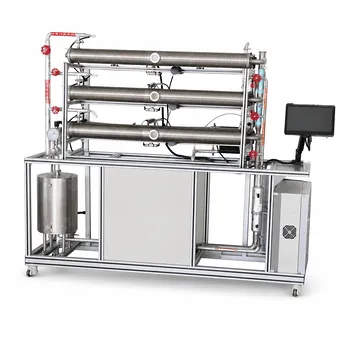
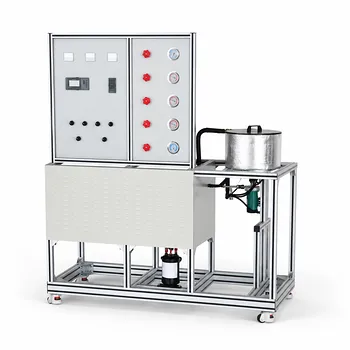
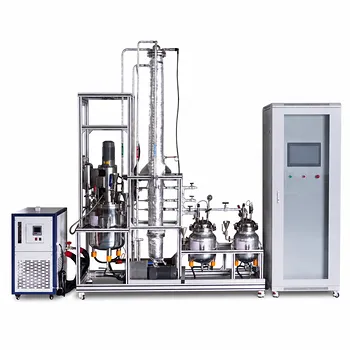
The answer lies in understanding that the core principle of indirect heating — using a medium to separate the heat source from the process — scales directly from a lab bench to a pilot plant’s heat exchangers, but the challenge shifts from simple temperature control to managing the physics of shrinking surface-area-to-volume ratios. In an educational setting, a student’s experience with a water bath or heating mantle becomes the mental model for jacketed reactors, shell-and-tube exchangers, and recirculating thermal oil systems. The jump in scale introduces real-world constraints: slower heat transfer, greater risk of temperature excursions, and the absolute need for predictive sizing and control loops. Pilot plants exist to teach exactly these transitions.
Direct heating in a lab (flame, hot plate) is inherently unsafe and uncontrollable at scale, so industrial processes adopt indirect heating through engineered surfaces. The real lesson for students is that scaling up a process is not about maintaining a setpoint — it’s about understanding how heat transfer dynamics change with size, how to map product quality across scales, and how to design systems that are both thermally stable and economically viable.
From Water Baths to Industrial Exchangers: The Direct-to-Indirect Shift
In a basic lab, direct heating — a flame touching a test tube — is quick but dangerous. It works only for tiny volumes of thermally stable materials because it creates unpredictable hot spots that can crack glassware or decompose sensitive compounds. Indirect heating, using a water, oil, or sand bath, absorbs and redistributes the energy, delivering uniform temperature control and a critical safety buffer. This principle is the foundation of all scaled-up heat transfer systems.
Why Indirect Heating Wins at Scale
As soon as you move to a pilot plant, you cannot afford to expose reacting fluids directly to a high-temperature source. The safety risk is too high, and the product quality would be inconsistent. Instead, indirect heating becomes the universal design philosophy. You see it in steam jackets that wrap a vessel, shell-and-tube heat exchangers where a utility fluid flows on the other side of a metal wall, and recirculating hot oil loops that maintain a precise temperature across multiple unit operations. In every case, a barrier separates the heating medium from the process stream — exactly like the glass wall of a lab beaker sitting in a bath.
The Educational Leap: Teaching Heat Transfer Coefficients and Control
In a teaching pilot plant, this translation is not just about hardware. It’s where students first encounter the heat transfer coefficient (hw) as a measurable, design-relevant parameter. The basic lab teaches the concept; the pilot plant forces them to calculate it from real-time data, account for fouling, and tune an automated control loop. They learn that “indirect heating” isn’t just a method — it’s a system of exchangers, pumps, sensors, and controllers that must be analyzed and optimized together.
The Heat Transfer Scaling Challenge: When Geometry Fights You
The most counterintuitive lesson from pilot plant education is that a larger vessel is not a simple scaled-up version of a lab flask. Heat transfer becomes disproportionately difficult as size increases. This is due to a fundamental geometric fact: the surface-area-to-volume ratio decreases as vessel diameter grows. The rate at which you can add or remove heat depends on the available transfer area, while the amount of thermal energy needing to be moved depends on the volume (and mass) of the contents.
Why a Larger Reactor Heats and Cools Slower
Imagine a spherical or cylindrical reactor. Its volume increases with the cube of its radius ($r^3$), but the wall area available for a jacket or coil only increases with the square ($r^2$). This means that for the same volumetric power input at lab and pilot scale, the heat flux per unit volume drops dramatically in the larger unit. While the film heat transfer coefficient ($h_w$) changes only slightly with diameter (proportional to $d_R^{-1/9}$), the overwhelming effect is the loss of relative surface area. The practical result is that a reaction that ran perfectly safely and isothermally on a benchtop can suffer from severe temperature gradients, hot spots, or an inability to cool down quickly enough to halt a runaway at scale.
Using Pilot Plants for UA Analysis and Safety
Educational pilot plants turn this challenge into a structured learning objective. Students perform UA (overall heat transfer coefficient times area) evaluations using water or solvent batches before running any real chemistry. By logging temperature ramps and calculating the time constant of the system, they can predict whether their available heat exchange area is sufficient. This exercise teaches the non-negotiable scale-up rule: when heat generation or removal is critical, you must install additional internal coils or external heat exchangers — simply relying on a bigger jacket isn’t enough. It’s a hands-on lesson in thermal safety and process design that no simulation can fully replicate.
Beyond Temperature: The Hidden Value of Pilot Plant Studies
Focusing only on heating principles misses the deeper educational purpose of a unit operations pilot plant. The real value is in tying heat transfer to process robustness, quality consistency, and economic feasibility. At the pilot scale, thermal effects are never studied in isolation; they are one piece of a larger puzzle that includes fluid dynamics, reaction kinetics, and long-term material behavior.
Detecting Real-World Impurities and Deactivation
Lab experiments often use pure starting materials and run for hours. Pilot plants, however, can be operated continuously in a closed loop for days or weeks. This immediately reveals the accumulation of by-products in recycle streams and gradual catalyst deactivation (such as coking) that are invisible in a short bench run. Heating and cooling strategies must then adapt to these changing conditions — a fouled heat exchanger loses UA, demanding higher utility temperatures or a cleaning schedule. Students learn that thermal design is not static; it must account for the process’s entire lifecycle.
Mapping the Process Signature for Scale-Up
A critical lesson taught through pilot plants is that successful scale-up is not achieved by simply matching a final product’s endpoint quality on a univariate chart. Students must instead map product quality in a multivariate space and understand the process signature — the trajectory of size, mass, and energy balances across time. By using sensor-rich pilot systems, they gather historical data and apply latent variable methods to determine how process parameters must shift to maintain consistent quality at different scales. Heat transfer parameters become key dimensions in that signature.
Costing Heat Exchangers: Teaching Feasibility
Finally, heating principles scale into the realm of engineering economics. Teaching students to estimate the cost of a heat exchanger using the economy of scale principle is a direct application. For a floating head shell-and-tube exchanger, the purchased cost scales with surface area to the 0.6 power: $C_p1/C_p2 = (A_1/A_2)^{0.6}$. This is then multiplied by a Material Factor (Fm) for construction alloys and a Pressure Factor (Fp) to arrive at a bare module cost ($C_{bm} = C_p \times F_{bm}$). When a student sees that a larger reactor requires a disproportionately smaller cost increase for its jacket but may need an additional expensive external loop, they grasp the real economic drivers behind thermal design.
Understanding the Trade-offs in Educational Pilot Plants
No educational tool is perfect, and pilot plants carry inherent limitations that must be acknowledged. An objective engineer must weigh these trade-offs against the learning benefits.
The Gap Between Pilot and Production
An intermediate-scale pilot plant can never exactly replicate full-scale mixing patterns, wall effects, or fouling behaviors. Students may draw conclusions from a well-behaved 50-liter reactor that do not hold in a turbulent 10,000-liter vessel. The heat transfer coefficient trends (like $d_R^{-1/9}$) are empirically derived; they guide thinking but don’t eliminate the need for mathematical modeling and scale-down verification. Modern industry is shifting toward predictive simulation to reduce costly trial-and-error, and pilot plants are now used more to validate those models than to simply mimic production.
Avoiding the Univariate Trap
The primary pitfall in education is teaching students to look at a single parameter — like jacket temperature — as the only lever for scale-up. Without the multivariate perspective, they might inadvertently scale up a reactor to match a heating curve while ignoring the impact of changed shear rates on product quality. Pilot plants must be presented as systems where heat transfer, mass transfer, and kinetics interact. The risk is fostering a “setpoint mentality” instead of a deep understanding of the underlying transport phenomena.
Applying These Principles to Your Educational Program
Whether you are designing a curriculum, selecting equipment, or guiding student projects, the focus should shift depending on your primary learning objective.
- If your primary focus is teaching thermal dynamics and safety: Prioritize pilot systems with high-integrity jacketed reactors and built-in UA calculation exercises. Use mock water batches to let students map the heating/cooling profile and calculate the exact point where additional heat transfer area would be needed at a larger scale.
- If your primary focus is process control and automation: Select pilot plants with advanced sensor networks and programmable logic controllers. The goal is to have students trace the process signature — linking temperature ramps directly to product quality attributes in a multivariate data set, rather than trusting a single thermocouple reading.
- If your primary focus is plant design and cost estimation: Integrate the hardware with design projects. Have students size a shell-and-tube exchanger for a given duty, select the material of construction based on corrosion data, and calculate the bare module cost using the exponent rule and material factor corrections.
The humble water bath in a freshman lab is the progenitor of every industrial heat transfer decision — mastering its scaled-up implications in a pilot plant is what transforms a student into a process engineer.
Summary Table:
| Feature | Direct Heating (Lab Scale) | Indirect Heating (Pilot/Industrial Scale) |
|---|---|---|
| Heat Source | Direct contact (flame, hot plate) | Separated medium (steam jacket, shell-and-tube, oil loop) |
| Safety & Control | High risk of hot spots; manual control | High safety buffer; automated control loops (PID) |
| Scale-up Physics | High surface-area-to-volume ratio | Shrinking surface-to-volume ratio; requires UA analysis |
| Key Learning Metric | Temperature setpoints | Overall heat transfer coefficient ($h_w$), fouling, economics |
Bring Industrial-Scale Heat Transfer Learning to Your Lab
Bridging the gap between benchtop chemistry and industrial scale-up requires hands-on, realistic training systems. LABPARK designs and manufactures high-quality Educational and Vocational Unit Operations Pilot Plants in chemical engineering, bioprocess & biotech, and environmental & water treatment for universities, research institutes, and enterprises.
Our systems empower students and researchers to calculate real-world heat transfer coefficients, manage process safety, and configure automated control loops on industrial-grade hardware.
Contact LABPARK today to discover how our pilot plants can enhance your curriculum, validate your process models, and prepare the next generation of process engineers.
Related Products
- Rising and Falling Film Evaporation Educational Unit Operations Pilot Plant
- Shell and Tube Heat Exchanger Heat Transfer Coefficient Determination Educational Pilot Plant
- Hot Filtration Educational Unit Operations Pilot Plant Laboratory System
- Solid Spherical Heat Transfer Coefficient Determination Educational Chemical Engineering Pilot Plant
- Comprehensive Heat Transfer Coefficient Determination Educational Unit Operations Pilot Plant
People Also Ask
- How do educational unit operations pilot plants bridge theory and design? Bridge the Engineering Gap
- How do educational unit operations pilot plants address safety and waste management when scaling up?
- How is the heat transfer area calculated for an evaporation unit operations pilot plant during experimental design? Guide
- How to select educational evaporator pilot plants for thermal & scaling solutions? Complete Guide
- What are the structural characteristics & applications of rising-falling film evaporators in unit operations training?