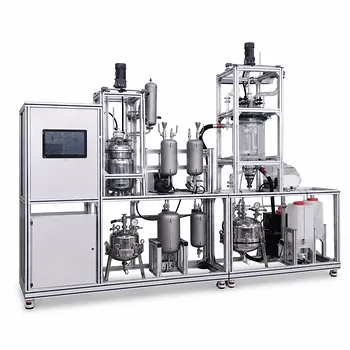
The formation conditions of transition metal heteropoly acids (HPAs) are not just a synthetic nuance—they are the critical control parameters that dictate everything from catalyst yield to activity in a pilot plant. In a chemical synthesis pilot plant, these conditions, specifically temperature and pH, directly determine the molecular structure and purity of the HPA catalyst. Therefore, pilot reactors must be designed with precision temperature jackets and online pH monitoring to systematically study and replicate these formation parameters, ensuring that the catalyst performs consistently during scaled-up process development.
While HPAs like phosphomolybdic acid are prized for their high activity, their formation is exquisitely sensitive to its environment. The core challenge for pilot plant development is that without rigorous, real-time control of pH and temperature during synthesis, the resulting catalyst structure—and thus its downstream efficiency—becomes unpredictable, jeopardizing the entire scale-up study.
The Chemistry Behind Heteropoly Acid Formation
Understanding why control is mandatory starts with the synthesis chemistry itself. The primary transition metals involved—Molybdenum, Tungsten, and Vanadium—form complex oxide clusters only under a narrow window of conditions.
The Key Role of pH and Temperature
Heteropoly acids self-assemble from simple oxoanions in an acidified aqueous solution. A precise, low pH is essential to drive the condensation reaction that builds the Keggin structure, such as the ( \text{PMo}{12}\text{O}{40}^{3-} ) ion.
Temperature acts as the kinetic steering wheel. Too low, and the reaction yields amorphous precipitates or incomplete polyanions. Too high, and you risk decomposing the thermally sensitive heteropoly structure before it even forms. The interplay is so tight that a shift of half a pH unit or a ( 10^\circ\text{C} ) drift can shunt the synthesis toward an inactive isomer.
Why Precise Control Matters for Catalyst Structure
A heteropoly acid's catalytic power comes from its unique three-dimensional architecture, which creates a strong Brønsted acidity and a highly mobile lattice oxygen. If the formation pH and temperature stray, you don't just get a lower yield—you get a physically different material. The resulting catalyst might be a lacunary species, a decomposed oxide mixture, or a different isomer, all with dramatically reduced or entirely different catalytic activity.
In a pilot plant, this means the foundational step of catalyst synthesis must be treated as a unit operation with its own critical process parameters, not a simple benchtop mix.
Implications for Pilot Plant Reactor Design
The direct consequence is that educational and research pilot plants must instrument the synthesis reactor as meticulously as the downstream catalytic reactor.
The Necessity of Precision Temperature Jackets
A simple heating mantle is insufficient for controlled HPA formation. Pilot reactors must be fitted with precision temperature jackets that provide uniform heating and rapid cooling capabilities. This allows researchers to exactly mimic the thermal profile that produced an optimal catalyst at lab scale, then study the effect of temperature excursions on catalyst quality during scale-up. Sloppy thermal control leads to a non-reproducible catalyst, which invalidates any subsequent catalytic process data.
Online pH Monitoring and Real-Time Feedback
Adding acid to a precipitating metal oxide solution changes the local pH wildly. Online pH monitoring, coupled with controlled dosing pumps, is non-negotiable. It provides the real-time data necessary to maintain the narrow formation window, even as the solution's ionic strength and buffering capacity change during the reaction. This transforms catalyst preparation from an art into a defined, teachable unit operation for chemical engineering students.
Bridging Lab Synthesis and Scaled-Up Operations
A pilot plant's core mission is to bridge the gap between a gram-scale discovery and a multi-kilogram process. For heteropoly acid catalysts, that bridge collapses if the formation environment is not faithfully scaled. The heat and mass transfer limitations in a larger vessel naturally alter the local temperature and pH. The pilot reactor must therefore be designed to actively counteract these effects—not just observe them—using intensified mixing and the aforementioned control systems.
Understanding the Trade-offs
Precision control sounds ideal, but it introduces real-world compromises that pilot plant managers must navigate.
The Cost of Precision vs. The Risk of Poor Control
Instrumenting a glass-lined or stainless steel pilot vessel with high-accuracy pH probes, automated acid dosing, and rapid-cycling thermal jackets represents a significant capital and maintenance investment. The probes themselves can be attacked by the highly corrosive heteropoly acid slurry. However, the cost of poor control is even higher: wasted raw materials (Molybdenum and Tungsten salts are expensive), months of invalid experimental data, and a failure to understand why a promising lab catalyst died at scale.
Overlooking the Support and Reactor Integration
Even a perfectly formed heteropoly acid can perform poorly if the pilot plant team ignores what happens downstream. These catalysts are often dispersed on a support for use in fixed-bed reactors. The exothermic heat of the catalytic reaction itself must be managed by the reactor's heat transfer design. If the pilot plant's catalytic reactor has poor heat removal, a highly active HPA can cause hot spots, sintering the catalyst. A focus on synthesis formation alone, without matching the catalyst to the reactor's heat transfer characteristics, leads to rapid and misleading catalyst degradation.
Making the Right Choice for Your Pilot Plant Goal
The necessary level of control should be dictated by your specific development objective.
- If your primary focus is vocational training and chemical engineering education: Invest in a highly transparent, instrumented reactor setup. The visual feedback and real-time pH/temperature data teach students the direct link between formation conditions and catalyst quality, preparing them for real-world process control challenges.
- If your primary focus is scaling up a novel HPA catalyst for the first time: Start with a reactor that faithfully replicates the lab’s thermal and mixing profile using dimensional analysis. Prioritize pH control at the point of acid addition, as this is where most scale-up syntheses fail.
- If your primary focus is optimizing catalytic efficiency in a downstream process: Do not treat the synthesis and catalytic reactors as separate problems. Consider the whole system—the formation conditions of the HPA must be tuned not just for structure, but to yield a particle morphology and acidity that integrates safely with the catalytic reactor’s heat transfer capabilities.
Precision in formation is the bedrock of predictability in performance; design your pilot plant systems to honor that link, and you will generate process data that is both trustworthy and scalable.
Summary Table:
| Parameter | Impact on HPA Catalyst Structure | Pilot Plant Design Requirement |
|---|---|---|
| pH Level | Controls Keggin structure condensation; deviations lead to inactive isomers. | Online pH monitoring & automated dosing pumps. |
| Temperature | Dictates kinetics; extremes cause amorphous precipitates or decomposition. | Precision temperature jackets (heating & rapid cooling). |
| Mixing/Mass Transfer | Influences local pH/temp; poor mixing causes localized synthesis failure. | Intensified mixing & dimensional analysis scale-up. |
Optimize Your Catalyst Scale-Up with LABPARK
Achieving precise control over critical process parameters like pH and temperature is essential for successful catalyst synthesis and scale-up. LABPARK provides state-of-the-art Educational and Vocational Unit Operations Pilot Plants in chemical engineering, bioprocess & biotech, and environmental & water treatment.
Whether you are a university training the next generation of engineers, a research institute developing novel heteropoly acids, or an enterprise scaling up chemical synthesis, our highly instrumented pilot plants deliver the precision and reproducibility you need.
Ready to elevate your research and training capabilities? Contact LABPARK today to discuss your project requirements!
Related Products
- Methanol Synthesis and Catalyst Performance Evaluation Educational Unit Operations Pilot Plant
- Methane Cracking Educational Unit Operations Pilot Plant
- Fixed Bed Gas Solid Catalytic Reaction Educational Pilot Plant
- Ethyl Acetate Synthesis Unit Operations Pilot Plant for Practical Training
- Carbon Dioxide Hydrogen Methanol Synthesis Educational Unit Operations Pilot Plant
People Also Ask
- Why is a purge system necessary when operating a gas recirculation loop in a methanol synthesis pilot plant? (Guide)
- How do temp & pressure affect methanol synthesis pilot plants? Optimize equilibrium and catalyst performance.
- Why do modern methanol pilot plants operate at lower pressures? Catalyst & Feed Requirements Explained
- What are the operational requirements for catalyst activation? Safe Methanol Pilot Plant Operation
- How do steady-state and dynamic simulations complement pilot plants? Validate scale-up and controllability