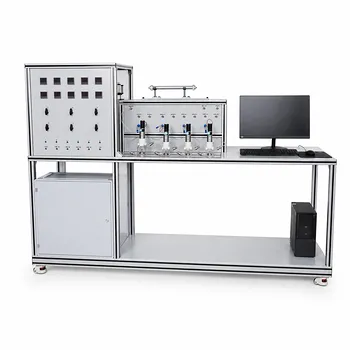
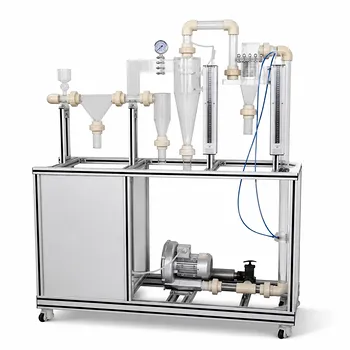
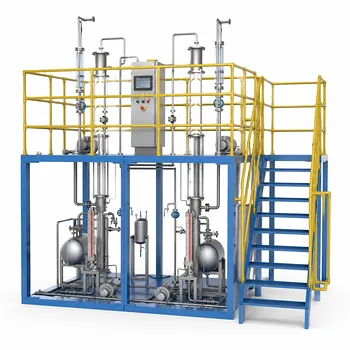
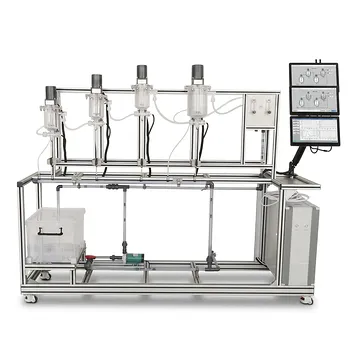
At the heart of every gasification pilot plant lies a fundamental difference in how solids and gases meet. Moving bed reactors generate a steep temperature gradient through counter-current flow, fluidized beds achieve a near-isothermal state via intense back-mixing, and entrained flow reactors maintain a uniform, blistering temperature envelope through co-current injection. These distinct flow patterns directly dictate the thermal profiles, syngas composition, and the entire downstream configuration you will need to manage in an educational or research pilot plant.
The core takeaway is this: flow pattern defines temperature distribution, and temperature distribution defines what you can study. Moving bed gives you a vertical thermal story of progressive coal conversion; fluidized bed offers a single, well-mixed temperature to simplify kinetics; entrained flow forces rapid, high-temperature reactions that produce the cleanest gas. Your choice in the pilot plant determines which industrial reality you replicate and which transport phenomena you isolate.
The Three Flow Patterns in Gasification Pilot Plants
To understand why a pilot plant behaves differently, you must first grasp the gas-solid contacting pattern. This single factor cascades into the thermal, kinetic, and mechanical design of the entire unit.
Moving Bed: Counter-Current Flow and a Tower of Thermal Zones
In a moving bed gasifier, large coal lumps are fed from the top while the gasifying agent enters from the bottom. This creates a classic counter-current flow — solids and gases move against each other. The solid bed slowly descends, encountering increasingly hotter gas, which sets up a pronounced vertical temperature profile.
From top to bottom, you see distinct zones: drying (up to 450 K), pyrolysis (700–900 K), gasification, and finally combustion near the grate, where temperatures peak around 1200°C. The outlet gas is relatively cool (700–900 K) because it has exchanged heat with the incoming coal. For a pilot plant operator, this means you can literally tap sample ports at different heights and walk students through staged coal decomposition — but you also face a heavy burden of tars and oils in the raw syngas that must be handled in the downstream cleanup skid.
Fluidized Bed: Back-Mixing for a Uniform Reaction Environment
A fluidized bed gasifier suspends crushed coal particles in an upward-flowing gas stream. The solids are violently mixed, breaking down any thermal or compositional gradients. This intense back-mixing produces a nearly isothermal bed, typically operating in the range of 1250–1400 K, with an exit gas temperature only slightly lower (1150–1300 K). In a pilot plant, this uniformity is a huge practical advantage: you don’t need to manage a complex axial temperature gradient, and you can assume a single temperature when analyzing kinetic data. However, the constant churning causes particle attrition and carries fine char out the top, so you’ll need cyclones and a separate boiler to burn the unconverted carbon in the ash.
Entrained Flow: Co-Current High-Velocity Flash Gasification
Entrained flow reactors inject a dust-like coal suspension (<0.1 mm) co-currently with oxygen and steam into a flame zone. Both solids and gas travel in the same direction at high velocity, experiencing extremely short residence times and a uniform, ultra-high temperature field that often exceeds 1600 K and can reach 2200 K. The entire reactor volume is essentially a radiant firebox. On a pilot plant scale, this configuration demands a precise powder feeding system and refractory-lined walls, but it yields a tar-free syngas composed almost entirely of CO and H₂. The outlet gas temperature matches the reactor temperature (1200–1850 K), so you’ll spend significant effort on quench cooling and heat recovery design.
Visualizing Temperature Gradients in the Pilot Plant
These flow patterns produce radically different thermal landscapes, and how you instrument and control the pilot plant depends on which landscape you’re navigating.
Moving Bed’s Vertical Gradient: A Live Demonstration of Drying, Pyrolysis, and Combustion
The moving bed’s counter-current flow acts like a natural heat exchanger. You can place an array of thermocouples down the length of the reactor and watch the entire conversion staircase: the temperature rises slowly through the drying zone, accelerates in pyrolysis, and spikes at the combustion bottom. This makes it a superb educational tool for teaching the heat and mass balance between stages. The trade-off? That cool outlet gas contains tars that condense easily, so your sampling lines and analytical instruments must be heated above 600 K to prevent blocking.
Fluidized Bed’s Isothermal Core: Simplifying Heat Transfer Analysis
Because back-mixing homogenizes the bed temperature, you can treat the entire reaction zone as a single control volume. This removes the spatial variable from your data, allowing you to focus purely on reaction kinetics and fluidization hydrodynamics. In a pilot plant, you’ll spend your time optimizing the distributor plate design and measuring the pressure drop as a function of gas velocity, rather than chasing hot spots. The uniform temperature also makes scale-up simpler, as you can more reliably predict performance from a bench-scale unit.
Entrained Flow’s Uniform Inferno: Modeling Slagging and Ash Fusion
The co-current, high-temperature environment means there is no cool zone — every particle is exposed to wall temperatures above the ash fusion point. For a pilot plant, this lets you study ash slagging and refractory corrosion under realistic commercial conditions. The challenge is thermal management; your reactor shell and sampling probes must survive sustained operation at 1600+ K. Data acquisition focuses on optical pyrometry and gas composition rather than distributed thermocouples, because the temperature profile is essentially flat once the flame stabilizes.
Understanding the Trade-offs
No single flow pattern is “better” — each solves one problem while creating another. A pilot plant is where you choose which trade-off to live with.
- Syngas Purity vs. Cold Gas Efficiency: Moving bed’s counter-current flow retains methane and tars, giving you a high cold gas efficiency (84–88%) but a dirty gas that requires extensive scrubbing. Entrained flow’s co-current high temperature cracks all hydrocarbons, yielding clean syngas but at a lower cold gas efficiency (74–81%) and with high oxygen consumption. Fluidized beds land in the middle (81–85% efficiency) with intermediate tar loads.
- Feed Flexibility: Moving beds demand large, non-caking lumps (5–50 mm). Fluidized beds accept crushed coal (<5 mm) and can handle a wider range of feedstocks, including biomass. Entrained flow requires the most preparation: fine dust (<0.1 mm) with consistent moisture, or slurry.
- Residence Time and Kinetic Isolation: The moving bed’s hours-long residence time is forgiving for reactions with slow kinetics, but the thermal gradient couples heat and mass transfer to kinetics. The fluidized bed’s isothermal back-mixing decouples them, letting you measure intrinsic rates, but back-mixing can reduce selectivity. Entrained flow’s sub-second residence time forces you to focus on diffusion and fast chemistry only.
- Thermal Management Effort: Moving bed and fluidized bed pilot plants can often use internal electric heaters with simpler insulation, operating between 1200–1400 K. An entrained flow pilot plant requires an oxygen-blown burner, ceramic refractories, and a molten slag removal system — a significantly higher capital and safety burden.
Making the Right Choice for Your Pilot Plant Goal
Your research objective should drive the reactor flow pattern you select. Define what you need to learn, then match the configuration.
- If your primary focus is tar formation, upgrading, or cleaning systems: Select a moving bed pilot plant, because its counter-current temperature gradient produces high tar yields, giving you a realistic development platform for downstream scrubbers, crackers, and reformers.
- If your primary focus is catalytic gasification or scale-up of fluidized bed commercial units: Use a fluidized bed pilot plant, as its back-mixed isothermal bed allows you to isolate kinetic models from heat transfer gradients, while realistically demonstrating catalyst attrition and circulation.
- If your primary focus is high-purity syngas for synthesis, slagging behavior, or integrated quench and heat recovery design: An entrained flow pilot plant with co-current, ultra-high-temperature flow will produce the tar-free gas and molten ash that mirror the challenges of a full-scale IGCC or coal-to-liquids plant.
Each flow pattern is a window into a different set of chemical engineering phenomena; the key is to align the window with the view you need.
Summary Table:
| Reactor Type | Flow Pattern | Temperature Distribution | Key Advantage | Pilot Plant Challenge |
|---|---|---|---|---|
| Moving Bed | Counter-current | Steep vertical gradient (drying to combustion zones) | Ideal for studying staged decomposition | High tar load in raw syngas |
| Fluidized Bed | Back-mixing | Near-isothermal bed (1250–1400 K) | Simplifies kinetic & hydrodynamic analysis | Particle attrition and char carryover |
| Entrained Flow | Co-current | Uniform, ultra-high temperature (>1600 K) | Produces tar-free, high-purity syngas | Severe thermal and material wear |
Build the Perfect Gasification Setup with LABPARK
Replicating complex transport phenomena in gasification requires precise control and reliable equipment. LABPARK provides state-of-the-art Educational and Vocational Unit Operations Pilot Plants in chemical engineering, bioprocess & biotech, and environmental & water treatment. Designed specifically for universities, research institutes, and enterprises, our pilot plants deliver the scalability and safety needed for advanced research and hands-on training.
Ready to elevate your engineering lab? Contact LABPARK today to find the right pilot plant solution for your goals!
Related Products
- Fixed-Bed Chemical Reaction and Gas Dust Tar Removal Unit Operations Pilot Plant
- Micro-Scale Gas-Solid Catalytic Reaction Educational Pilot Plant
- Fixed Bed Gas Solid Catalytic Reaction Educational Pilot Plant
- Fluidized Bed Gas Solid Catalytic Reaction Educational Pilot Plant
- Gas Phase Mixing and Residence Time Distribution Determination Educational Unit Operations Pilot Plant
People Also Ask
- When to transition from PID to adaptive control in pilot plants? Key process indicators.
- How do deviations in estimating latent heat impact pilot plant thermal systems? Avoid hardware mis-sizing.
- Why Compare Predicted and Experimental Excess Enthalpy? Key to Accurate Pilot Plant Scale-up
- How to study gasification in pilot plants? Compare exit gas composition & efficiency
- Why Use PTFE & Hastelloy in Chemical Pilot Plants? Prevent Corrosion & Ensure Safety