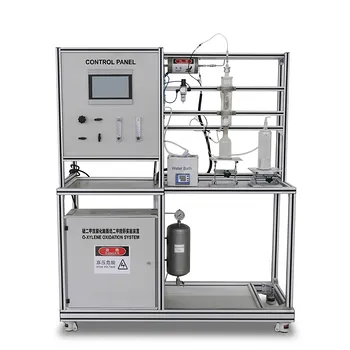
The core challenge is a mismatch in molecular states. In a chemical engineering pilot plant, temperature fluctuations directly alter the fundamental molecular behavior that Raman spectroscopy measures. These changes unequally affect high- and low-frequency spectral bands, primarily by disrupting hydrogen bonding networks and shifting molecular population distributions. The result is that a calibration model built at one temperature will produce biased, inaccurate concentration measurements when the reactor operates at another.
Accurately managing temperature's impact on Raman spectroscopy is not just about fixing an instrument signal. It is a systems-level challenge about bridging the gap between a static laboratory calibration and a dynamic, reacting process. The guiding principle is that your calibration dataset must either represent the process's thermal reality or be mathematically corrected to match it.
The Precise Mechanism of Temperature-Induced Bias
Quantitative Raman spectroscopy relies on the principle that the intensity of scattered light is proportional to analyte concentration. Temperature fluctuations invalidate this proportionality by changing the physical state of the molecules themselves, not just adding random noise.
Shifting Molecular Populations and Hydrogen Bonds
Temperature directly influences the distribution of molecules across different vibrational and rotational energy states. Higher temperatures populate higher energy states, altering the baseline from which Raman scattering occurs.
More critically in chemical processes, temperature disrupts hydrogen bonding networks. The strength and extent of hydrogen bonding directly affect the polarizability of a bond, which is the root of Raman scattering. A heated molecule with fewer or weaker hydrogen bonds will have a fundamentally different Raman cross-section, making it seem more or less concentrated than it truly is.
The Disproportionate Effect on Spectral Bands
This is not a uniform scaling of the entire spectrum. The effect is band-specific. Low-frequency bands, often associated with lattice vibrations or intermolecular interactions, are acutely sensitive to thermal expansion and bonding changes. High-frequency bands, like a carbonyl (C=O) stretch, shift and broaden as hydrogen bonding weakens.
Consequently, a simple ratio or a multivariate model trained on cold-flow data will fail when applied to a hot reactor. The model learns a correlation between a spectral pattern and a concentration that no longer holds true, generating a systematic prediction error rather than simple scatter.
Thermodynamic Implications for Your Process Data
This phenomenon has a direct parallel in the thermodynamic laws governing the reactor itself. Just as the Gibbs-Helmholtz equation ($\Delta G = \Delta H - T\Delta S$) dictates that temperature can shift a reaction's equilibrium, it also shifts the molecular "equilibrium" that generates the Raman signal.
You are dealing with two temperature-dependent systems: the chemical reaction and the measurement of that reaction. The measurement's thermal sensitivity can easily be misinterpreted as a change in reaction kinetics or endpoint, leading to incorrect process control decisions.
How to Manage Temperature Effects for Reliable Quantitation
Success in a pilot plant requires moving beyond passive acceptance of these errors. A robust management strategy involves one or a combination of these three approaches, moving from direct hardware control to sophisticated data modeling.
Mathematical Correction with Independent Temperature Measurement
This method treats temperature as a known interferent. You first measure the process temperature independently using a thermocouple or RTD with high precision. You then develop a correction algorithm, often based on a pre-characterized spectral library at multiple temperatures, that warps or normalizes the live spectrum to match the calibration temperature.
This is a powerful approach for existing models, but it demands that the spectral response to temperature is well-behaved and reproducible. It effectively shifts the burden from the calibration model to the pre-processing algorithm.
Incorporating Temperature Variance into Robust Calibration
The more elegant and holistic solution is to build a "rugged" calibration model from the start. This involves a design of experiments (DOE) where calibration samples are measured not at a single ideal temperature, but over the exact range the pilot reactor will experience.
The resulting multivariate model, built with methods like partial least squares (PLS), learns to treat temperature-induced spectral variations as irrelevant noise correlated with a secondary variable. This approach creates a single model that remains accurate across a defined thermal operating window, inherently managing the bias without real-time correction.
Using an Internal Standard for Dynamic Correction
This strategy leverages the chemistry of your system. By identifying a spectral peak from a component whose concentration is effectively constant and unreactive—a solvent peak or a dissolved internal standard—you create a built-in reference. You then ratio your analyte peaks against this internal standard peak.
If temperature changes the scattering intensity of both the analyte and the standard proportionally, the ratio cancels out the temperature effect. This is functionally similar to the electronic locking mechanism in process NMR, where a stable Lithium-7 reference signal is used to dynamically correct for magnetic field drift. The challenge is reliably finding a truly inert and thermally responsive internal standard in your complex reaction mixture.
Understanding the Trade-offs and System-Wide Effects
Focusing solely on a spectral model can blind you to the physical instrument, which is equally susceptible to process conditions. A holistic strategy must defend against all sources of error.
Physical Instrument Drift vs. Spectral Bias
Temperature fluctuations don't only affect the molecules you're measuring; they warp the measurement tool itself. Thermal expansion in optomechanical parts can misalign mirrors and gratings, manifesting as peak shifts or intensity loss.
Furthermore, detector performance is temperature-dependent. A thermal spike in the pilot plant bay can raise the detector's dark current, degrading the signal-to-noise ratio. While Peltier cooling is standard, integrating the spectrometer with a temperature compensation design and a ruggedized optical bench is non-negotiable for continuous pilot plant runs.
The Pitfall of Vibration and Flow
A common mistake is to solve the temperature problem while becoming vulnerable to other physical parameters. Pumps and stirrers generate vibration that displaces optical mounts, adding shot noise. Fluid flow and turbulence alter the sample's particle size distribution or the effective focal volume, introducing presentation effects.
A robust calibration model, therefore, cannot just be multi-temperature. It must ideally be a multi-parameter model that includes datasets representing the actual ranges of flow, turbulence, and concentration expected during the pilot operation. Calibrating only for temperature can give a false sense of security if the model then fails during a high-flow-rate experiment.
The Cost of Simplicity vs. Completeness
The mathematical correction method is easy to implement but brittle. It relies on a perfect thermal characterization that may change if the reactor's solvent matrix changes. The robust calibration method is the gold standard for accuracy but is time-consuming and expensive to develop, requiring extensive bench-scale DOE. The internal standard method provides dynamic, real-time correction but is entirely dependent on finding a suitable, chemically stable reference peak, which is not always possible in a reactive mixture.
Making the Right Choice for Your Pilot Plant Goal
Your specific operational goal dictates which temperature management strategy should take priority. The best solution often involves a layered approach.
- If your primary focus is absolute accuracy on a well-characterized single-temperature process: Invest in hardware-level stability. Prioritize precise reactor temperature control, Peltier-cooled detectors, and a ruggedized optical bench. A tightly integrated system with minimal thermal variation simplifies the entire analytical workflow.
- If your primary focus is process development across a wide temperature range: Build a robust, multi-temperature calibration model from the start. Design a focused DOE where you deliberately vary temperature within your experimental range. This upfront investment pays off by generating a model that is inherently stable and provides trustworthy data during critical kinetic studies.
- If your primary focus is rapid deployment or monitoring a process with a variable solvent background: Explore the internal standard method. A carefully selected solvent peak or an inert spike can provide a dynamic correction factor for both temperature and instrument drift, offering resilience when comprehensive calibration is impractical.
By defining your measurement not as a laboratory snapshot but as a dynamic variable of the process itself, you can transform Raman spectroscopy from a temperamental sensor into a definitive source of process truth.
Summary Table:
| Strategy | Mechanism | Key Advantage | Main Limitation |
|---|---|---|---|
| Mathematical Correction | Warps spectrum using independent RTD/thermocouple data | Easy to implement on existing models | Requires highly predictable spectral response |
| Robust Calibration | Incorporates temperature variance into PLS models via DOE | Inherently manages bias in operating window | Time-consuming and expensive to develop |
| Internal Standard | Ratios analyte peaks against a stable, inert reference peak | Dynamic, real-time correction | Finding a suitable reference peak can be difficult |
Optimize Your Pilot Plant Operations with LABPARK
Managing complex reactor dynamics like temperature-induced spectral shifts requires robust, high-performance equipment. LABPARK provides state-of-the-art Educational and Vocational Unit Operations Pilot Plants in chemical engineering, bioprocess & biotech, and environmental & water treatment.
Tailored for universities, research institutes, and enterprises, our pilot plants ensure precise process control, stability, and reliability to help you bridge the gap between laboratory research and industrial success.
Ready to elevate your research, training, or development capabilities? Contact LABPARK today to find the perfect pilot plant solution for your facility!
Related Products
- Fixed Bed Gas Solid Catalytic Reaction Educational Pilot Plant
- Multi-Reactor Educational Pilot Plant for Reaction Engineering Unit Operations
- Residence Time Distribution and Reactor Flow Characteristics Determination Educational Pilot Plant
- Fixed-Bed Chemical Reaction and Gas Dust Tar Removal Unit Operations Pilot Plant
- Tubular Reactor Flow Characteristics Determination Educational Unit Operations Pilot Plant
People Also Ask
- Fixed-Bed vs. Fluidized-Bed Reactor: How to Choose the Right Pilot Plant for Gas-Solid Catalytic Reactions
- How to determine catalyst pore radius & porosity? Optimize your chemical engineering pilot plant.
- What reactor configurations study gas-solid reactions? Guide to key types and applications.
- How does identifying the rate-limiting step optimize reaction conditions? Pilot Plant Guide
- How do reactor pilot plants safely study gas-solid reactions? Master kinetics with thermal & flow control.