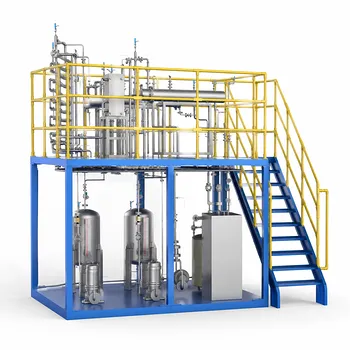
Lowering oil viscosity—typically by heating—allows water droplets to grow larger and settles them faster in an oil–water separator. However, this relationship is not linear or universally beneficial. In heavy oils (API gravity below 15°), heating can simultaneously shrink the density difference between oil and water, undermining the very driving force for gravity separation. A chemical engineering unit operations pilot plant brings this nuance to life by letting students directly manipulate emulsion temperature, then measure the resulting water–cut and separation rate to uncover the real‑world trade‑off.
The core insight: Higher temperature reduces oil viscosity, which promotes water droplet coalescence and a larger allowable droplet diameter. But for heavy crudes, the benefit of lower viscosity can be cancelled out by a smaller density difference—an essential caution that pilot‑scale experiments make tangible.
The Physics of Water Droplet Size in Oil–Water Separation
How Oil Viscosity Governs Droplet Growth and Settling
Water droplets in oil must collide and coalesce before they can settle under gravity.
Higher oil viscosity dampens droplet motion, reducing the frequency and energy of collisions.
The result is a population of smaller, more stable droplets that take far longer to separate.
An empirical design equation captures this sensitivity for oils in the 0.5–10 cP range:
Dₘ = 500 × (VISC)^(-0.675)
Where Dₘ is the maximum allowable water droplet diameter for efficient free‑water removal.
Lower viscosity directly translates into a larger Dₘ, which dramatically improves settling velocity according to Stokes’ law.
Temperature’s Dual Effect on Separation
Heating is the most practical way to lower oil viscosity in a process.
A moderate temperature increase can cut viscosity by half or more, as seen in many coating and process fluids.
That alone would suggest “the hotter, the better.”
But for heavy oils, rising temperature also narrows the density gap between the oil and water phases.
The specific gravity difference (ΔSG) is the driving force for gravity separation.
If ΔSG shrinks significantly, even large droplets settle slowly—or not at all.
This creates a tug‑of‑war: lighter oils enjoy a pure win from heating, while heavy crudes demand a careful balance between viscosity reduction and density preservation.
Demonstrating the Principle in a Chemical Engineering Unit Operations Pilot Plant
Experimental Setup and Procedure
In a liquid–liquid separation trainer, students work with a stable water‑in‑oil emulsion fed from a heated tank.
Temperature control is the critical independent variable—operators set the emulsion inlet temperature by adjusting a heating jacket or in‑line heat exchanger.
Flow rate, emulsion composition, and separator geometry (vessel length L, diameter d) are held constant to isolate temperature’s effect.
The pilot plant is instrumented to measure:
- Inlet and outlet temperatures
- Flow rate (Qₒ)
- Water content (water cut, Wc) in the treated oil leaving the separator
- Visual observation of the coalescing interface
Students collect data at four to five temperature points, spanning a range from ambient to near 80–90 °C, depending on the oil’s flash point.
Data Analysis: From Residence Time to Water Cut
Once water cut values are recorded, students calculate the separation efficiency.
They also estimate the effective residence time in the vessel and compare it to empirical thresholds:
If the first‑stage residence time is under 10 minutes (or under 30 minutes for emulsions exceeding 20 % by volume), a second‑stage separator is typically required to reach 80–90 % water removal.
The empirical droplet‑size equation can be back‑calculated using the measured oil viscosity at each temperature.
Students then see how the allowable droplet diameter grows as viscosity falls—but they also observe whether water cut actually improves.
When the density difference collapses, the theoretical larger droplet fails to deliver; the separator’s performance plateaus or even worsens.
This exercise cements a critical design lesson: vessel sizing and operating temperature cannot be chosen in isolation; they must respect the fluid’s entire physical property envelope.
Understanding the Trade‑offs (and Avoiding Pitfalls)
A straightforward heating strategy can backfire.
The viscosity‑density trade‑off is most pronounced for heavy oils (below 15°API) and for emulsions that already exhibit a small density differential.
Key limitations and common mistakes include:
- Applying the empirical droplet‑size equation outside its viscosity range (0.5–10 cP). Heavier crudes often exceed 10 cP, rendering the correlation misleading.
- Ignoring thermal degradation or light‑end flashing if the oil is heated too aggressively for the separator’s pressure.
- Overlooking the impact of non‑ideal mixing behavior. Some oil–water systems exhibit viscosity peaks or volume contraction at certain temperatures, which can unexpectedly raise local shear and disrupt coalescence.
Pilot plant demonstrations thrive when students deliberately push the temperature beyond the obvious optimum.
They witness that while higher temperature always reduces bulk viscosity, separation performance does not follow a simple monotonic improvement—it can decline due to the loss of density driving force or due to increased turbulence that re‑entrains droplets.
Making the Right Choice for Your Separation Goal
These pilot‑scale insights translate directly into industrial reasoning. Use the following guiding principles:
- If your system is a light oil (API > 30) with a wide density difference: Moderate heating will almost always improve separation. Focus on achieving the lowest viscosity practical without wasting energy.
- If you are dealing with a heavy oil (API < 15) or a tight density difference: Experimentally map the water cut versus temperature. Identify the point where the viscosity‑density trade‑off turns negative, and operate just below that threshold.
- If you are designing a separation train from pilot data: Use the measured water cut at different temperatures to estimate the necessary residence time and vessel size. Confirm that the intended operating window stays within the valid range of your design correlations.
Every chemical engineer who has run a pilot‑scale liquid–liquid separator learns that viscosity is only half the story. Temperature controls the whole property landscape, and only careful, hands‑on measurement reveals where the true optimum lies.
Summary Table:
| Parameter | Effect of Heating | Impact on Separation | Key Trade-off / Limitation |
|---|---|---|---|
| Oil Viscosity | Decreases | Promotes droplet growth & faster settling | Correlation is less reliable for heavy oils (>10 cP) |
| Density Difference (ΔSG) | Narrows | Slows down settling velocity | Can completely cancel out viscosity benefits in heavy crudes (API < 15) |
| Emulsion Temperature | Increases | Lowers viscosity, enhances coalescence | Risk of thermal degradation, light-end flashing, or turbulence |
Bring Hands-On Separation Science to Your Lab
Mastering complex chemical processes requires high-fidelity, hands-on learning tools. LABPARK provides premium Educational and Vocational Unit Operations Pilot Plants in chemical engineering, bioprocess & biotech, and environmental & water treatment. Designed specifically for universities, research institutes, and enterprises, our pilot plants enable students and researchers to safely manipulate, measure, and understand real-world thermodynamic and fluid dynamics trade-offs.
Ready to upgrade your lab's capabilities? Contact LABPARK today to explore our custom pilot plant solutions!
Related Products
- Carbon Dioxide Hydrogen Methanol Synthesis Educational Unit Operations Pilot Plant
- Multi Pump Fluid Transport Process Piping Unit Operations Training Pilot Plant
- Natural Product Extraction Unit Operations Training Pilot Plant
- Multi-Modal Distillation Unit Operations Training Pilot Plant
- Multi-Reactor Educational Pilot Plant for Reaction Engineering Unit Operations
People Also Ask
- How do temp & pressure affect methanol synthesis pilot plants? Optimize equilibrium and catalyst performance.
- Why is a purge system necessary when operating a gas recirculation loop in a methanol synthesis pilot plant? (Guide)
- Why do modern methanol pilot plants operate at lower pressures? Catalyst & Feed Requirements Explained
- What are the operational requirements for catalyst activation? Safe Methanol Pilot Plant Operation
- Why is the chemical plant startup schedule crucial? De-risk scale-up with pilot plants.