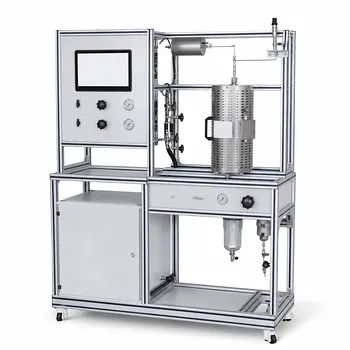
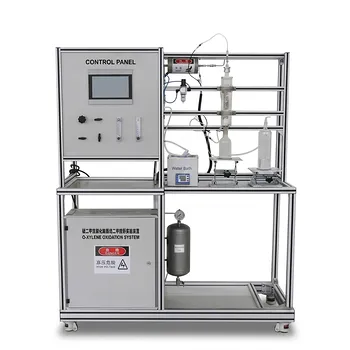
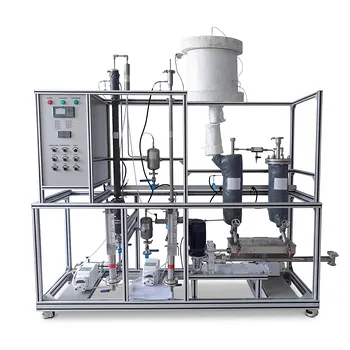
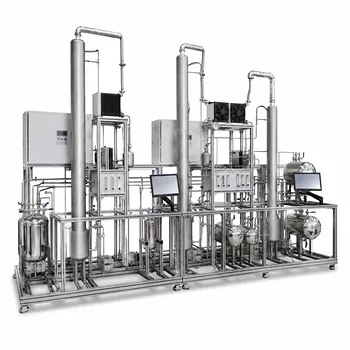
You perform mass balance verification by systematically reconciling all metered inputs with the quantified outputs, critically using the inert nitrogen in air as a fundamental tie component. Students feed vaporized methanol and air into the reactor, monitor all flow rates, and then analyze the composition of the liquid product and tail gas. The core verification is a two-step process: first, a direct mass-in versus mass-out reconciliation, and second, an independent atomic balance—specifically for carbon, hydrogen, and nitrogen—to validate the measurements and quantify key performance metrics like conversion and selectivity.
Performing a mass balance on a methanol-to-formaldehyde pilot plant is not just about proving
mass in = mass out. The deep challenge is resolving the inherent measurement uncertainty and accounting for the distribution of atoms from a single reactant into multiple product streams. The most rigorous verification is achieved by applying an elemental balance, using the non-reacting nitrogen as an internal standard to back-calculate molar flow rates, thereby decoupling the closure of the balance from physical flow meter errors.
Mapping the Process: Defining the Control Volume
The first practical step is to establish a clear boundary around the continuous system and identify every stream precisely. A steady-state assumption is critical here because it simplifies the fundamental equation to Input = Output, eliminating the accumulation term.
Identifying Input and Output Streams
Students must identify two distinct input streams: the vaporized methanol feed and the compressed air feed. The outputs are more complex: a condensed liquid product (containing formalin: formaldehyde, water, and unreacted methanol) and a gaseous tail gas stream (containing unconsumed oxygen, nitrogen, formaldehyde vapors, and over-oxidation products like carbon dioxide). Critically, the mass of any liquid knock-out in auxiliary condensers must also be included in the total output weight.
The Criticality of Metering and Sampling
Verification quality depends entirely on data fidelity. Students must record the mass flow rates or volumetric flow rates (with temperature and pressure corrections) of the air and methanol feed. They then take representative samples from the liquid product and tail gas at steady-state. Without accurate flow metering and chemically representative sampling, the most elegant theoretical balance will fail to close, leading to a false diagnosis of a process leak or measurement error.
The Verification Procedure: From Gross Mass to Atomic Reconciliation
Students often start with a simple gravimetric balance—comparing the total kilograms of feed to the total kilograms of product collected—but this is merely a rough check. True verification requires moving from a bulk weight basis to a molar and elemental basis.
Reconciling the Gross Mass Balance
A gross mass balance (total mass flow in vs. total mass flow out) is the first sanity check. However, a closure to within 5% does not automatically validate the results; it could mask a compensating error where a flow meter over-reads the methanol feed while a gas chromatograph under-reports the tail gas flow. Therefore, a gross balance only detects major leaks or catastrophic measurement failures.
Executing an Atomic Carbon Balance
The definitive verification technique is the atomic carbon balance. All carbon entering as methanol must exit as unreacted methanol, formaldehyde product, or side products like carbon dioxide and carbon monoxide. By quantifying the molar flow of carbon in every output stream and comparing it to the known molar carbon input, students can calculate reactor conversion and mass balance closure with high confidence, independent of the gross weight.
The Central Role of Nitrogen as a Tie Component
The most sophisticated student-level verification uses the inert nitrogen in the air feed as a tie component. Since nitrogen does not react, its molar flow rate is constant throughout the system. By using the nitrogen concentration in the tail gas as an internal standard, students can back-calculate the total tail gas molar flow rate. This calculated flow rate is then compared against a physical flow meter reading, revealing the true accuracy of the instrumentation and providing a rock-solid foundation for resolving the oxygen and formaldehyde product balances.
Common Pitfalls in Measurement and Interpretation
Even with a perfectly functioning pilot plant, students frequently encounter systematic errors that sabotage mass balance closure. These are not operational failures but rather complexities inherent to the chemistry.
The Formaldehyde-Water Equilibrium
A major pitfall is assuming formaldehyde exists purely as free aldehydes in the liquid product. Formaldehyde reacts with water and methanol in situ to form methylene glycol, hemiformals, and polyoxymethylenes. Analytical methods like sodium sulfite titration measure total formaldehyde, but a student calculating mass based solely on formaldehyde monomer will find their balance in error because they have neglected the mass of water incorporated into these oligomers.
Accounting for Over-Oxidation
A "perfect" carbon balance does not just track the main product. Students must account for the side reaction: the deep oxidation of methanol to carbon dioxide. If the tail gas is not analyzed for CO and CO₂, the exit carbon will be under-reported, making the conversion appear lower than it actually is. A closed carbon balance must include these minor components, often detected via gas chromatography.
Correcting for Condensable Vapors
The tail gas exiting the condenser is saturated with formaldehyde and water vapor at the condenser’s operating temperature. Their partial pressures represent mass that left the reactor but didn't condense. If a student only weighs the liquid collected without calculating the mass of these vapors (using Antoine's equation for water and vapor-liquid equilibrium data for formalin), thermodynamic reality will be misinterpreted as a physical mass loss.
Applying This to Your Educational Goals
The specific approach you take to mass balance verification should align directly with the learning objective of the exercise. A simple check teaches process flow; a rigorous balance teaches analytical chemistry and thermodynamics.
- If your primary focus is troubleshooting instrument accuracy: Use the nitrogen tie component to independently calculate the tail gas molar flow rate and compare it to the rotameter or mass flow controller reading. Discrepancies directly quantify the meter's error.
- If your primary focus is quantifying catalyst selectivity: Concentrate efforts on the atomic carbon balance across the liquid and gas phases, ensuring that all minor side products (CO, CO₂, dimethyl ether) are analytically quantified so you can account for every mole of carbon.
- If your primary focus is constructing a precise process model: Do not rely on the flow rate of the liquid product. Instead, solve the balance based on the methanol feed rate, the known stoichiometric conversion, and the rigorous vapor-liquid equilibrium of the condenser to predict separation efficiency.
Ultimately, verifying the mass balance on a formaldehyde pilot plant is a forensic exercise that forces you to reconcile the ideal world of a stoichiometric equation with the messy reality of physical measurements and thermodynamic equilibria.
Summary Table:
| Verification Method | Primary Focus | Key Benefit |
|---|---|---|
| Gross Mass Balance | Bulk weight (total input vs. output) | Serves as a quick sanity check to detect major leaks |
| Atomic Carbon Balance | Molar flow of carbon across all streams | Quantifies true reactor conversion and product selectivity |
| Nitrogen Tie Component | Inert $N_2$ gas flow as internal standard | Back-calculates gas flow rate to isolate instrumentation errors |
Bring Hands-On Process Engineering to Life with LABPARK
Looking to equip your students or researchers with advanced training systems? LABPARK provides state-of-the-art Educational and Vocational Unit Operations Pilot Plants in chemical engineering, bioprocess & biotech, and environmental & water treatment. Designed specifically for universities, research institutes, and enterprises, our systems allow users to master complex industrial concepts—such as mass balance verification and reactor kinetics—on high-fidelity equipment.
Ready to elevate your engineering lab? Contact us today to explore our custom pilot plant solutions!
Related Products
- Carbon Dioxide Hydrogenation Methanol Synthesis Educational Unit Operations Pilot Plant
- Methanol Synthesis and Catalyst Performance Evaluation Educational Unit Operations Pilot Plant
- Carbon Dioxide Hydrogen Methanol Synthesis Educational Unit Operations Pilot Plant
- Methane Cracking Educational Unit Operations Pilot Plant
- O-Xylene Oxidation to Phthalic Anhydride Educational Unit Operations Pilot Plant
People Also Ask
- How do temperature variations affect CO2 transport models in pilot plants? Model vs Reality
- Why is a purge system necessary when operating a gas recirculation loop in a methanol synthesis pilot plant? (Guide)
- How do temp & pressure affect methanol synthesis pilot plants? Optimize equilibrium and catalyst performance.
- How do CVD parameters affect stoichiometry and phase purity? Optimize thin film deposition.
- Why do modern methanol pilot plants operate at lower pressures? Catalyst & Feed Requirements Explained